
U.S. bishops at their spring meeting earlier this month produced guidelines on how to hold themselves accountable. Here are some of the measures.
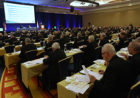
U.S. bishops at their spring meeting earlier this month produced guidelines on how to hold themselves accountable. Here are some of the measures.
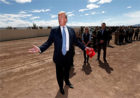
Following President Donald Trump’s plans to deport “millions” of undocumented migrants, the United States Conference of Catholic bishops (USCCB) released a statement acknowledging that nations have a right to protect their borders, while urging attention toward the root causes of migration.
Yesterday officially kicked off the U.S. bishops’ annual “Religious Freedom Week,” which is a bit of an exercise in rebranding.
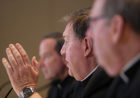
For some observers, it was a welcome sign that even in an archaic institution, change is possible. Yet for others, it remains to be seen whether such change is more than mere symbolism.
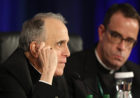
After three days of intense debate over the role of the laity in overseeing bishops accused of abuse or its cover-up, the U.S. Catholic bishops voted to enact new standards for holding bishops accountable that include lay involvement, although stopping short of making it a mandatory requirement.
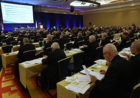
As the U.S. Catholic bishops move closer to enacting new protocols for bishop accountability, they concluded the second day of their high stakes spring meeting by approving a measure to design a national third-party system for reporting claims against bishops.
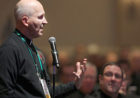
At a time when the U.S. Catholic bishops are meeting to vote on new measures for bishop accountability, Pope Francis has given the green light for a penal process for a retired U.S. bishop accused of multiple accounts of abuse.
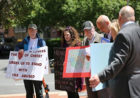
As has been the case for years now, a small group of protesters dismissive of the U.S. bishops’ efforts to enact reforms in their handling of abuse cases gather outside the Baltimore hotel where they conduct their general meeting.

Author Dawn Eden Goldstein said she saw the need for her newest book after the U.S. Catholic bishops adopted the “Charter for the Protection of Children and Young People” in 2002.
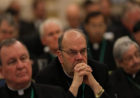
As the U.S. Catholic bishops gathered for a closely watched meeting with the hopes of enacting new standards for bishop accountability, debate over the role lay people could have in their oversight dominated day one of the gathering.