
The Food and Drug Administration’s safety review of mifepristone is expected to stretch into next year, according to an Oct. 7 court filing, prompting disappointment from pro-life groups.

The Food and Drug Administration’s safety review of mifepristone is expected to stretch into next year, according to an Oct. 7 court filing, prompting disappointment from pro-life groups.

The Food and Drug Administration recently approved a new generic form of mifepristone – a pill commonly, but not exclusively, used for early abortion – drawing criticism from pro-life advocates. It marks the second time a Trump administration has approved a generic form of the pill.

Officials at Walgreens and CVS announced March 1 that they are getting ready to sell the abortion pill mifepristone in early March in states where it is legally allowed.
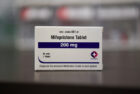
The Supreme Court said it will hear arguments on March 26 about how patients can access the commonly used abortion pill, mifepristone.

A federal court in Colorado has sided with a Catholic health care clinic in its challenge to a recent state law that forbids doctors and nurses from administering a natural hormone to reverse the effects of the first step of a medically induced abortion, which the state had implemented in part because of safety concerns.

Legal abortions most likely increased in the United States in the first six months of 2023 compared with 2020, according to a New York Times analysis of data from the Guttmacher Institute, which opposes abortion restrictions.

In a two-hour hearing on May 17 looking at the U.S. Food and Drug Administration’s decades-old approval of an abortion pill, federal judges seemed to have a harsher line of questioning for attorneys for the federal government and the drug maker, indicating they might be sympathetic to those challenging the drug’s availability.

A federal appeals court in Louisiana is hearing arguments May 17 about the accessibility of the abortion drug mifepristone.
An advisory panel of the Food and Drug Administration voted unanimously on May 10 to recommend that a birth control pill be sold in the U.S. without a doctor’s prescription.

The U.S. Supreme Court said April 14 it would temporarily keep in place status quo federal regulations regarding the use of an abortion drug, giving the court additional time to consider a lower court’s ruling to stay the U.S. Food and Drug Administration’s approval of the drug.