
Catholic priests, nuns and church agencies are providing some relief in East Africa’s drought, which scientists and experts describe as the worst in 40 years.
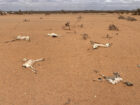
Catholic priests, nuns and church agencies are providing some relief in East Africa’s drought, which scientists and experts describe as the worst in 40 years.
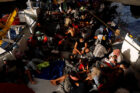
Pope Francis denounced the “inhuman violence” waged against migrants, refugees and other displaced peoples in Libya, and called for an end to sending people back to unsafe countries.
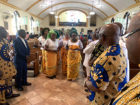
The Nigerian Igbo community celebrated its annual remembrance of the Holy Family’s flight to Egypt with a Mass and fellowship Feb. 23 at St. Fortunata Church, East New York.
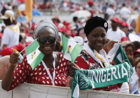
Throughout his papacy, during which he clocked some 40 trips to Africa, St. Pope John Paul II would frequently refer to the continent as both a “missionary church and a mission church.”
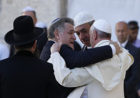
Dialogue and encounter have been two of the popular buzzwords of the Francis papacy, but for one of the pontiff’s major interreligious interlocutors, they are more than mere maxims, they are a way of life.
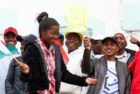
A young Madagascar girl sat nervously on the side of a humble stage, sporting a white dress, light pink sweater and green sandals – a colorful, seemingly new ensemble perhaps bought with considerable sacrifice by her parents for the occasion.
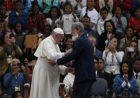
The great majority of those who packed the small sports stadium Sunday were children who live in the 5,000 homes built by Opeka and his foundation. Some 15,000 children a year receive a free education that runs from kindergarten to university. The kids waited for hours for Francis to arrive, singing songs and cheering whenever Opeka spoke to them in Malagasi, the local language.
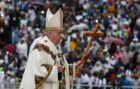
On Friday, Pope Francis was due to touch down in Madagascar, the second leg of his three-nation African trip.
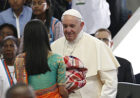
On his first full day in Mozambique, a country torn apart by a civil war from 1977 to 1992 and still struggling with violence, Pope Francis said lasting peace is not the mere absence of armed conflict but a tireless commitment to secure equal opportunities for all, because if some “are left on the fringes,” aggression will eventually explode.
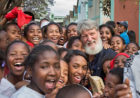
Pope Francis’s return to sub-Saharan Africa begins in Mozambique, a nation which, according to the United Nations, ranks among the world’s poorest and least developed despite being rich in natural resources. Locals hope Francis’s visit inspires “Hope, Peace and Reconciliation,” as the country is still feeling the effects of a bloody civil war from 1977 to 1992.