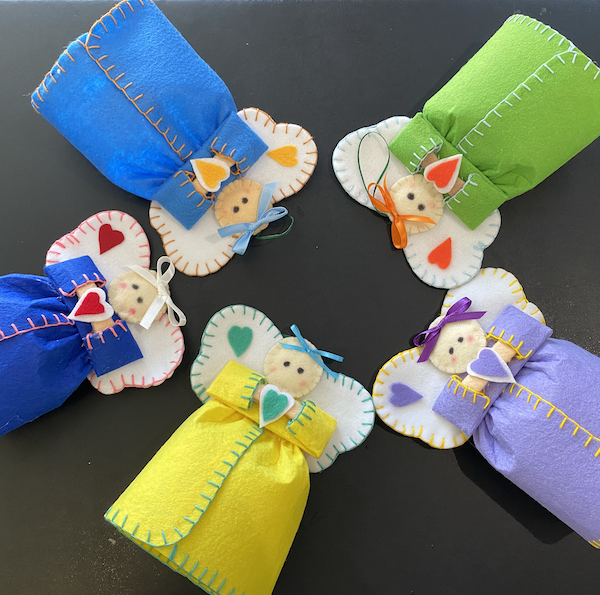
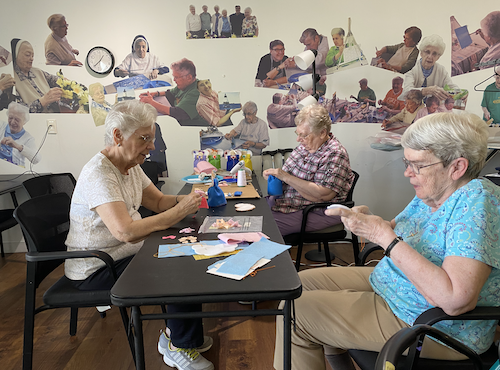
WHITESTONE – In the recreation room of the Sisters of Mercy residence in Whitestone, three nuns are quietly making a difference with felt, needle, and thread.
Gathered around a table, they sew delicate angel dolls, each one a symbol of compassion and solidarity for Haitian mothers and pregnant women newly arrived in New York. Many of these women have fled violence and political chaos in their homeland, arriving with little more than hope and uncertainty.
“Most of us live in a house of retired sisters, and there’s not a lot we can do physically anymore,” Sister Eileen Payne said. “But to be able to do something that reaches into people’s families and their hearts – it’s important. We even had someone translate a welcome message in Haitian Creole, which we include in the bag with each angel.”
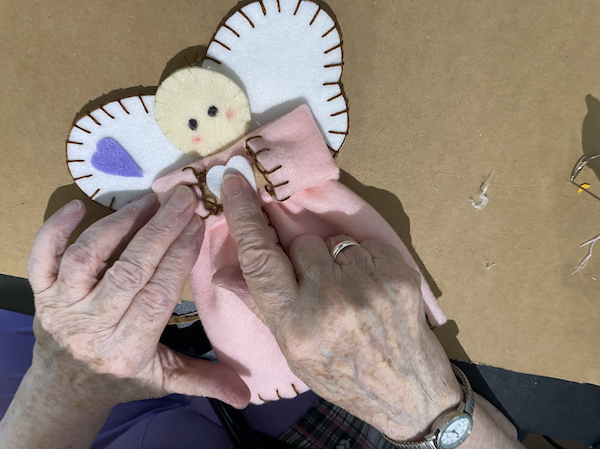
Last month, Sisters Eileen Payne, Louise Cullen, and Eileen Corrigan sat together, making the dolls – complete with felt wings, colorful bows for halos, and small fabric hearts stitched to their chests.
Each sister has her part: Sister Louise cuts and sews the wings, Sister Eileen Corrigan makes the hearts, and Sister Eileen Payne stitches the skirts and assembles the final dolls.

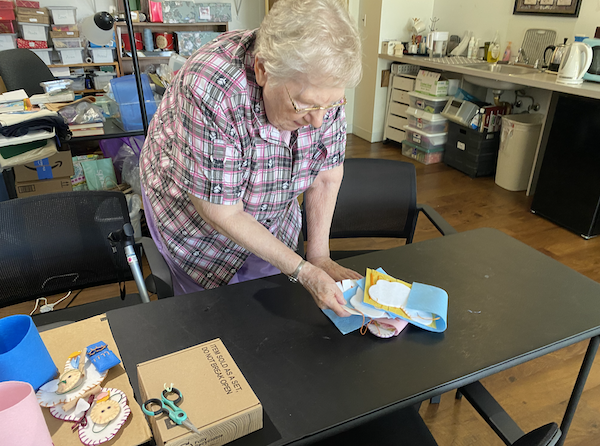
As Sister Eileen Corrigan sat with her fellow sisters, she recalled growing up surrounded by guardian angels of her own — in the form of statues, stories, and her mother’s unwavering belief in their presence.
RELATED: Brooklyn Bishop Robert Brennan, Faithful Celebrate Sisters of Mercy For ‘Legacy’ of Service
“I love the angels, I always prayed to them. My mother started me off with, ‘My angel of God, my guardian dear, to whom God’s love commits me here,’ ” she said. “My mother loved angels. She felt they were always with us, taking care of us, guiding us on the right path.”
As Haiti continues to face a violent political crisis, with gang violence running rampant throughout the region, and with food insecurity, the gifts serve as a welcome for the women who have escaped the hardship or already live within the Diocese of Brooklyn and are looking for a sense of community.
“Angels are very prominent in the Haitian community,” Sister Eileen Payne said. “They’re seen as signs of God’s presence – of protection, of comfort. So the dolls became a kind of spiritual welcome.”
Initially, the nuns made the dolls for friends, family, and one another. But two years ago, the project found a new purpose when Sister Betty Calfapietra, then a board member and volunteer librarian at Cristo Rey Brooklyn High School, suggested that they share the angels with Haitian women through Life of Hope, a nonprofit organization based in East Flatbush.
The center serves Brooklyn’s growing Caribbean population, particularly Haitian immigrants and asylum-seekers.
RELATED: People Returning After White House’s Migrant Order
“It served two purposes, one was to have something that the parent could save for a baby, or just to welcome a family,” Sister Betty said.
Life of Hope, which is chaired and co-founded by Father Juan Luxama, parochial vicar of the Shrine Church of St. Bernadette in Dyker Heights, hosts parenting classes, distributes essential items like diapers, and provides community support for newly arrived migrants.
The angels, Sister Betty said, quickly became one of the center’s favorites. “I brought some angels over one day, and there was a mother, father, and two small children there,” Sister Betty said. “We gave them one of the dolls, and you could just see how touched they were. It meant something.”
Since they started, they have given away more than 300 angels, assembled in batches of 60 to 90 at a time.
“It’s quite a project,” Sister Betty said.
Sister Louise said helping the Haitian families isn’t new for the Sisters of Mercy, as the angels are an extension of the broader mission of service in Haiti. “I’ve been doing it since I came here, which is about two and a half years ago,” Sister Louise said, “and it’s as both Eileens said, it’s a way of helping and participating in something that’s important for the mothers.”
Sisters of Mercy across the U.S. have also raised funds to support Haitian-run community development programs, like water collection systems, senior care homes, and sustainable agriculture through an ongoing effort called Mercy Focus on Haiti.