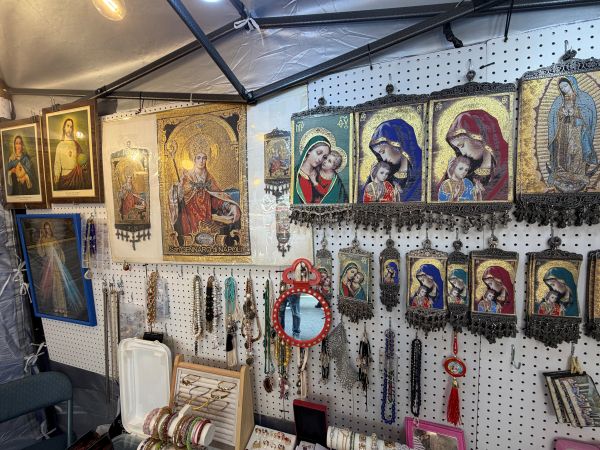


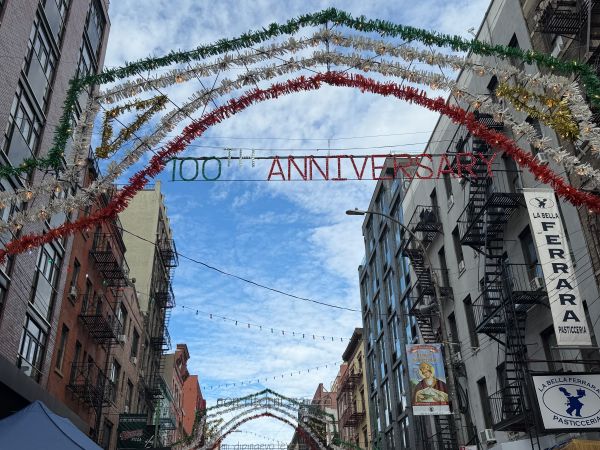
LITTLE ITALY — For years, Peter and Rachel Valenzon came to the Feast of San Gennaro with a prayer, and on Sept. 21, as the feast celebrated its 100th anniversary, the couple from Norwalk, Connecticut, returned to Little Italy to fulfill a promise.
“Decades ago, we had a lot of fertility issues,” Rachel said. “We would come here and have a devotion, saying that if we ever had a child, we’ll bring him here to pay respect to St. Gennaro.”
For the first time, their 9-year-old son, Pietro, joined them in the century-old tradition of pinning a dollar bill to the saint’s statue and saying a prayer.
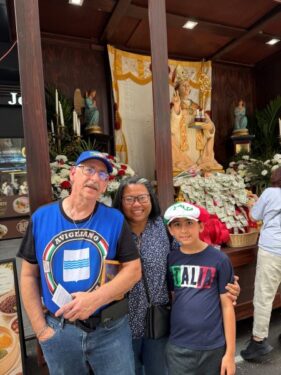
“[Attending] means a lot to me because I just started going here, and it tells me more about important moments in my religion and history,” Pietro said.
The tradition Pietro first experienced began in 1926, when Italian immigrants from Naples organized a one-day block party on Mulberry Street to honor St. Gennaro, their hometown’s patron saint.
Legend has it that St. Gennaro, a bishop who was martyred in 305, has been associated with miracles for centuries. His preserved blood, normally solid, is said to liquefy on his Sept. 19 feast day.
Each year during the festival, a solemn Mass is celebrated on the feast day at the Church of the Most Precious Blood on Baxter Street, which houses relics of the saint.
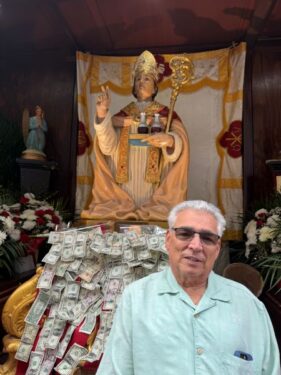
Among its founders was Luigi Vitale, the feast’s first president, whose great-grandson, John Fratta, now serves as vice president of Figli di San Gennaro.
“This is something we look forward to every year. It’s our tradition. It’s my family’s tradition, but it’s something that we always try to make better and better every year,” Fratta told The Tablet. “It’s become like a reunion for people that used to live on Mulberry Street and moved out, to meet up with their old friends and look at their old buildings.
“It’s in our blood. It really is.”
RELATED: Crowds Jam Little Italy for Heritage, Food & Hopefully Evangelization
That sense of heritage also keeps Celia Croteau coming back. A Catholic from Brooklyn who has volunteered at the St. Gennaro statue for about five years, Croteau has watched that devotion play out among the people who stop by.
“We get smiles, and we get prayers, and I’ve gotten hugs and pictures,” she said. “Really, I just love it.”
Being part of the feast’s centennial, she added, is particularly meaningful.
“It gives me chills,” Croteau said. “These people have passion. These streets have history. It’s amazing, and I’m so grateful to be part of it.”
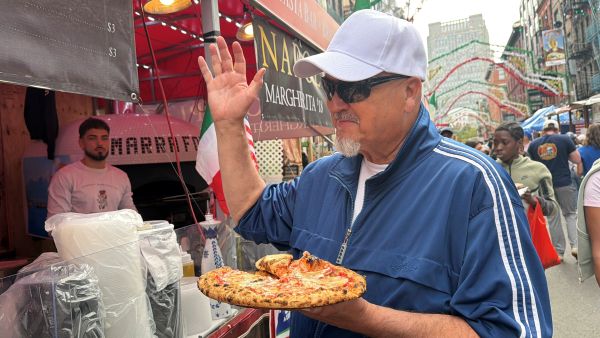
Beyond its religious traditions, the feast is also an annual opportunity for families to spend time together — usually over plenty of food.
Patricia Rodriguez, a parishioner at St. Bartholomew Church in Elmhurst, comes with her family every year, sometimes two or three times during the 11-day celebration, and become self-described “foodies” — enjoying everything from pizza to sausage and peppers.
“It’s super special. It’s a family day,” Rodriguez said. “We all gather and get together, come out here, and just try a little bit of everything.”
For Lucy Spata, owner of Lucy’s Sausage, sausage and peppers are more than a feast-day favorite — they are a family tradition stretching back generations.
Spata began helping at her grandmother’s stand when she was about 6 years old. Before she was old enough to cook the sausage, she had another job.
“First, I had to learn how to peel the onions,” she said.
By age 12, her grandmother, whose involvement stretched back to the feast’s earliest days, taught her to cook sausage. When her grandmother died, Spata said her grandmother asked her to continue the tradition.
“It was her wish that I carry it out because she was Lucy, and I was named after her,” she said. “So now, I’m 52 years cooking sausage.”
Wearing a cross and a medal of St. Gennaro around her neck, Spata said her family’s longevity at the feast is inseparable from the saint it honors.
“He’s the saint of miracles,” she said. “If it wasn’t for him, we wouldn’t have this. And he’s just with us every year, and it just gets better and better.”
Fratta echoed that sentiment, saying that despite all the changes the feast has seen over 100 years, its purpose has remained unchanged.
“We love the vendors; we love the people that come, but this feast is nothing without this man right here,” he said, gesturing to St. Gennaro. “He’s the most important part … and will always be.”
After a century, Fratta has no intention of seeing the tradition end.
“When I was young, very young, they used to always say this feast wasn’t going to last 50 years. It wasn’t going to last 75 years,” he said. “And here we are 100 years later, and we’re going to keep it going.”