
NOHO — For nearly 100 years, two generations of the wealthy Tredwell family were oblivious to a secret inside their fashionable row home that, during the 1800s, could have put them under suspicion of hiding fugitive slaves.
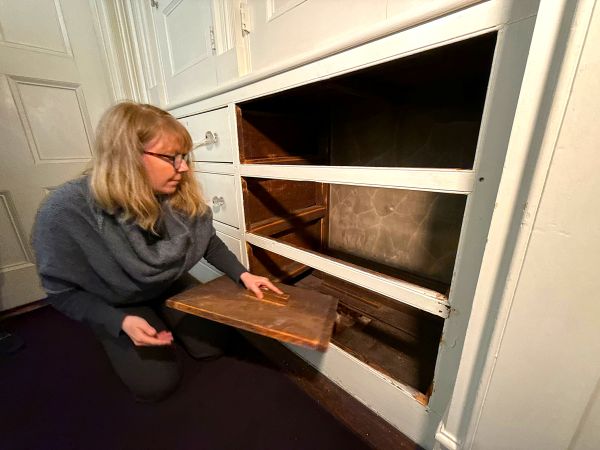
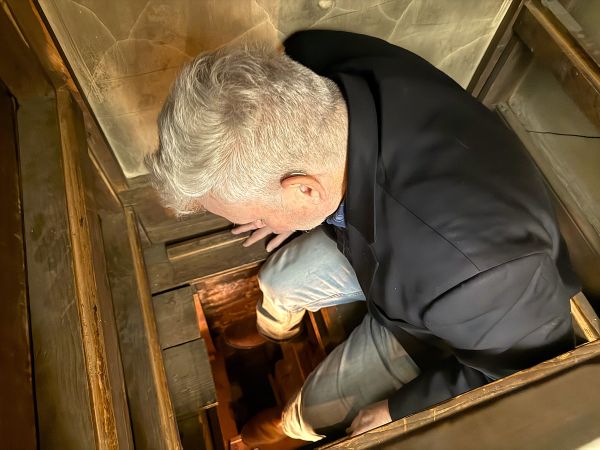
The house, built in 1832, includes an upper-level bedroom that has drawers built into the walls of a walk-in closet. Beneath the drawers is a trapdoor leading to a cramped, vertical shaft that ends in the ceiling of a pantry next to the ground-floor kitchen.
House painters in the early 1930s stumbled upon this covert space while preparing the home at 29 E. Fourth St. for its conversion from domicile into what is now called the Merchant’s Home Museum.
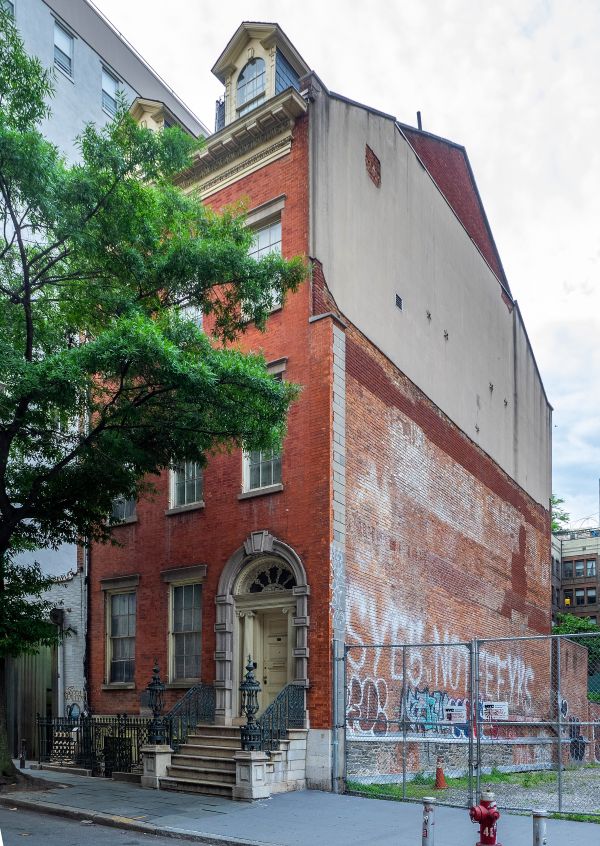
Since 1936, the museum has become “the only family home in New York City to survive intact from the 19th century with original furniture, decorative arts, and personal possessions,” according to its website.
RELATED: Central Park’s Seneca Village Has Pre-Civil War Legacy of Resilience
Still, the secret shaft had no obvious purpose, said Emily Hill-Wright, the museum’s director of operations. She said it suggests the Tredwell home was a waystation on the “Underground Railroad — a network of secret routes and safehouses run by abolitionists to help enslaved people escape to northern free states or Canada.
“Part of our research,” Hill-Wright explained, “has been looking at other 19th-century homes to find out: Is there another possible use for a space like this?
“It’s not an air shaft; it’s not a laundry chute. It’s not a dumb waiter. Is there a practical thing that we’re missing? And the answer is ‘no.’ ”
The museum archives have early staff notes speculating that the passageway was intended to help “fugitive” slaves, just like other New York City buildings with confirmed connections to the Underground Railroad.
Camille Czerkowicz, curator and collections manager, said there are no records of the Tredwell family being involved with the abolitionist movement. She noted that the Tredwells might have known nothing about the passageway.
But why? Probably because they didn’t build the house. That distinction goes to Joseph Brewster (1787-1854), a hatmaker from Connecticut who also dabbled in real estate and construction. He designed and built the home and several others in the NOHO neighborhood wedged between New York University and the East Village.
Brewster completed the home in 1832 and lived there until he sold it three years later to the hardware merchant, Seabury Tredwell (1780-1865), who moved there with his wife, Eliza, their eight children, and four Irish servants. Two generations of Tredwells lived in the house continuously for 98 years, Czerkowicz said.
Hill-Wright explained that both Brewster and Tredwell were prominent among the businessmen who prospered with the development of the Erie Canal.
Starting in 1825, the canal, spanning more than 300 miles, opened commerce by linking communities along the shores of the Great Lakes with New York City and its harbor.
RELATED: How a Son of Former Slaves Became the Rockefeller of New York City’s Oyster Restaurants
While there is no known tie between Tredwell and abolitionism, the museum historian learned two years ago that Brewster detested slavery, Czerkowicz said.
“That’s what made us re-evaluate our history,” she said.
Brewster, she explained, was part of the Presbyterian Church in New York City. His
faith deepened during an evangelical movement of the early 1800s, which was part of the “Second Great Awakening” in the U.S. from the 1790s through the 1830s. It was a time of fervent revivalism that moved Protestantism toward a more emotional, individualistic, and reform-oriented faith.
Presbyterianism during this time opposed slavery, but it also looked to end it gradually. Meanwhile, Brewster and like-minded progressive Protestants wanted it abolished outright — hence the term, “abolitionism.”
Czerkowicz said his attitude aligns with Catholic Church teachings on social justice, human dignity, and God’s love and mercy for all people.
“Brewster was part of an active group of people that really wanted to do good in the world,” said Czerkowicz, who is Catholic. “They worked together to help people wherever they could.
“I think that resonates with all religious communities.”
RELATED: Brooklyn Site, Home To Abolitionists, Wins Landmark Ruling
Still, such opinions and actions could risk one’s livelihood and freedom because of the Fugitive Slave Acts of 1793 and 1850. Consequently, it is hard to find written accounts of people moving through a waystation, Hill-Wright said. She noted the museum has not found any examples of people using the secret passageway to escape slavery.
“Underground Railroad work was extremely secretive and extremely dangerous, so most people did not keep records,” Hill-Wright said. “Of course, we would absolutely love to find a diary with lots of information about people in this house.
“We’re always looking.”
Hill-Wright and Czerkowicz said the passageway is gaining wider attention among New Yorkers and tourists, which bolsters wider interest in the museum itself.
That’s critical, they said, because new neighborhood construction plans threaten the structural integrity of the museum’s foundation and walls. They urge people to visit the museum or merchantshouse.org to learn more.
“We’re excited to have all these new angles and different parts of history to talk about,” Czerkowicz said. “We’ve been overwhelmed with media attention, and we feel grateful and honored to be telling these new stories.”