SPRINGFIELD GARDENS — In a year that has so far seen religious violence result in the killing of 7,000 people in Nigeria, President Donald Trump announced on Oct. 31 that the nation was reinstated as a Country of Particular Concern (CPC).
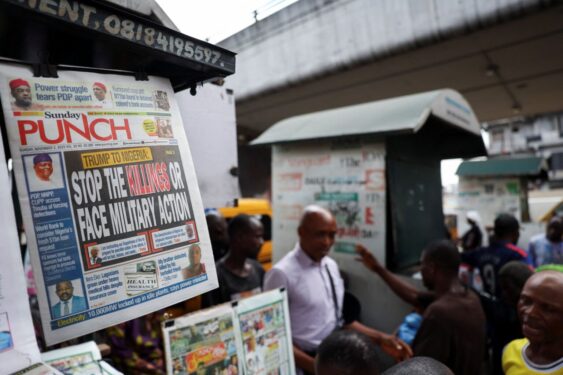
The designation reverses President Joe Biden’s policy of keeping Nigeria off the list. Trump also suggested he’d deploy the U.S. military “with guns a-blazing” to the West African nation if the killing is not stopped.
“The United States cannot stand by while such atrocities are happening in Nigeria,” the president said on Truth Social. “We stand ready, willing, and able to save our Great Christian population around the world!”
CPC is a classification by the U.S. Secretary of State for countries experiencing “systematic, ongoing, and egregious violations of religious freedom,” as described in the International Religious Freedom Act (IRFA) of 1998.
The designation, as outlined by IRFA, leads the government to pursue non-economic policy options to end a country’s religious freedom violations and, if those fail, impose economic penalties thereafter.
Father Cosmas Nzeabalu, coordinator for the Nigerian Apostolate in the Diocese of Brooklyn, said he preferred not to see U.S. “boots on the ground” in his homeland.
Still, he said the CPC designation has lifted the spirits of Nigerians throughout the diocese.
“It feels so good because it shows that the world is listening,” Father Nzeabalu said. “It has shaken the fabric of the (Nigerian) leadership.”
Trump put Nigeria on the CPC list in 2020 during his first term, only to have it reversed a year later by the Biden Administration. Those State Department officials said the legal definition of CPC did not apply to Nigeria, but they never explained why.
The silence flabbergasted advocates of religious freedom throughout the world, who argued that the ongoing violence was enough proof.
The 7,000 murders reported in 2025 are based on data collected by the Alliance Defending Freedom (ADF) International.
Meanwhile, the Armed Conflict Location & Event Data Project projected that, as of 2025, nearly 53,000 people have been killed in targeted violence since 2009, when the terrorist group Boko Haram came to Nigeria.
These Jihadi extremists, joined by Islamic State-West Africa Province (ISWAP), have targeted Christians and fellow Muslims with mass murder, kidnapping, and extortion.
Observers also decry the repeated assaults in Nigeria’s Middle Belt region, perpetrated by Fulani-speaking cattle herders. They battle Christian farmers, many of them Catholic, for fertile land.
Nigerian President Bola Ahmed Tinubu, who is Muslim, responded that Trump’s characterization of Nigeria as religiously intolerant, “does not reflect our national reality.”
Tinubu’s wife, Oluremi, is Christian. They’ve been married since 1987.
He further argued that Trump’s rhetoric fails to take “into consideration the consistent and sincere efforts of the government to safeguard freedom of religion and beliefs for all Nigerians.”
Tinubu’s words carry little weight with Father Nzeabalu, who is also the parochial vicar for St. Mary Magdalene Church in Springfield Gardens, Queens.
He noted that Fulani attackers from northern Nigeria often kill with AK-47 rifles, which are illegal for the average Nigerian to own. Some analysts suggest that Fulani herdsmen have the support of Boko Haram and ISWAP.
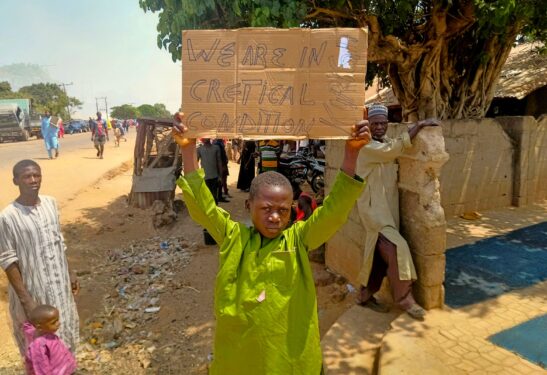
News of more violence surfaced in late November and the first week of December.
As Nigerian journalists scrambled for details on the latest attacks, an earlier incident was confirmed by Aid to the Church in Need International (ACN). The agency reported that gunmen abducted a priest on Nov. 17 from a parish in the Archdiocese of Kaduna.
Father Bobbo Paschal, parish priest of the St. Stephen Parish in Kushe Gugdu, Kaduna, was grabbed before sunup by armed assailants in his home, ACN reported.
The gunmen also killed the brother of another priest, Father Anthony Yero, and kidnapped many other people, according to ACN.
“They move, conquer a place, settle there, and kick the owners of the land away,” Father Nzeabalu said. “Then they move onward. If left untouched, it will be a gradual movement from north to south.
“The killing will be very massive because most of the people in the south are Christians. It will be merciless destruction.”
Still, Father Nzeabalu said U.S. military strikes would surely produce collateral damage, killing people these measures would be meant to save, as well as innocent Fulani speakers.
He urged U.S. officials not to let up on the Nigerian government, but to also work closely with the Africans to determine the sources of the weapons so that local security forces can finally sever that pipeline.
Fred Cocozzelli, a political science professor at St. John’s University, said the U.S. has conducted limited air strikes in recent decades, such as in Kosovo in the 1990s, to protect Albanian Muslims.
Another example is Libya during the early 2000s, which happened concurrently with the toppling of dictator Muammar Ghadafi’s regime; his death soon followed.
RELATED: Nigerian Clergy Decry Violent Attacks by Muslims
But Cocozzelli, who lectures on genocide and who specializes in conflict resolution, noted that Nigeria is a democracy, a U.S. ally, and a recipient of U.S. military aid.
Thus, he said, a full-scale U.S. military intervention in Nigeria, “seems very unlikely.”
Cocozzelli explained that a large-scale campaign in Nigeria could involve ousting militants from that nation’s thick forests. He said the herdsmen tend to use the terrain to launch their attacks, but securing them could be prolonged and “messy.”
Cocozzelli instead favored a strategy that encouraged and incentivized powerbrokers on both sides of the conflict to take control of their attackers — a form of self-policing that, he said, worked in Kosovo.
He suggested Trump’s sabre rattling over West Africa might be an attempt to shore up his base at home, which tends to be conservative, Christian, and concerned about religious freedom overseas.
“There’s that sort of adage about Trump,” Cocozzelli said. “You can’t take him literally, but you have to take him seriously. I think this is one of those cases.”