
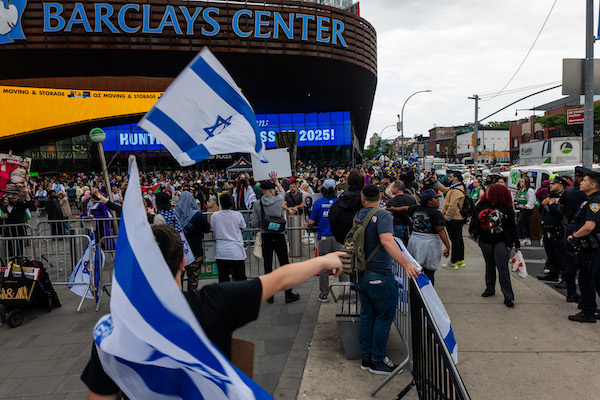
CITY HALL — An executive order issued by Mayor Zohran Mamdani, which revoked the definition of antisemitism established under the previous administration and whether city agencies can boycott Israel, is causing concern in New York’s Jewish communities, religious and secular leaders said.
On Jan. 1, the first day of his administration, Mamdani issued an executive order that declared “All Executive Orders issued on or after September 26, 2024, and in effect on December 31, 2025, are hereby revoked.”
The Sept. 26, 2024 date coincides with the federal indictment against former Mayor Eric Adams.
RELATED: Bishop Brennan Stands in Solidarity With Jewish Community on Last Day of Hanukkah
Among the revoked orders, was Adams’ broadened definition of antisemitism that included criticism of Israel. The other barred city employees and agencies from boycotting or divesting from Israel.
Under the Adams administration, the city adopted an antisemitism definition that aligned with the International Holocaust Remembrance Alliance’s view, which states that calling the existence of Israel racist is antisemitic, as is accusing the state of Israel of exaggerating the atrocities of the Holocaust.
The Council on American-Islamic Relations (CAIR) and other groups had been critical of the idea that criticizing Israel would be considered antisemitic. CAIR charged that such an idea stifles the rights of Palestinian supporters to engage in free speech.
The recent moves by Mamdani are upsetting to Jews, said Rabbi Brad Hirschfield, president of the National Jewish Center for Learning and Leadership in Manhattan.
“Most Jews identify as part of a culture, and the vast majority of the members of that culture see Israel as a critically important piece of their identity,” he said.
Other Jewish leaders are equally alarmed.
“Singling out Israel for sanctions is not the way to make Jewish New Yorkers feel included and safe,” the UJA Federation of New York and the New York Board of Rabbis said in a joint statement.
According to the NYPD, antisemitic incidents decreased by 3% between 2024 and 2025. However, antisemitic incidents accounted for 57% of all hate crimes during that period, even though Jews make up only 10% of the city’s population.
And it’s not just Jewish leaders who are upset over the mayor’s actions.
“I think the mayor is wrong,” said Msgr. Guy Massie, pastor of Sacred Hearts and St. Stephen’s Church in Carroll Gardens. “And I think in some ways that attitude could give license to antisemitic behavior.”
Msgr. Massie, who earned his master’s degree in Judaic studies at the Jewish Theological Seminary, is the former chair of the Ecumenical and Interfaith Commission for the Diocese of Brooklyn. He keeps in close touch with Jewish leaders, who he said are “concerned for their children.”
The worry spreads beyond New York City.
Alan Mindel, chairman of the Holocaust Memorial and Tolerance Center of Long Island, called the new orders “abrupt reversals (that) remove vital protections that Jewish New Yorkers secured,” and said the mayor’s moves “send a chilling message.”
Mindel also charged that the recent orders “normalize discrimination against Jews and undermine the safety and dignity of all Jewish New Yorkers.”
However, there is also a diversity of opinion among Jews on the hot-button topic, and not everyone is worried. Raphael Wakefield, who lives in Queens and said he goes to shul infrequently, said fears of antisemitic attacks are unfounded.
“I think these fears are ridiculous and extremely dishonest given the realities of being Jewish in New York City today,” he said. “It is overblown for the political benefit of the state of Israel and its supporters.”
The mayor’s office did not respond to a request for comment from The Tablet. But, in a Jan. 2 press conference, Mamdani defended his orders and said he is committed to protecting the rights of Jews, including keeping the Mayor’s Office to Combat Antisemitism up and running.
“What we will do is actually deliver on our commitment to protect Jewish New Yorkers in a manner that is actually able to do that,” he said.