
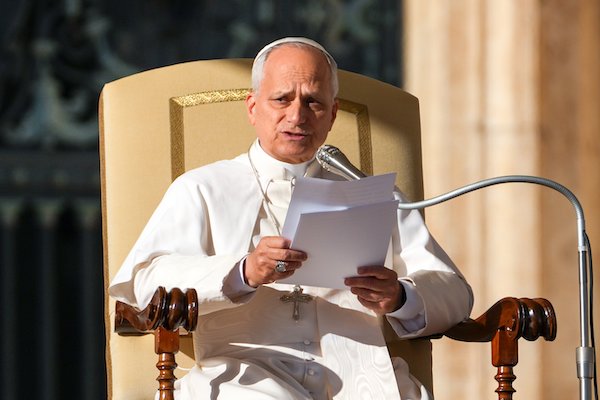
PROSPECT HEIGHTS — A practice nearly as old as the Church itself, using Latin as its official language, was eased on Nov. 24 when Pope Leo XIV signed a new regulation allowing documents to be started in other languages.
Previously, Latin was the default language for drafting official documents issued by the governing body of the Church, the Roman Curia. However, this new regulation broadens that to include other languages, like English, French, and Spanish.
“Curial Institutions will, as a general rule, draft their documents in Latin or another language,” the regulation stated. It became effective on Jan. 1.
Vatican officials have said this move streamlines communications in an age when very few people speak Latin.
To understand why Latin, an ancient language, has dominated Roman Catholic communications for more than 2,000 years, it helps to comprehend that the Church is also ancient.
RELATED: Pope Leo XIV Authorizes Traditional Latin Mass in St. Peter’s Square
It began two millennia ago, about 33 A.D., in Jewish Palestine with the ministry of Jesus Christ and his original apostles. The land was controlled by the Roman Empire at that time, whose citizens spoke Latin.
Acts of the Apostles, the fifth book of the New Testament, describes how the Church grew during that time, even amid waves of Roman persecution.
As the empire’s reach stretched across North Africa, the Middle East, and Europe, the Church followed along, said Father Michael Bruno, an authority on Church history.
“Certainly, a Latin tradition emerged by the 2nd century,” Father Bruno said. “One of the places that Latin flourishes in terms of Christianity is North Africa.”
Father Bruno is the associate vicar for clergy and consecrated life for the diocese. But until last year, he served at the St. Joseph’s Seminary and College in Dunwoodie, Yonkers, where he held several responsibilities, including serving as a lecturer in Church history.
He described how North Africa in the 2nd century was a Roman province, but was well represented by early Christian scholars.
“And so you see Tertullian (155-220 A.D.), eventually Cyprian (210-258 A.D.), and St. Augustine (354-430 A.D.), who will all be using Latin in Roman Africa,” Father Bruno said. “And that becomes, also, another way that Christianity begins to really develop.”
Meanwhile, the Church got another boost when Emperor Constantine, having converted to Christianity, outlawed its persecution in 313 A.D. through the Edict of Milan.
This was followed by other developments, including the translation of scriptural texts from Aramaic Hebrew (Old Testament) and Greek (New Testament) to Latin.
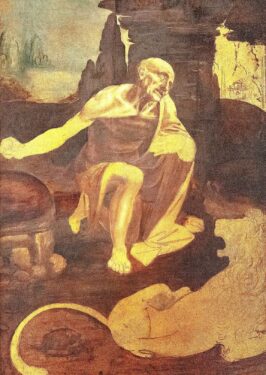
One pioneering translator was Jerome (342-420 A.D.), a scholar from the Roman Empire’s holdings in present-day Dalmatia.
Around 382 A.D., he traveled to Rome, where Pope Damasus I commissioned him to revise old Latin translations of the Bible into a contemporary Latin dialect.
Jerome shifted to translating scriptures from Hebrew and Greek into Latin. He soon realized his grasp of Hebrew was weak, so he moved to Bethlehem in present-day Israel to study and master it.
RELATED: Pilgrims Glad to See Long-Awaited Renovations at Grotto of Nativity
He became a fixture in and around the Church of the Nativity, which is atop the Grotto of the Nativity – the birthplace of Jesus. There, in 405 A.D., he completed the Bible translation known as the “Vulgate,” which in Latin means common, popular, or widely circulated.
That was a “tremendous movement forward,” Father Bruno said, to share the Gospel throughout the empire.
Therefore, Latin became the official language of the Church.