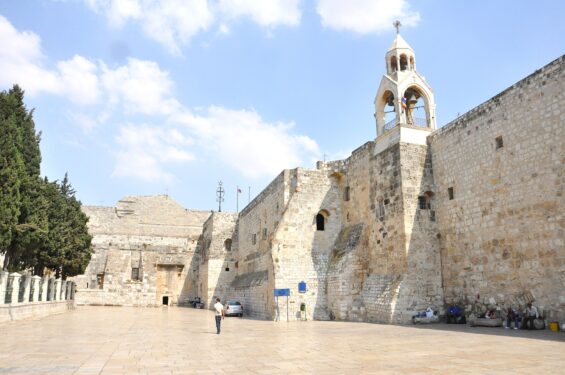
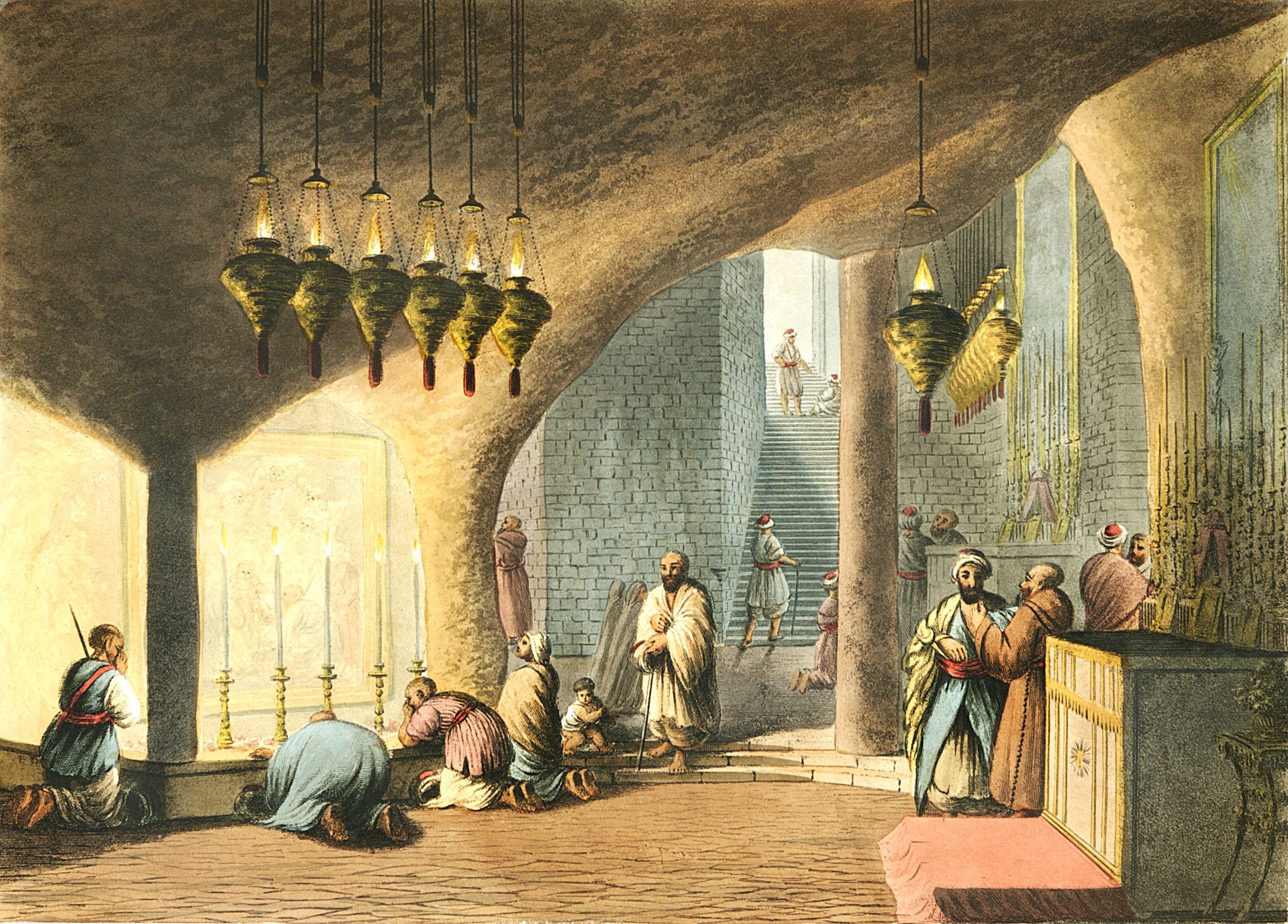
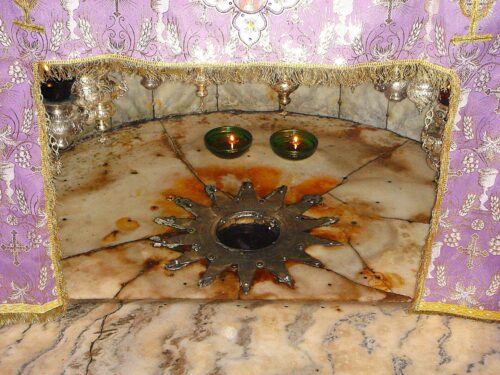
PROSPECT HEIGHTS — Michael La Civita recalled his first visit to the Grotto of the Nativity in 1991, joining other pilgrims crowding the spot to savor where Jesus entered the world, not to condemn, but to save it.
La Civita, of Brooklyn, is director of communications and marketing for Manhattan-based Catholic Near East Welfare Association (CNEWA). He said his 1991 visit to Bethlehem came just before the Middle East peace efforts of the Madrid Conference in late October and early November of 1991, and the Oslo Accords in 1993 and 1995.
“It was a different world then,” he recalled. “It looked to be an encouraging sign of peace between Palestinians and Israelis.”
La Civita said there were “huge numbers of pilgrims” in 1991, waiting in line to enter the grotto.
The opposite was true last September when La Civita visited Bethlehem with a contingent representing CNEWA and the U.S. Conference of Catholic Bishops.
“There were no pilgrims,” he lamented.
La Civita is also a lieutenant for the USA Eastern Lieutenancy of the Order of the Holy Sepulcher of Jerusalem. He blamed the ongoing conflict in Gaza for discouraging trips to the Holy Land.
Yet in this time of violence and displaced humanity, the caretakers of the grotto began its first renovations in some 600 years.
The repair work was announced in a joint statement on Jan. 24 by the Greek Orthodox Patriarchate of Jerusalem and the Custody of the Holy Land, a ministry of Franciscan friars that helps preserve sacred places like the Grotto of the Nativity and the complex church above it — the Church of the Nativity.
According to the joint statement, “This project embodies a unified Christian commitment to preserve the spiritual, historical, and cultural patrimony of the Holy Grotto for future generations, and to uphold the dignity of a site where the Christian proclamation took visible form.”
RELATED: Pope Marks 800th Anniversary of Nativity Scene, Asks Prayers for Holy Land
(Photo: Wikimedia Commons)
Humble Beginnings
The grotto’s significance to Christianity is noted in the Bible.
In John 3:17 — a single verse that is one of the most-quoted scriptures of all time — John explains that God didn’t send his son to condemn the world, but to save it.
This transpired through the “Incarnation” — God’s fusing of his spirit with human flesh, which resulted in the “Nativity” of the Christ.
The stage was set for Jesus’ ministry, the sacrifice of his blood, and the resurrection, all to fulfill the proclamation that whoever “believes in him might not perish but might have eternal life (John 3:16).”
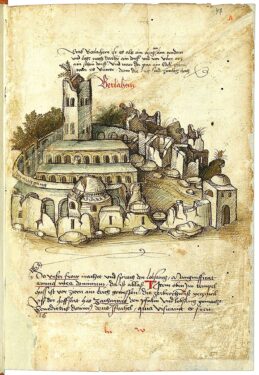
Therefore, the grotto — a cave turned into a humble stable for livestock in Bethlehem — became so revered that Christians built the Basilica of the Nativity over it. For centuries, it has been among the Holy Land’s top tourist destinations.
Children of Abraham
La Civita explained that Muslims also cherish the grotto because Jesus is considered a prophet in Islam. The point was reinforced for him during his 1991 visit.
“There were huge numbers of pilgrims,” he said, “not only pilgrims from overseas, but local pilgrims — Christian and Muslim — who waited in line in the basilica to enter the grotto.
“I make that point because many Muslim families, young families in particular, visit the grotto to pray for similar reasons as so many of our people.”
He said many people of diverse faiths are tolerant of each other’s customs and holy sites, despite ongoing violence in the region.
“They know,” La Civita said, “because we are of the same children, sons and daughters, of Abraham — Christians, Jews and Muslims.”
Still, the ongoing violence has devastated Israel’s tourism industry, La Civita said, even though there are no government bans on travel.
“But,” he added, “there are plenty of things in place that prevent one from making a pilgrimage. One of the most significant ones, of course, is the fear of being caught in the crosshairs.”
Goosebumps
Peter Bahou has a unique understanding of the ongoing violence. He is president and owner of Peter’s Way Tours in Melville, Long Island, and has been organizing pilgrimages for 40 years.
Bahou, a Catholic, is also a native of Israel who, as a boy, frequently visited the grotto.
He said the renovations are important to keep people returning to the grotto and experiencing its spiritual power.
He said many people are moved by the stories of saints associated with the site, such as St. Jerome, who translated scripture into Latin while living there.
Bahou recalled one of his early pilgrimages, when a woman collapsed, weeping profusely. He rushed to help her, but an accompanying priest told him she was OK — just overwhelmed by the site’s sacred atmosphere.
“A lot of people go there just as a site to visit while in Bethlehem,” Bahou said. “But the faithful — when I see these pilgrims, it feels like goosebumps coming to me.”