
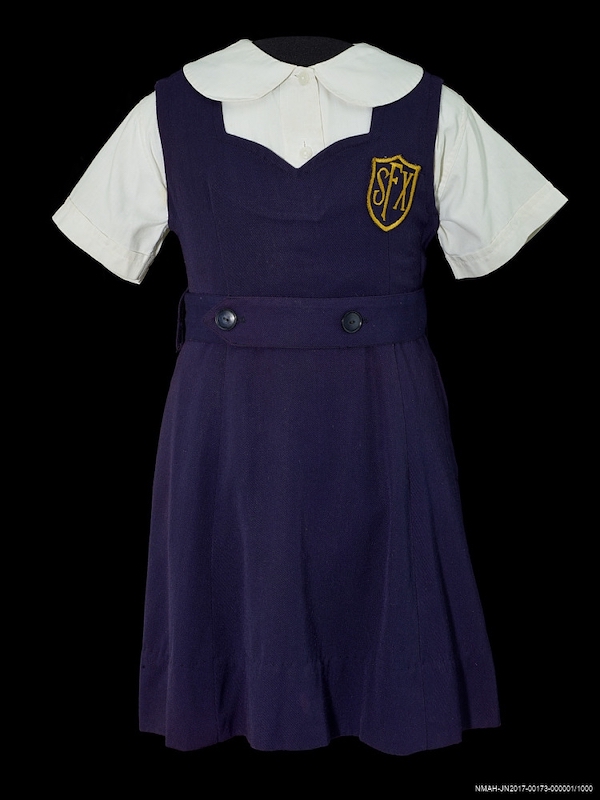
Among the 1.7 million artifacts in the Smithsonian’s National Museum of American History is a girl’s Catholic school uniform from 1962.
Consisting of a navy-blue jumper, white short-sleeved blouse, and blue bow tie, the 64-year-old garment is from St. Francis Xavier Catholic School in Washington, D.C., and is part of the Smithsonian’s permanent collection.
It is also part of a long tradition of Catholic school dress, said Debbie Schaefer-Jacobs, curator in the Smithsonian’s culture and community life division.
“It’s a piece of history,” Schaefer-Jacobs told The Tablet.
Susan Laudicina, a volunteer at the Smithsonian, is originally from Bushwick and has fond memories of the uniform she wore at Fourteen Holy Martyrs School in the 1950s. It gave her a sense of belonging, she said.
“I understood as a child that the uniform was about having values. It gave a sense of pride and identity,” Laudicina explained. “Looking back from the perspective of an adult, I realize it was also about economics. We were a working-class community, and uniforms saved money.”
She recalled having two uniforms and switching off so she could wear one while her mother washed the other.
School uniforms have evolved over the decades, said Sally Dwyer-McNulty, a history professor at Marist University. In the mid-19th century, there were different types of Catholic schools, including asylums for children, convent schools, parochial schools, and, eventually, parish-run schools, she noted.
It was at the asylum and convent schools that dress uniformity first came into being. “This is where the idea of a uniform dress comes into play; to set discipline and to diminish any kind of economic differences among the children,” she explained.
Practicality was the order of the day, said Dwyer-McNulty, author of the book “Common Threads: A Cultural History of Clothing in American Catholicism.”
“And sometimes, it was a smock the children would wear; something that was functional and utilitarian,” she said.
Fashion was not the focus. The clothing was meant to instill discipline, Schaefer-Jacobs said.
She explained that “They were created more as a way to curb student individuality and make them behave the same; not stand out and not be envious of each other.”
In the late 19th century and early 20th century, uniforms had a conservative look but still reflected the fashion of the day, Dwyer-McNulty said. She pointed to a uniform she came across in her research — a girl’s outfit from Mount St. Joseph’s Academy in Philadelphia in 1899 — a full-length black dress with mutton chop sleeves that were puffy at the shoulder and thin at the wrist.
“Plain as it was, it reflected the contemporary style of women’s clothing,” she said.
Parochial schools were around for years, but many did not require uniforms. That didn’t come until the 1920s, Dwyer-McNulty said. Modesty was the order of the day.
In 1928, Pope Pius XI issued dress guidelines for girls, dictating that necklines be high, sleeves cover the elbows, and skirt lengths be below the knee.
From the 1920s to the 1940s, one of the most popular uniforms was the “Peter Thomson,” a dress designed by Thomson, a Philadelphia tailor, that was based on a sailor suit. In the 1940s, the A-line jumper began to gain popularity.
During this period, boys’ common attire included a shirt, a jacket, and knickers.
RELATED: Map of Surnames Celebrates Bay Ridge’s Irish History in Brooklyn
When many people think of Catholic school uniforms, they probably think of pleated, plaid skirts. Plaid patterns made their debut in the early 1950s, thanks in part to clothing manufacturers who sought to link Catholic schools with Irish-Celtic traditions.
“The post-World War II period and especially through the 1960s, that’s really when we see plaid come in,” Dwyer-McNulty explained.
By the time the 1970s rolled around, changes in society led to more relaxed dress codes, including the allowance of girls to wear slacks. It was also around this time that wools, linens, and cottons gave way to polyester. “It was easy to wash and wear,” she said.
In recent years, polo shirts containing the school’s logo have become more commonplace.
However, the jumper and skirt have not disappeared from the scene. Many schools still require them.
Laudicina said she is glad uniforms haven’t disappeared.
“They’re a sign of unity. It tells the students that they’re all in this together and that they’re all equal,” she added.