Religious liberty advocates are hailing a June 27 Supreme Court decision that a high school football coach had a constitutional right to pray at the 50-yard line after his team’s games as a landmark ruling for religious exercise in public life.
In a 6-3 vote June 27, the Supreme Court ruled that a former high school football coach had the right to pray on the football field after games because his prayers were private speech and did not represent the public school’s endorsement of religion.
U.S. bishops reacted to the Supreme Court overturning Roe v. Wade with appreciation for the decision, combined with an emphasis on the long road and important work ahead in terms of support, advocacy, and dialogue with abortion supporters.
The 6-3 ruling to overturn Roe came in the court’s decision in Dobbs v. Jackson Women’s Health Organization, which was a challenge to a Mississippi law banning most abortions after 15 weeks.
“A historic day,” is how the Catholic bishops of New York state, including Bishop Robert Brennan of Brooklyn, described June 24 — the date Roe v. Wade was overturned by the U.S. Supreme Court.
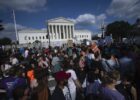
Decades of prayers from pro-life advocates were answered this morning as the Supreme Court overturned Roe v. Wade, and in doing so abolished the legal right to an abortion at the federal level, and returned the jurisdiction back to state lawmakers.
The backstory of the National Eucharistic Revival planned by the U.S. Conference of Catholic Bishops (USCCB) includes surprising statistics from a Pew Research Center study revealing beliefs on a subject at the heart of the Church’s mission.
When about 300 Catholic leaders gather Thursday, June 23 to Sunday, June 26, in Chicago for the U.S. Bishops’ Conference’s “Journeying Together” initiative, they’ll have completed almost two years of virtual meetings and dialogues that weren’t originally planned, but which laid a foundation for them to build upon.
In a 6-3 ruling June 21, the Supreme Court said a Maine tuition aid program that excluded religious schools violated the Constitution’s free exercise clause.
On the 10th anniversary of Deferred Action for Childhood Arrivals (DACA) — the 2012 executive order signed by then-President Barack Obama — the offices of District Three Youth & Adults Inc. on Wyckoff Avenue was as busy as ever with staff members assisting DACA recipients looking to file renewal applications.