
Not only are there no atheists in foxholes, but some of the denominational differences seem to disappear, too, once you’re under heavy fire. That was the situation that Mark Geist and Kris Paronto found themselves in working as military contractors in Benghazi, Libya.
Guest Columnists

Our Duty to Those Who Doubt
Recently, I received a letter from a person desperate because his brother left the church in anger, saying a lot of what the church teaches is a myth. I told the person I would pray for the situation. But I imagine there are a lot of similar situations out there.

Opportunity Amid Demographic Crisis
State-sponsored cruelty has been a staple of the human condition for millennia. But has there ever been a more wicked policy, with more disastrous social consequences, than the “one-child policy” China began to implement in the early 1980s – a state-decreed population-control measure that resulted in, among other horrors, untold tens of millions of coerced abortions?

Pray Your Way Through the Year
Pray first and ask what God wants of you. Then write down some goals. Don’t get too specific because as you pray your way through the year, God may help you define or refine your goals.

Memorable Messes in The Family Kitchen
“When it comes to making gravy, there are two kinds of people,” I said to my 10-year-old grandson this past Christmas. “Flour people and cornstarch people. We’re cornstarch people.” He nodded.
Ukraine: A Country at The Crossroads
When Ukraine celebrated Christmas two weeks ago, there were ample reasons for pessimism about that long-suffering country’s future.

Encountering Our Muslim Neighbors
A few months ago, I wrote a column about the word “they” and how it can be a dangerous word. Since then and after the tragedies in Paris and San Bernardino, Calif., the point is driven home by the consequences when some segments of global societies label Muslims as “they.”
Dear Father: Pray the Black, Do the Red
In all the 16 documents of the Second Vatican Council, is there any prescription more regularly violated than General Norm 22.3 of the Constitution on the Sacred Liturgy? Which, in case you’ve forgotten, teaches that “no … person, not even a priest, may add, remove, or change anything in the liturgy on his own authority.”

A Loving Gesture for Those Who Are Sick
A serious illness is stressful and exhausting for a patient and his or her loved ones, and it can also be a time of deep emotional sadness. The more we ease the burden of those who suffer and those who care for them, the more we are of help.
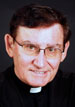
Late Bishop Imesch Was Like Family
Father Eugene Hemrick pays tribute to the late Bishop Joseph L. Imesch, of Joliet, Illinois — a man with the heart of a loving father, who was more concerned about his priests than the exalted title of bishop.