
by Tablet Staff
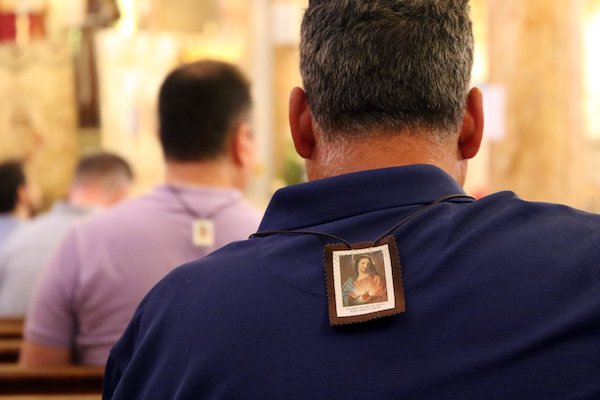
PROSPECT HEIGHTS — On July 16, 1251, the Virgin Mary appeared to Carmelite priest St. Simon Stock and presented him with a brown scapular.
“It must be a sign and a privilege for you and for all Carmelites,” she promised him. “Whoever dies wearing the scapular will not suffer eternal fire.”
The scapular, consisting of two small pieces of cloth connected by strings, is worn over the shoulders with one piece resting on the chest and the other on the back. It originated as a practical garment worn by monks over their habits during work, and symbolizes consecration to Mary.
Today, Catholics associate the Scapular Promise with the feast day of Our Lady of Mount Carmel, which honors Mary as the patroness of the Carmelite religious order. July 16 is a significant occasion for reflecting on the brown scapular’s spiritual importance.
Here’s what you need to know about its history and proper usage:
- Not a ‘Charm’: The scapular is not a magical amulet or automatic ticket to salvation, nor does it excuse one from living a non-Christian life.
- Latin Origins: The term “scapular” comes from the Latin “scapulae,” meaning shoulders.
- Not Just for Religious: After the Virgin Mary gave the scapular to St. Simon Stock, the Church later extended its use to laypeople.
- Threefold Symbolism: The scapular represents Mary’s maternal love, protection, and devotion to Christ, which she helps Catholics carry.
- Sacramental Role: The scapular fosters a holy life and deepens devotion. While it doesn’t impart grace like sacraments, it prepares the wearer for God’s love and repentance when received devoutly.
- Fátima Connection: In October of 1917, St. Lucia reported that Mary appeared in a Carmelite habit, holding the scapular, and urged her true children to wear it reverently as a sign of consecration.
- Preserved Relic: The scapular of Blessed Pope Gregory X was found intact 600 years after his burial. Similar cases occurred with St. Alphonsus Liguori, and saints such as John Bosco, John Paul II, and Peter Claver also wore or promoted the scapular.
- Communal Significance: The scapular is usually given to the wearer in a community ceremony. A priest blesses the first scapular a person wears, placing it on the devotee while praying: “Receive this blessed scapular and ask the Most Holy Virgin Mary, on her merits, that you may wear it without any stain of sin and that she guard you from all adversity and bring you unto everlasting life.”
- Blessing and Disposal: Only the first scapular a person wears in their lifetime needs blessing. Worn-out blessed scapulars should be burned or buried, as is the custom for sacramentals.