

DYKER HEIGHTS — To this day, Msgr. Robert Romano cannot bring himself to watch footage of the World Trade Center attack. “I turn my head,” he said.
Video of the hijacked jetliners slamming into the Twin Towers and the buildings collapsing brings back painful memories, said Msgr. Romano, pastor of Our Lady of Guadalupe Church in Dyker Heights and an NYPD chaplain. In a recent conversation with The Tablet, he recalled where he went and what he saw on that fateful day.
On Sept. 11, 2001, the then-Father Romano raced to the World Trade Center as soon as he heard what happened. He then spent months at “the pit” — as he calls it — escorting remains from the site, administering Communion to recovery workers, and celebrating Mass. Several moments stand out for him.
One of the first things he saw was the bodies of people who had jumped to their deaths. “It was terrible,” he said.
RELATED: Paulie’s Final Push Honors 9/11 Flight Crews, One Mile at a Time
There was also the moment when he administered absolution to Father Mychal Judge, a Franciscan friar who was an FDNY chaplain and New York City’s first certified casualty.
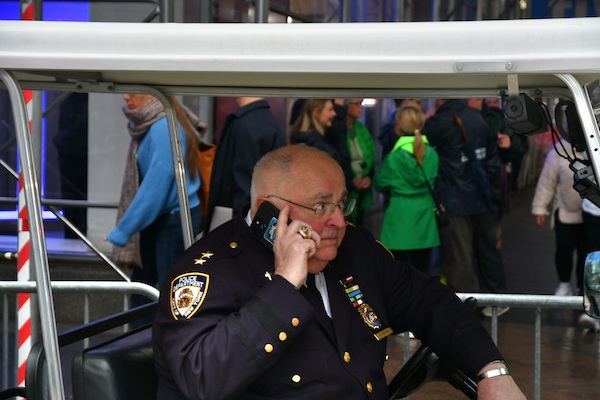
And then there was the image he saw in a mirror at One Police Plaza: his NYPD uniform covered in dust, “as if I had poured flour on myself,” he recalled.
What stayed with him most from those hours was not only what he saw, but what he heard — one sound in particular that haunts him all these years later.
In the hours after the attack, Lower Manhattan was eerily quiet, and the air was filled with dust, “like being in a snowstorm,” he said.
“But there was this traffic light, and it had a battery powering it. The battery kept clicking for the light to change,” Msgr. Romano said. “We live in New York, and you don’t normally hear the traffic light click because the city is so noisy.
“That sound stayed with me.”
On the morning of Sept. 11, 2001, he was presiding over a funeral at the Shrine Church of St. Bernadette in Dyker Heights, where he was pastor at the time. As the Mass ended, he was informed that the Twin Towers had collapsed.
“I ran to the rectory, changed my clothes, put on my police uniform, and called the local precinct,” he said.
The precinct dispatched a police officer to drive him to Manhattan.
“I remember debris floating in the air when we drove on the Gowanus Expressway,” he said. “It was awful to see the smoke and all that stuff blowing. And then I realized that it was the ashes of people that were in the World Trade Center.
“I get emotional sometimes when I think about it.”
When he arrived at the site, he said he remembered seeing “bodies on the ground of people who had jumped from the buildings.”
Within minutes, he learned of the death of a clergyman.
“Mychal Judge was the first to die,” he said. “They took his body and placed it on the sanctuary floor at St. Peter’s Church. I went there and gave him absolution.”
He then ran into Msgr. John Delendick, a fellow Diocese of Brooklyn priest and a FDNY chaplain. “I’ll never forget the look on his face,” Msgr. Romano recalled. “He said, ‘We lost a lot of people.’ ”
Msgr. Romano then went to One Police Plaza.
“They set up in the auditorium a place for families to wait,” he explained. “Every time a cop would walk into a family that was waiting, there’d be screams, tears, and applause. I felt bad for those who didn’t get reunited.
“By the end of the night, we were sure there were 23 police officers missing.”
Indeed, the NYPD lost 23 officers.
From One Police Plaza, Msgr. Romano went back to the World Trade Center.
“It was a horrific scene,” he recalled. “Twisted metal everywhere. Part of the facade was still standing. They didn’t find any bodies that day but every time they found a body, I was called and I went into the pit, and we escorted the body to the morgue in a dignified way.”
Msgr. Romano celebrated Mass every Sunday morning at the site.
“I said Mass for the people who were working there,” he recalled. “I used to say Mass in 20 minutes. And I used to tease them and say, ‘You give me 20 minutes, I’ll give you faith.’ ”
Msgr. Romano was a steady presence at the World Trade Center from Sept. 11 until May 2002, when “by that time, the pit was empty. There was nothing left.”
While he remembers the horror of 9/11, there were positive moments.
“On the night of 9/11, all these fire trucks were lined up from volunteer fire departments because they had searchlights,” he said. “That’s what was needed. I looked at them and started to cry. I thought, ‘Look at the goodwill of people.’ ”
He was heartened by the sight of people standing on the corner of West and Christopher streets applauding recovery workers changing shifts: “That was beautiful.”