
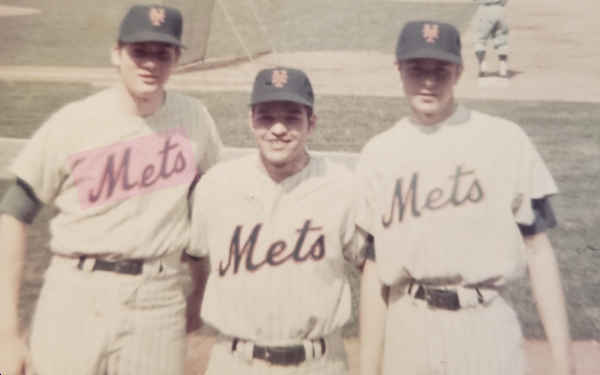
Curtin) was the batboy for the World Series champion Mets. (Photo: Courtesy of Bobby Sacca)
More than 55 years later, we’re still talking about the 1969 New York Mets. After seven miserable seasons to begin the franchise’s history, the Mets turned in nothing short of a miracle in 1969 — winning 100 regular-season games to capture the National League East crown, sweeping the Atlanta Braves in the league championship series, and then stunning the mighty Baltimore Orioles to win the World Series.
What an experience it must have been to be a part of that miracle as a player, coach, or even the batboy.
For batboy Bobby Sacca, the memories of that tremendous season still bring him tons of joy all these years later. Sacca grew up in Jamaica, attending St. Nicholas of Tolentine parish and its grammar school. Though he played some hockey, his primary sport was baseball, and he played as a catcher in local leagues founded by the late Joe Austin, a renowned youth baseball coach who ran his leagues out of the now-defunct St. Monica’s parish in Jamaica.
Once the Mets were born in 1962, Sacca was immediately on board as a fan. In fact, he used to get in trouble for coming home too late after going to the Mets games at the Polo Grounds in Upper Manhattan — quite the long subway trip from Jamaica.
RELATED: Catholic Virtue of Patience Key for Mets Groundskeeper
When the Mets needed a fill-in batboy/ballboy during the 1968 season, the team sent a scout to the neighborhood to meet with Austin, known as a guru of the local baseball scene. Austin — who was inducted posthumously into the New York State Baseball Hall of Fame in 2015 — thought his catcher, Sacca, would be a great fit. Sacca was only 16 years old at the time.
He said he remembers being incredibly nervous for his first game as the ballboy, but once ace pitcher Tom Seaver told him to relax, he started calming down and getting comfortable with his new role.
For the 1969 season, Sacca was elevated to permanent batboy starting on Opening Day. In addition to picking up the bat after a batter hit the ball, he found his responsibilities began to evolve as the season wore on. He was present at every home game and was asked to participate in the pregame workout routines.
“I was a little nervous,” said Sacca, 74, still a parishioner and usher at St. Nicholas of Tolentine. “Picking up bats was one thing, but now I was actually playing the game. But I said, ‘I played with Joe Austin, I know this game.’ He gave me the confidence to know that I belonged on the big-league field.”
Part of his duties included warming up the coach who would pitch the day’s batting practice, serving as the catcher during infield practice, and catching bullpen sessions from the likes of Seaver, the great Nolan Ryan, and relief expert Tug McGraw.
RELATED: The 2024 New York Mets: OMG, What a Ride!
He also took part in long-toss drills with reserve outfielder Rod Gaspar, which helped them both build up their arm strength. Mets catcher Jerry Grote and bullpen coach Joe Pignatano, a former catcher, took a special liking to Sacca since they were all catchers.
Speaking of catchers, that team’s first base coach was the legendary former catcher Yogi Berra, owner of 10 World Series rings as a player for the New York Yankees — more than any other player in MLB history.
“Yogi used to call me ‘Shorty’ because I was short,” Sacca said. “They all treated us batboys and ballboys just like we were part of the team.”
As for manager Gil Hodges, Sacca said he was a quiet man who treated everyone — including the batboy and ballboys — with the utmost respect. Between Hodges, Berra, and the rest of ’69 Mets, Sacca was surrounded by positive influences who left an indelible mark on the young catcher.
RELATED: Ringing in MLB Opening Day With New York Mets Chaplain
For the World Series, Sacca flew with the team to Baltimore, where the atmosphere and national coverage were off the charts. The Mets dropped Game 1 but proceeded to win the next four to complete a journey that seemed impossible given the team’s hapless beginnings.
Sacca continued as batboy for part of the 1970 season, and he even traveled on a long road trip to Houston, St. Louis, and Chicago. He then stepped aside for the next young ballplayer to take over.
He began a career as a cross-country truck driver, driving from New York to Seattle twice a month.
He is now retired and still reliving his batboy glory days, with his cherished memories making him feel like he was fully part of the miracle.
“The players made me feel that way too,” said Sacca, who played competitive baseball into his 50s. “It was an amazing feeling to be part of that team.”
That sure does sound pretty Amazin’.