

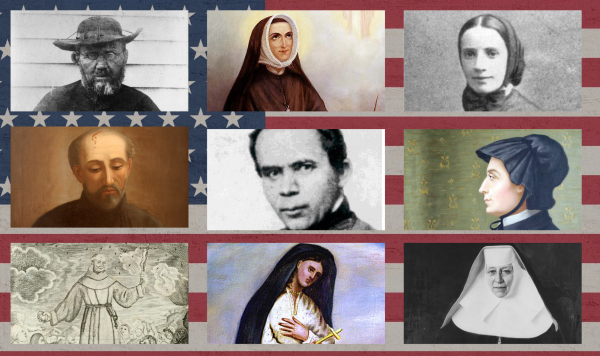
PROSPECT HEIGHTS — With the nation’s 250th birthday fast approaching, Catholics can mark the occasion by reflecting on the contributions of American saints.
According to the U.S. Conference of Catholic Bishops (USCCB), there are 11 American saints.
The USCCB counts those who were American-born, naturalized Americans, or missionaries who served in the U.S. or its territories.
The list includes well-known names like Sts. Frances Xavier Cabrini, Elizabeth Ann Seton, Katharine Drexel, Junípero Serra, Kateri Tekakwitha, and John Neumann.
Others are Sts. Marianne Cope, Damien de Veuster of Molokai, Théodore Guérin, Isaac Jogues, and Rose Philippine Duchesne.
St. Frances Xavier Cabrini (1850-1917), who was canonized in 1946, is the first naturalized U.S. citizen to become a saint. She was born in Italy and became an American citizen in 1909.
St. Elizabeth Ann Seton (1774-1821) is the first saint born in the United States. She was born in New York City, two years before the Declaration of Independence.
RELATED: Seeking Saints Helped U.S. Catholics Become More American
The most recently canonized American saint is St. Junípero Serra, a missionary whose canonization took place in 2015.
Overall, sainthood for an American is “a very recent phenomenon,” said Kathleen Cummings, a history professor at the University of Notre Dame and author of “A Saint of Our Own: How the Quest for a Holy Hero Helped Catholics Become American.”
“One of the reasons the United States didn’t have a saint for a long time is because they had so little wealth and influence in Rome,” explained Cummings. “You actually needed that to move a cause forward.”

But in the 19th century, Catholics started to develop a desire to see American saints.
“What a cause for canonization does is to affirm someone’s holiness. It also affirms that holiness can exist in particular times and places.
And people started to say, ‘We want a saint who lived on our land and walked where we walked,’ ” Cummings explained. “It was a way to validate themselves in the eyes of the universal Church and prove that holiness was incarnate on
American soil.”
By gathering evidence of someone’s holiness, “they were also gathering evidence of their own relevance,” Cummings added.
The path to sainthood differed for St. Frances Cabrini and St. Elizabeth Ann Seton.
St. Frances Cabrini was canonized in 1946, less than 30 years after her death in 1917, when supporters first proposed sainthood for her. St. Elizabeth Ann Seton, on the other hand, had a longer road to sainthood.
“Seaton’s cause was first proposed in 1882, and it took a really long time,” Cummings said.
It wasn’t until 1940 that her cause for sainthood was officially opened, and it took another 35 years after that for her to become a saint in 1975.
One saint whose journey to sainthood was relatively quick was St. Katharine Drexel (1858-1955), a native of Philadelphia who founded the Sisters of the Blessed Sacrament. Her cause for canonization opened in 1964, nine years after her death. She was canonized in 2000.
“It wasn’t too long. That had a lot to do with Philadelphia and the cardinal there, Cardinal (John) Krol, who really pushed for it,” Cummings said.
Canonization can be a complicated process, often fraught with drama, she noted.
“Canonization is about holiness, but it isn’t just about holiness. And it interacts with what Catholics think is important at any given time,” she explained.
However long or short the road to sainthood, it doesn’t diminish the holiness of the saints, Cummings added: “I think it magnifies it because holiness shines through all the politicking.”