“I made it out of captivity because of my mother’s prayers to God.”
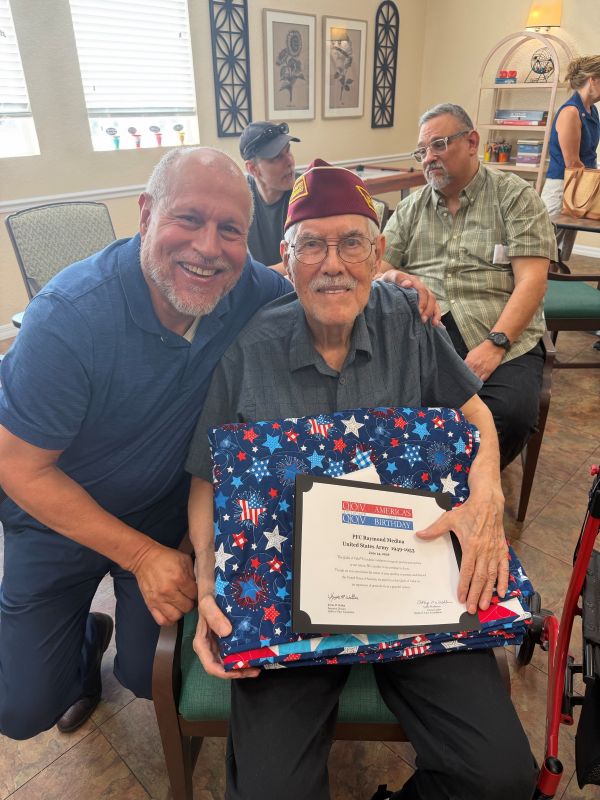
At 100 years old, Raymond Medina credits his survival as a prisoner of war in Korea — and his eventual return to New York City — to his family’s Pentecostal faith.
“Yes, I was with the Borinqueneers in Korea,” he told The Tablet on Oct. 27, four days shy of his 100th birthday. A native New Yorker who was drafted while visiting Puerto Rico, Medina served with Company A of the 65th Infantry Regiment — the Borinqueneers — from 1950 to 1953.
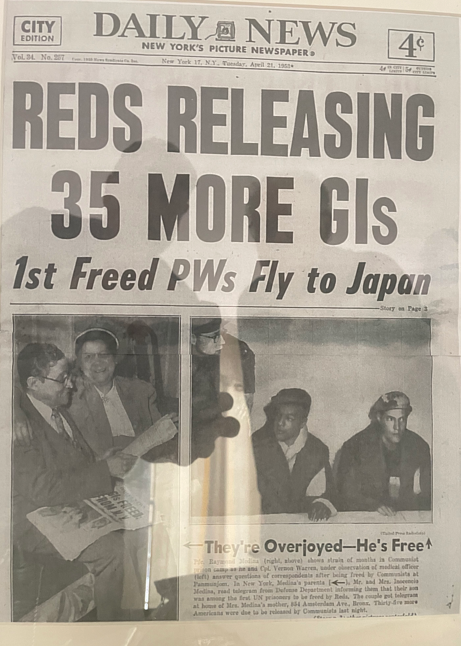
Today he lives in Florida. His Protestant pastor, Jaime Fret, a fellow U.S. Army veteran, noted that Medina still vividly recalls those prayers as his saving grace.
“During the Korean War, just like many of his fellow soldiers, he would go to chapel predominantly, at that time, of Catholic Faith,” Fret said. “He knew his mother was very devoted to God, along with his father. They lifted up prayers in their home, their family, and neighbors, but especially in church.”
Medina’s testimony opens a window onto a larger story of a very religious — especially Catholic — and predominantly Puerto Rican regiment.
Established on March 2, 1899, the U.S. Congress authorized the creation of the first indigenous Puerto Rican military unit: The Porto Rico Regiment of Volunteer Infantry.
The year prior, the island had been ceded to the United States by Spain under the Treaty of Paris following the Spanish-American War. After the U.S. assumed control of the island in 1898, the existing Spanish colonial unit was reorganized and redesignated as the 65th Infantry Regiment of Puerto Rico for World War I service.
By the start of the Korean War in 1950, the group was known as “The Borinqueneers,” named after “Borinquen,” the indigenous Taíno name for the island of Puerto Rico.
Roughly 61,000 to 65,000 Puerto Rican service members would pass through the 65th Infantry Regiment between 1914 and 1953. In 1953, the Army reconstituted the 65th as a fully integrated infantry regiment.
Faith on the Frontlines
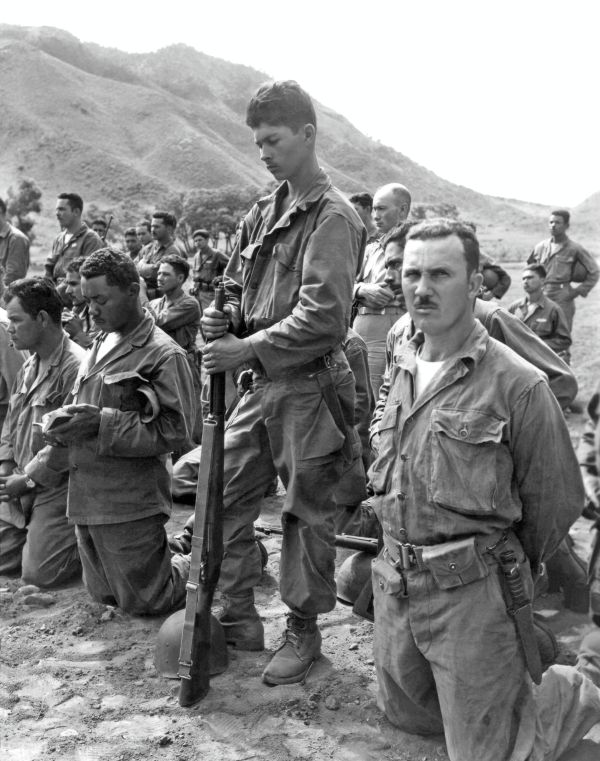
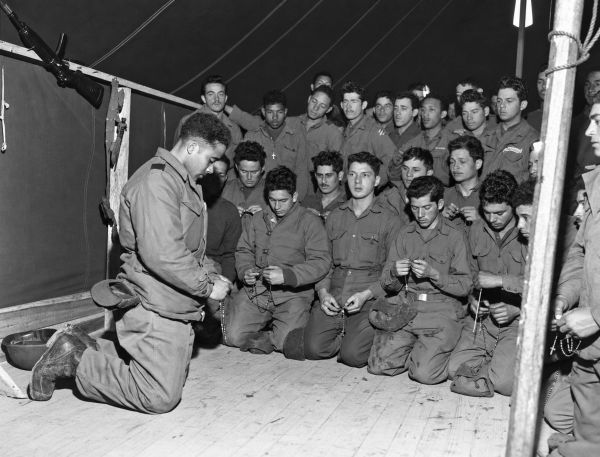
Religion was not peripheral to the Borinqueneers; it was central to their daily endurance.
According to an April 12, 1952, article in Stars and Stripes, the U.S. military’s own newspaper, about 90% of the regiment’s soldiers were Catholic at the time of the Korean War.
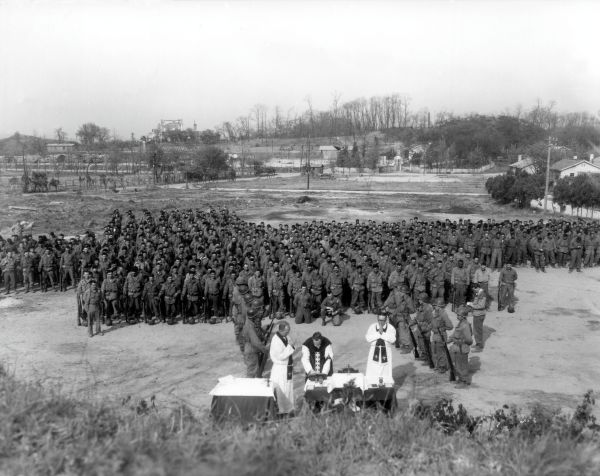
On Sundays, only the most essential duties kept men from Mass, which many regarded as the high point of the week. Soldiers often assembled early and waited for the priest.
At night, they gathered to pray, frequently asking for the intercession of Our Lady of Guadalupe, the regiment’s patron saint. Many wore rosaries, medals, and scapulars, and displayed sacred pictures from home on bunker walls.
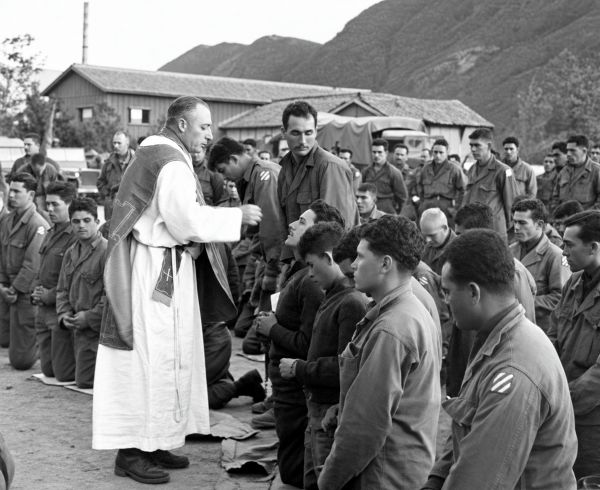
The report notes that the 65th’s regimental Catholic chaplain, Maj. John C. Brucker, received roughly three times as many personal visits as chaplains in other units under combat conditions.
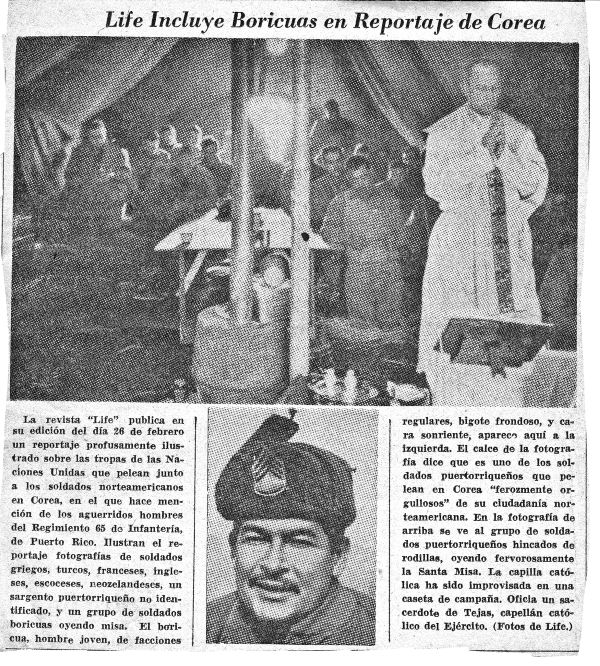
“I interviewed a veteran who told me that before every battle, they used to have a Mass,” Noemi Figueroa Soulet, producer and director of the award-winning PBS documentary “The Borinqueneers” and a descendant of regiment members, told The Tablet.
“Religion played a more important role probably than the typical soldier, and that’s something that’s unique to the Borinqueneers.”
Figueroa Soulet highlighted one veteran’s story in particular: A soldier who was holding a dying comrade and later found a letter and an “escapulario” (scapular) in the man’s shirt pocket, sent by the fallen soldier’s mother.
“He saw that as a sign,” she said. “And he kept that escapulario.”
The survivor kept it in his wallet until he died in 2025.
Figueroa Soulet also described the chaplains’ special place among the men.
“They were their father figure,” she explained. “It’s undeniable the role that religion played for these soldiers. It is a part of their makeup that you just cannot ignore.”
A Puerto Rican Legacy
The regiment’s story is inseparable from Puerto Rico’s complex relationship with the United States. Tony Mele, a descendant of Borinqueneers, an Army veteran, and an honorary member of the regiment, carefully follows that connection as chairman of the 65th Infantry Honor Task Force.
Inspired by his own family’s lineage — he discovered his great-grandfather was a founding member of both the regiment and its retired association — Mele proposed a formal task force, which was chartered in September 2000.
“All we’re supposed to do is protect their reputation, protect their honor, and retell their acts of bravery, loyalty, and brotherhood to each other,” he told The Tablet. “It’s an American story of Americans who happen to be Puerto Rican.”
In her work, Figueroa Soulet analyzes the distinctive experiences of the Puerto Rican soldiers. “Even though they’re U.S. citizens, if a war starts, they can draft them,” she explained. “And that did happen in World War I, World War II, and Korea … But you’re a colony with unequal rights in terms of you can’t vote for the commander-in-chief that sends you.
“They’re drafted. They don’t speak the language. It’s a different language than the Army. It’s a different culture. And then they’re sent to fight in another country with a different language and another culture.”
Yet the regiment’s service, she said, belongs to the broader American narrative.
“It is our American history, it is Puerto Rican history, and they are heroes,” Figueroa Soulet said.
Mele’s task force has honored veterans of the 65th with street renamings, plaques, and memorials across the U.S. and Puerto Rico — from New York to San Juan and the Tomb of the Unknown Soldier in Arlington, Virginia.
A Universal Brotherhood
Although the 65th was predominantly Puerto Rican, it never closed its ranks. According to Mele, combat realities created a broader fraternity.
“Like any other National Guard or state unit, it was composed of the people from that place,” Mele explained. “If it was the National Guard from Texas, it would be Texans; from New York it would be New Yorkers.”
When units fell below strength, replacements arrived from across the Army. “You’ll see names like Horowitz, Steinberg, Jones, Jackson, Brown,” he noted. “As far as soldiers are concerned, as long as they wore the Borinqueneers identity patch on their shoulder, they’re Borinqueneers. Plain and simple.”