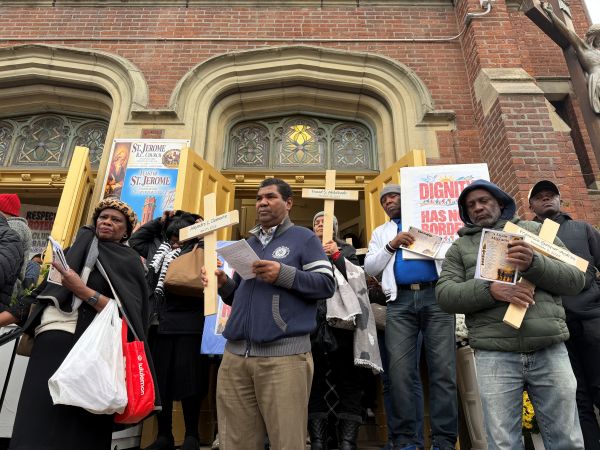


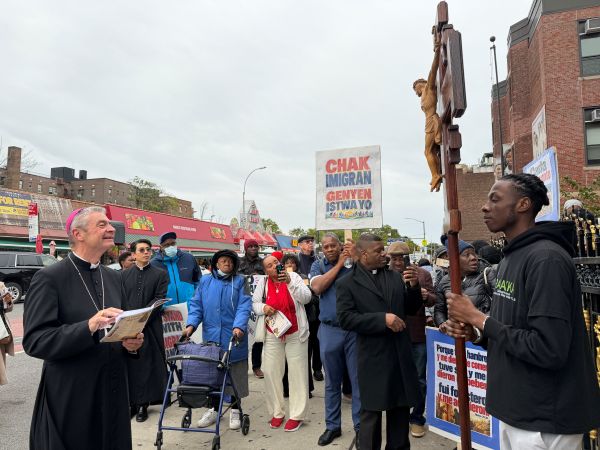
EAST FLATBUSH — Led by Bishop Robert Brennan, hundreds of the faithful took to the streets on Oct. 17 for a prayerful procession to show solidarity with the plight of Haitian migrants caught in turbulent political waters and facing deportation.
Called “Stations of the Cross for Migrant Dignity,” the procession began at St. Jerome Church in East Flatbush (a parish with a large Haitian population) and proceeded to two other local churches — St. Thérèse of Lisieux and St. Vincent Ferrer.
“This is really about two things — accompaniment and solidarity,” Bishop Brennan told The Tablet. “All of us are here spiritually accompanying those who cannot make this journey because of fear and who live to not draw attention to themselves. “We are walking together for the dignity of all migrants and for human dignity.”
RELATED: USCCB Migration Chair’s Brooklyn Visit Brings Message of Hope to Haitians
Concern for the well-being of migrants, particularly Haitian migrants who fled the island nation because of its poverty and gang violence, was heightened by a decision the U.S. Department of Homeland Security (DHS) announced on July 29 to revoke Temporary Protected Status (TPS) for hundreds of thousands of Haitians living in America.
Under TPS, immigrants from certain countries are permitted to remain in the U.S. because conditions in their home countries have deteriorated to the point where it is unsafe for them to return. In its July 29 announcement, DHS stated that “Haiti no longer met the conditions for its designation.”
According to Global Refugee, an estimated 350,000 Haitians could be forced to leave the U.S. as a result of the loss of TPS.
“It was unfair to target TPS because it’s been up since the 1990s. I don’t understand why it was cut,” said Ronald Paul, a parishioner of St. Jerome Church. “I am here to stand with the migrants and to show them I care.”
Another St. Jerome parishioner, Gladys Chaubet, who came to the U.S. from Haiti in 1980, said it was important to show support for people with uncertain immigration status.
“Haitians do not deserve this,” she said. “Economically, we have contributed to America. We work hard. Many are in hospitals as nurses and physicians. A lot of people work in health care. We pay taxes.”
The procession took place three weeks after the Catholic Church observed the 112th World Day of Migrants and Refugees. In a message on Sept. 27 to mark the occasion, Pope Leo XIV expressed concern for the safety of children and adolescents “who are forced to leave their homeland because of war, poverty, violence, environmental disasters, and other tragedies.”
During Mass, which Bishop Brennan celebrated at St. Jerome Church prior to the procession, he blessed 60 wooden crosses for participants to carry, each bearing the name of someone who has died in detention centers since 2024.
The procession echoed the Stations of the Cross, with participants stopping at each church to pray and reflect on Jesus Christ’s journey to his crucifixion at Calvary. At each of the 14 stations, Bishop Brennan offered prayer intentions for migrants who have suffered indignities and injustice, parents and children who have been separated, medical and social workers affected by the expiration of TPS, and those held in detention centers.
“We’re walking with Jesus Christ because he came to walk the journey with us,” Bishop Brennan said. “We firmly believe that he did not walk that journey once, but that he walks that journey with us today.”