

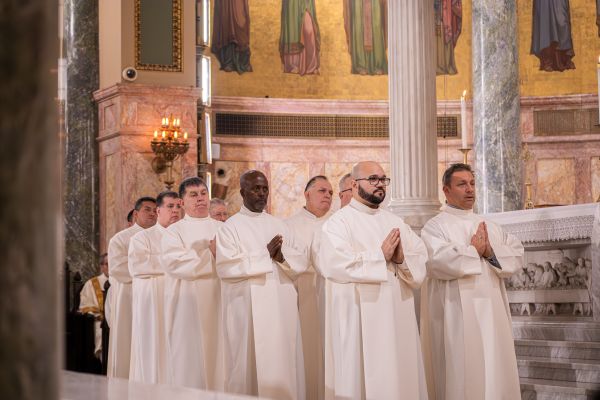
WINDSOR TERRACE — Future ordinations of permanent deacons in the Diocese of Brooklyn are expected to keep pace with deacons aging out of their active ministries, said Father Joseph Gibino, director of the diaconate.
According to information from the diocese, there are 202 permanent deacons in Brooklyn and Queens, 140 of whom are actively serving, with the remaining 62 in a “senior” deacon status.
Meanwhile, five-year deacon-formation classes locally are filled with the desired number of candidates who must meet requirements set by the Church. However, according to Father Gibino, the diocese is a trendsetter in deacon formation.
“Our requirements are a little more strict than some others, but we still are getting 12 to 15 in the class,” he said. “So, we’re doing quite well in terms of the diaconate.”
To enter diaconate formation in the diocese, a man must be a fully initiated member of the Church, married in the Church for at least five years, between the ages of 35 and 60, and be financially stable, among other requirements.
RELATED: Brooklyn Bishop Robert Brennan Ordains 11 New Members to Permanent Diaconate
Once ordained, permanent deacons can preach the Gospel, baptize, witness marriages, preside at funeral and burial rites, and lead certain liturgical celebrations. They can’t, however, celebrate Mass, consecrate the Eucharist, anoint the sick, or hear confessions.
Permanent deacons also differ from “transitional” deacons who are seminarians serving the final year of formation prior to their ordination into the priesthood.
In May, the Center for Applied Research in the Apostolate (CARA) at Georgetown University and the United States Conference of Catholic Bishops jointly reported that an all-time high was recorded in the total number of permanent deacons in the U.S. — 21,562 of them.
The report noted that of these deacons, 14,879 (69%) are actively serving, including the 570 men ordained in 2025, 11 of whom were from the Diocese of Brooklyn. But further analyses in media reports noted there is a possibility that the record-high could be offset by annual retirements and deaths.
Still, Father Gibino and Deacon George Velez, coordinator of clergy personnel, expressed confidence in the diocese’s current pace of ordinations.
Father Gibino explained that class sizes are set based on the available resources — including seminary faculty and priestly “mentors” — needed to train and educate the candidates. The ordinations are usually held every other year in the spring or fall.
“So, right now, we have two classes,” Father Gibino said, noting that there’s a Class of 2027 and a Class of 2030. “And then, we will begin the interview process this fall for those who would be the Class of 2032.”
Deacon Velez added that the class sizes do not represent the number of men who want to become deacons.
“The 13 to 15 — that’s not how many men are applying,” Deacon Velez said. “It’s how many men are being accepted.”
Not everyone who applies comes in, at least not on their first try, which is what happened to him. “I think what’s happening in the Diocese of Brooklyn is that the scrutiny is getting better,” Deacon Velez said.
Father Gibino agreed.
“We have a rather well-thought-out program,” he said, “and we’ve added some things that other dioceses have not.”
For example, Father Gibino said the diocese prefers to have deacons with children to begin formation when their kids are teenagers to alleviate concerns about childcare and early child development. Deacon Velez offered his story as a “case in point.”
He first applied for the diaconate in 2005 when he was seven years married with five children, from a newborn to age 6. “They said, ‘You have a primary responsibility of being a husband and father, and because they’re so young, it would be wrong for us to pull you away from the family,’ ” he recalled.
His second try was in 2017, at which time he succeeded. “At that time,” he said, “all my children were much older.”
Father Gibino noted that exceptions are sometimes made for candidates and their wives who can demonstrate that their childcare issues are adequately covered.
“We take that really seriously, that children have real needs, and we need to be cognizant of those needs,” Father Gibino said.
The Diocese of Brooklyn has also added a requirement that candidates have at least a bachelor’s degree when applying to the program, so they can proceed with their graduate degree pursuits.
Father Gibino noted that if their undergraduate work lacks coursework in theology or philosophy, “we can fill in those pieces.”
“But,” he added, “they need to be able to move into a graduate theological program.”
Father Gibino said the language skills of the diaconate reflect the cultural diversity of the “Diocese of Immigrants.”
“We have the United Nations in our diaconate,” he said. “Right now, in formation we have deacons who speak Lithuanian, Polish, Spanish, Chinese, Haitian (Creole), Italian, and English.”
Still, the ability to speak English is a requirement for entering the formation program. “We cannot teach or form in all these different languages,” Father Gibino explained. “We can get a spiritual director or a mentor, but it is impossible because we’re paired with St. Joseph Seminary, and there are limitations of resources.”
Deacon Velez estimated that about a third of the current deacons speak Spanish, which is a unique distinction for the diocese. Its deacons include men of diverse heritages from countries throughout Latin America, such as Mexico, Colombia, Guatemala, Peru, Ecuador, and Nicaragua. Deacon Velez added that the diocaonate also includes speakers of French, Mandarin, Cantonese, Korean, and Tagalog, to name a few.
Father Gibino also noted that while some deacons are older, they can still serve.
According to the USCCB, permanent deacons are expected to step down from formal, full-time administrative and parish assignments at age 75.
But they can also enter “senior deacon” status, which allows them to continue assisting with the permissions of their pastor and the bishop.
Father Gibino indicated that more requirements might be added in the future.
“Each year, as we do the end-of-the-year review, we find more areas that we probably need to work on,” he said. “That’s the caveat I always like to give.
“As good as I think our program is, there’s always room for improvement.”