


A surge in immigration fraud has overwhelmed legal aid organizations, doubled federal complaint filings, and, in at least one documented case, led directly to deportation.
The Federal Trade Commission, the agency responsible for consumer protection and preventing anticompetitive business practices, said the number of reported immigration scams more than doubled from 613 in 2023 to 1,291 in 2024.
In 2025, it got even worse, with almost 2,000 complaints and at least $94.4 million stolen from immigrants. Experts said the number could be higher, as many immigrants don’t report fraud out of a fear of deportation.
“Over the last 6 to 9 months, we have been experiencing an increase of reports that there are people impersonating both Catholic migration services staff and staff from our affiliate agency, Catholic Charities Brooklyn and Queens, and Catholic Charities agencies throughout the country,” Magdalena Barbosa, director of legal services for the Diocese of Brooklyn-based Catholic Migration Services, told The Tablet.
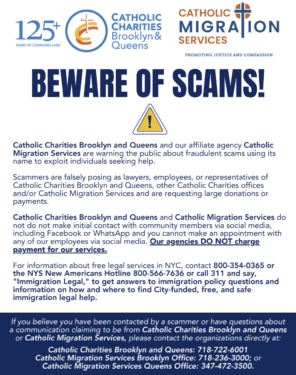
Catholic Charities Brooklyn and Queens have posted a flier on its website warning immigrants about the increase of fraudulent scams targeting immigrants.
RELATED: Invoking Mother Cabrini, Bishops Call For ‘Christian Charity’ on Immigration
“Scammers are falsely posing as lawyers, employees, or representatives of Catholic Charities Brooklyn and Queens, other Catholic Charities offices, and/or Catholic Migration Services and are requesting large donations or payments,” the flier states.
“Catholic Charities Brooklyn and Queens and Catholic Migration Services do not make initial contact with community members via social media, including Facebook or WhatsApp, and you cannot make an appointment with any of our employees via social media.”
“Our agencies DO NOT charge payment for our services,” it continues.
On Feb. 20, five people were prosecuted “with wire fraud conspiracy, wire fraud, money laundering conspiracy, and two counts of false impersonation of an officer or employee of the United States,” according to a press release from the US Attorney’s Office for the Eastern District of New York.
The alleged scammers staged fake immigration court proceedings via video calls, wearing judicial robes and law enforcement uniforms in front of courtroom-like backgrounds with official agency seals and flags. They also used forged documents bearing U.S. government symbols and collected victims’ personal information during the fake hearings.
In some cases, they falsely told victims their immigration cases had been resolved — causing them to miss their real court dates. At least one victim was ordered deported as a result, though that order was later reversed.
“In total, the investigation has identified over $100,000 in fraudulent transactions transmitted by victims to the defendants and other individuals associated with the fake CM Bufete De Abogados Consultoria Migratoria law firm,” a press release said.
With increased deportation enforcement, shifting immigration policies, and heightened rhetoric targeting immigrant communities, Barbosa said the current political climate has made immigrants especially susceptible to these scams.
“We have a lot of desperate people out there,” she said. “People are looking for help, and they’re looking for legal assistance, and, like many people do nowadays, they often go to social media to get answers.”
Scammers create fake Facebook pages and paid advertisements mimicking the logos and branding of well-known legal aid organizations like Catholic Charities, then lure immigrants into conversations through Facebook Messenger and WhatsApp, she explained. Once contact is made, the scheme escalates to fake consultations, forged documents, and staged court proceedings.
Barbosa recalled speaking with a man who had been scammed three separate times by fraudsters on social media.
“I had to tell him, ‘This is a real organization. Next time you have questions or any legal issue, come directly to our storefront,’ ” she recalled. “ ‘Don’t try to get legal assistance from social media.’ ”
Catholic Migration Services has retained a law firm and worked with platforms to remove fraudulent Facebook and Instagram posts misusing its branding.
But Barbosa acknowledged the challenge of keeping up.
“Almost every week I’m regularly hearing of new scams,” she said. “Either individuals who come to us saying they were previously scammed and are looking for a real attorney, or people who reach out saying, ‘Hey, you told me you were going to be representing me — where are you?’ — and when we ask additional questions, we find out this is not a client of ours. We’ve never had any contact with this person.”
Barbosa’s advice: Do not seek immigration legal services through social media. Instead, reach out to organizations through their official websites, call their published phone numbers, or visit their physical offices. Agencies like Catholic Migration Services and Catholic Charities do not charge for their services — and any request for fees should immediately raise a red flag.
“Whenever somebody starts talking about a fee,” she said, “be very careful and try to verify the identity of the individual you’re talking with.”
For more information, visit the website for Catholic Migration Services.