

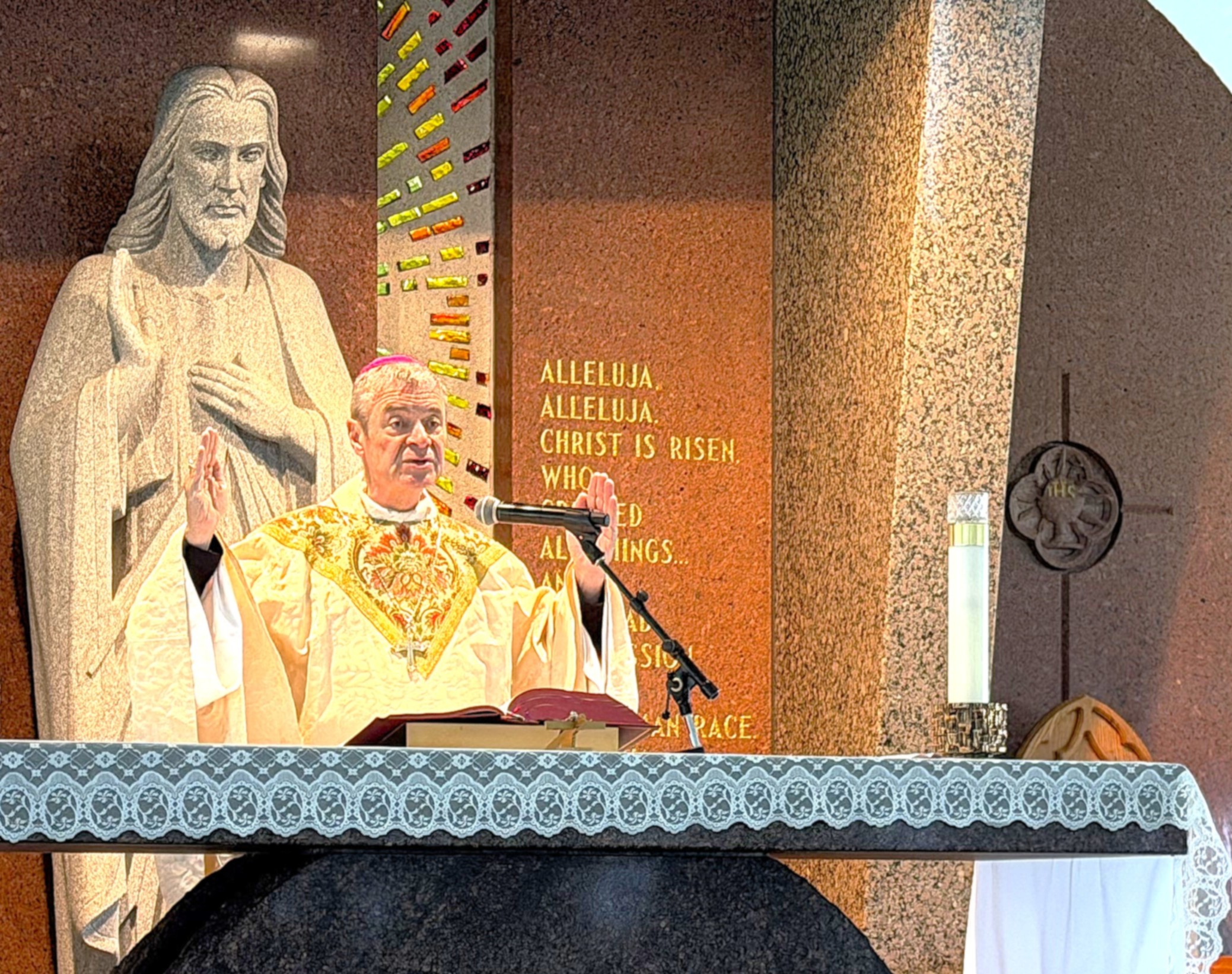
FARMINGDALE — Human dignity, peace, justice, love, war, plus some notes on Pope Leo XIV’s new encyclical on artificial intelligence, were recurring themes in Bishop Robert Brennan’s comments on May 25 during a Memorial Day field Mass.
More than 250 people attended the Mass at St. Charles/Resurrection Cemeteries in Farmingdale on Long Island.
Bishop Brennan celebrated the Mass on Memorial Day to honor all U.S. service members who died defending the nation.
“Remembering those who have made the ultimate sacrifice of their lives for the cause of peace and justice,” Bishop Brennan said during the homily. “We pray fervently for those who are in harm’s way, that serving with dignity and honor, they might be protected.”
Field Masses, which are hosted each year by the diocesan Catholic Cemeteries Office, were also celebrated at St. John Cemetery, Middle Village; Holy Cross Cemetery, Flatbush; and Mount St. Mary Cemetery, Flushing.
Bishop Brennan also offered prayers for innocent people “caught in the crosshairs of war and violence all around the world.”
“We ask God,” he continued, “to make of us, true instruments of his peace.”
The homily also touched on aspects of human dignity in the first encyclical letter of Pope Leo XIV. The letter — titled, “Magnifica Humanitas (Magnificent Humanity), On the Protection of the Human Person in the Age of Artificial Intelligence” — was signed May 15 and published on May 25.
In it, the Holy Father warns that “the use of AI is never a purely technical matter.”
“When it enters processes that affect people’s lives,” he continued, “it touches on rights, opportunities, status and freedom.”
Pope Leo added that important decisions concerning employment, credit, access to public services, or reputations, “risk being fully delegated to automated systems” that do not know “compassion, mercy, forgiveness, and above all, the hope that people are able to change.”
RELATED: 13 Things To Know About Pope Leo XIV’s Encyclical on AI
He also noted that AI used in war could place the responsibility for life-and-death decisions into “automated systems.”
“No algorithm,” Pope Leo wrote, “can make war morally acceptable.”
Bishop Brennan likened AI to the ancient people’s attempt to build the Tower of Babel “to reach the heavens and unseat God.”
“Well,” he said, “we know how that worked out. This was not just idolatry, worshipping their own work over God, it was also a gross misunderstanding of human dignity — of the magnificence of being human.
“Pope Leo calls on us to be builders of communion, not architects of Babel, so that humanity may not lose its magnificence and the world may recognize, in the human heart, the place where God wishes to dwell.”
Bishop Brennan blessed pins that were distributed at the end of the Mass, recognizing the commitment of the four Catholic Cemeteries of Brooklyn and Queens to honor the nation’s citizens who died in war.
Before the final blessing, Msgr. Michael Reid, CEO of Catholic Cemeteries of Brooklyn and Queens, offered remarks and led those gathered in a prayer for the United States before the closing song, “America the Beautiful,” was played.