


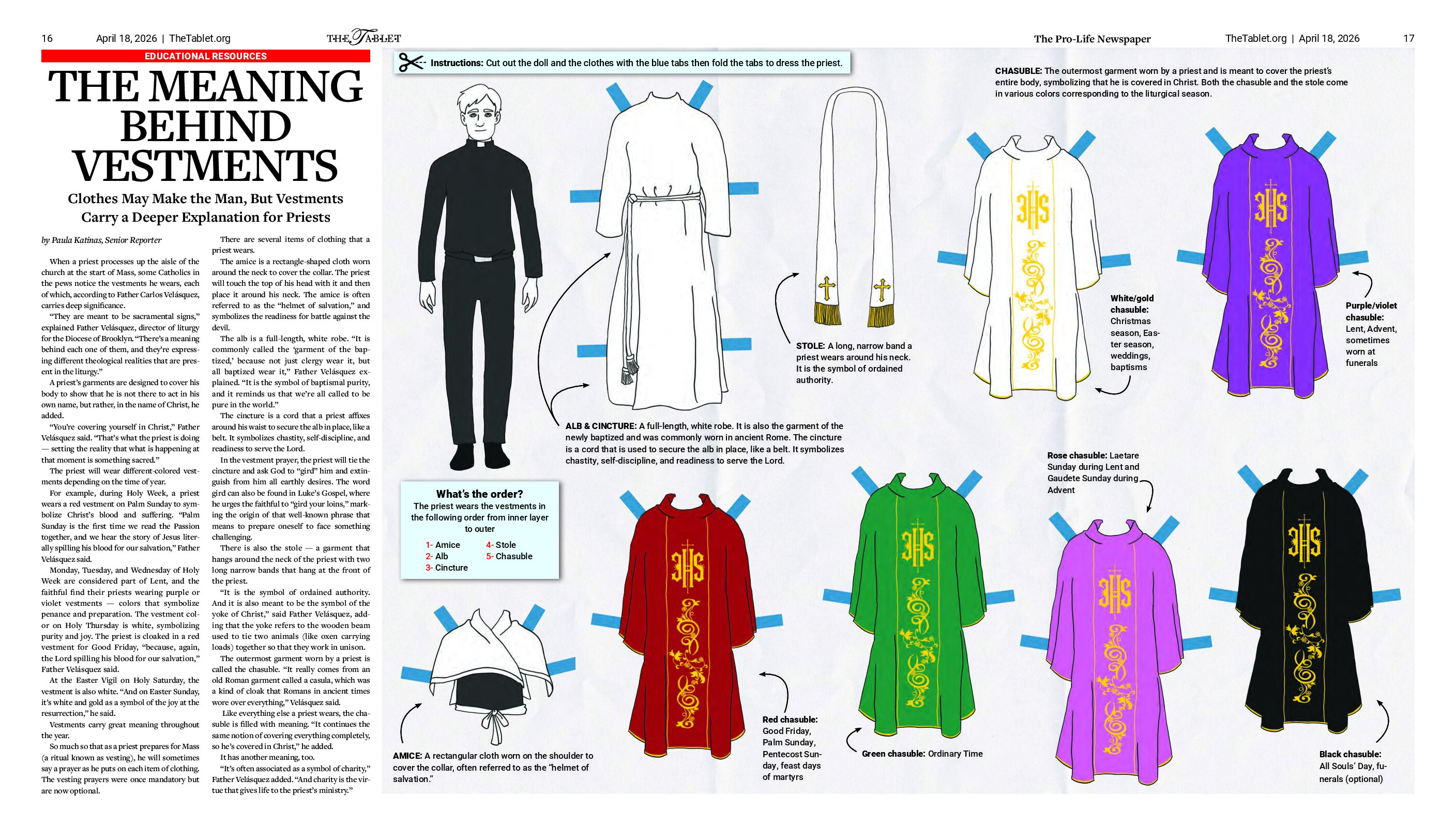
CLICK HERE TO VIEW FULL CENTERFOLD FROM THE APRIL 18, 2026 EDITION OF THE TABLET
When a priest processes up the aisle of the church at the start of Mass, some Catholics in the pews notice the vestments he wears, each of which, according to Father Carlos Velásquez, carries deep significance.
“They are meant to be sacramental signs,” explained Father Velásquez, director of liturgy for the Diocese of Brooklyn. “There’s a meaning behind each one of them, and they’re expressing different theological realities that are present in the liturgy.”
A priest’s garments are designed to cover his body to show that he is not there to act in his own name, but rather, in the name of Christ, he added.
“You’re covering yourself in Christ,” Father Velásquez said. “That’s what the priest is doing — setting the reality that what is happening at that moment is something sacred.”
The priest will wear different-colored vestments depending on the time of year.
For example, during Holy Week, a priest wears a red vestment on Palm Sunday to symbolize Christ’s blood and suffering. “Palm Sunday is the first time we read the Passion together, and we hear the story of Jesus literally spilling his blood for our salvation,” Father Velásquez said.
Monday, Tuesday, and Wednesday of Holy Week are considered part of Lent, and the faithful find their priests wearing purple or violet vestments — colors that symbolize penance and preparation. The vestment color on Holy Thursday is white, symbolizing purity and joy. The priest is cloaked in a red vestment for Good Friday, “because, again, the Lord spilling his blood for our salvation,” Father Velásquez said.
At the Easter Vigil on Holy Saturday, the vestment is also white. “And on Easter Sunday, it’s white and gold as a symbol of the joy at the resurrection,” he said.
Vestments carry great meaning throughout the year.
So much so that as a priest prepares for Mass (a ritual known as vesting), he will sometimes say a prayer as he puts on each item of clothing. The vesting prayers were once mandatory but are now optional.
There are several items of clothing that a priest wears.
The amice is a rectangle-shaped cloth worn around the neck to cover the collar. The priest will touch the top of his head with it and then place it around his neck. The amice is often referred to as the “helmet of salvation,” and symbolizes the readiness for battle against the devil.
The alb is a full-length, white robe. “It is commonly called the ‘garment of the baptized,’ because not just clergy wear it, but all baptized wear it,” Father Velásquez explained. “It is the symbol of baptismal purity, and it reminds us that we’re all called to be pure in the world.”
The cincture is a cord that a priest affixes around his waist to secure the alb in place, like a belt. It symbolizes chastity, self-discipline, and readiness to serve the Lord.
In the vestment prayer, the priest will tie the cincture and ask God to “gird” him and extinguish from him all earthly desires. The word gird can also be found in Luke’s Gospel, where he urges the faithful to “gird your loins,” marking the origin of that well-known phrase that means to prepare oneself to face something challenging.
There is also the stole — a garment that hangs around the neck of the priest with two long narrow bands that hang at the front of the priest.
“It is the symbol of ordained authority. And it is also meant to be the symbol of the yoke of Christ,” said Father Velásquez, adding that the yoke refers to the wooden beam used to tie two animals (like oxen carrying loads) together so that they work in unison.
The outermost garment worn by a priest is called the chasuble. “It really comes from an old Roman garment called a casula, which was a kind of cloak that Romans in ancient times wore over everything,” Velásquez said.
Like everything else a priest wears, the chasuble is filled with meaning. “It continues the same notion of covering everything completely, so he’s covered in Christ,” he added.
It has another meaning, too.
“It’s often associated as a symbol of charity,” Father Velásquez added. “And charity is the virtue that gives life to the priest’s ministry.”