


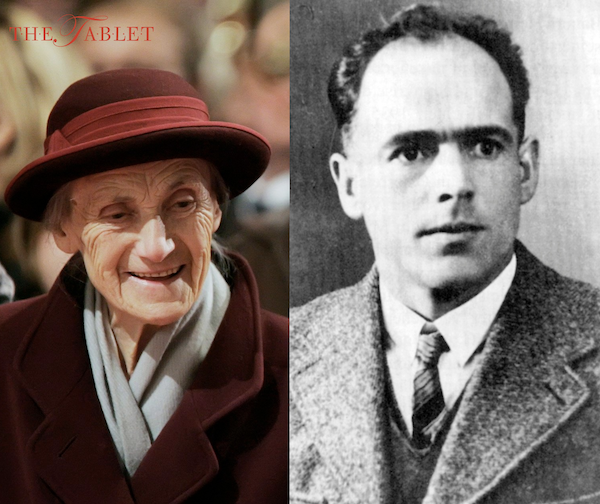
CHELSEA — Auxiliary Bishop James Massa said he first encountered the witness of Blessed Franz Jägerstätter as a student at Boston College, when he met Gordon Zahn, author of “In Solitary Witness,” which details the life and death of the Austrian farmer.
“I read the book, and I went to hear him give a lecture about Franz Jägerstätter,” Bishop Massa recalled. “I was just so taken by this idea of someone following their conscience because they heard the voice of God. It was one of the most important books I’ve ever read.”
That witness continues to resonate today.
On Feb. 14, the New York Encounter, an annual three-day cultural event hosted in New York City, will host “There is No Greater Love: The Journey to Holiness of Franz and Franziska Jägerstätter,” an exhibit tracing the spiritual journey of the Austrian couple whose Catholic faith shaped their lives.
Born May 20, 1907, in St. Radegund, Upper Austria, Jägerstätter was a farmer, husband, and father of three daughters. After marrying Franziska in 1936, his faith deepened through Mass and service as a parish sacristan. As Nazism rose, he became convinced the regime threatened human dignity and the Church.
Maggie Tobin, a senior at Benedictine College in Atchison, Kansas, and one of the exhibit collaborators, said in a statement that studying Franz’s life challenged her own approach to political and moral questions.
“Franz’s witness is showing me a different path,” Tobin said. “Such freedom did not come from himself — it came to him from Christ, in company with his wife.”
The exhibit is the brainchild of Communion and Liberation University (CLU) students, a network of university students on campuses across the United States and Canada who belong to the Catholic Communion and Liberation movement.
Their work began with studying the Jägerstätters’ lives and hosting a public screening of “A Hidden Life,” a 2019 movie on the couple, at Benedictine College in Atchison, before expanding into a shared effort to prepare the exhibit panels. “The more we learned about Franz and Franziska, the more we realized how human they were, and how their simplicity became extraordinary,” Veronica Vato, a student member of the CLU, told The Tablet.
On March 12, 1938, came the annexation of Austria into Nazi Germany, known as the 1938 Anschluss, in which Franz was the only local citizen to vote against it. He was also called into military service twice in 1940 and 1941, but thanks to his mayor’s intervention, he was permitted to return home both times.
In February 1943, Franz was called to take up arms again and, this time, presented himself at an induction center on March 1, 1943, to announce his refusal to fight. He decided that participating in the war under the Nazi regime was a grave moral wrong incompatible with his Christian conscience. He even offered to perform non-combatant service — a request that was denied.
He was arrested, tried, and on July 6, 1943, was condemned to death for sedition.
While imprisoned at Berlin-Tegel, Bishop Massa explained that Jägerstätter famously rejected a copy of the New Testament given to him by a prison chaplain.
RELATED: Monsignor Andrew Landi’s Legacy ‘Nuanced’ for Global War Relief Efforts, Adoption Program
“The prison chaplain was just struck by Franz’s peaceful character and offered him a Bible,” Bishop Massa said. “And he said this in response: ‘I am completely bound in inner union with the Lord, and any reading would only interrupt my communion with my God.’ ”
On Aug. 9, 1943, at age 36, Franz was executed. On Oct. 26, 2007, Franz was beatified by Pope Benedict XVI, earning him the title of Blessed, with his children and his wife, then 94, in attendance. That day, Franziska became the only woman in Church history to witness the beatification of her husband.
Although his fidelity to the Lord was recognized by the Church years after his death, it was already clear in a letter he wrote to his family while in prison. “Neither prison nor chains nor sentence of death can rob a man of the faith and his free will,” Franz wrote. “God gives so much strength that it is possible to bear any suffering.”