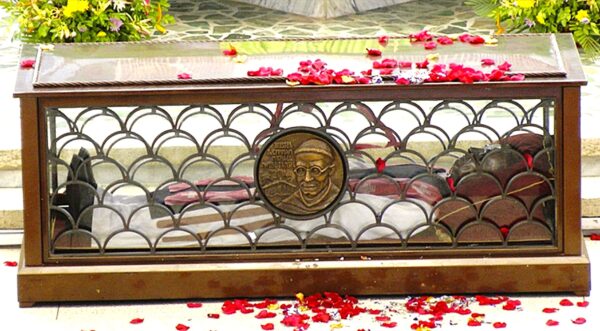


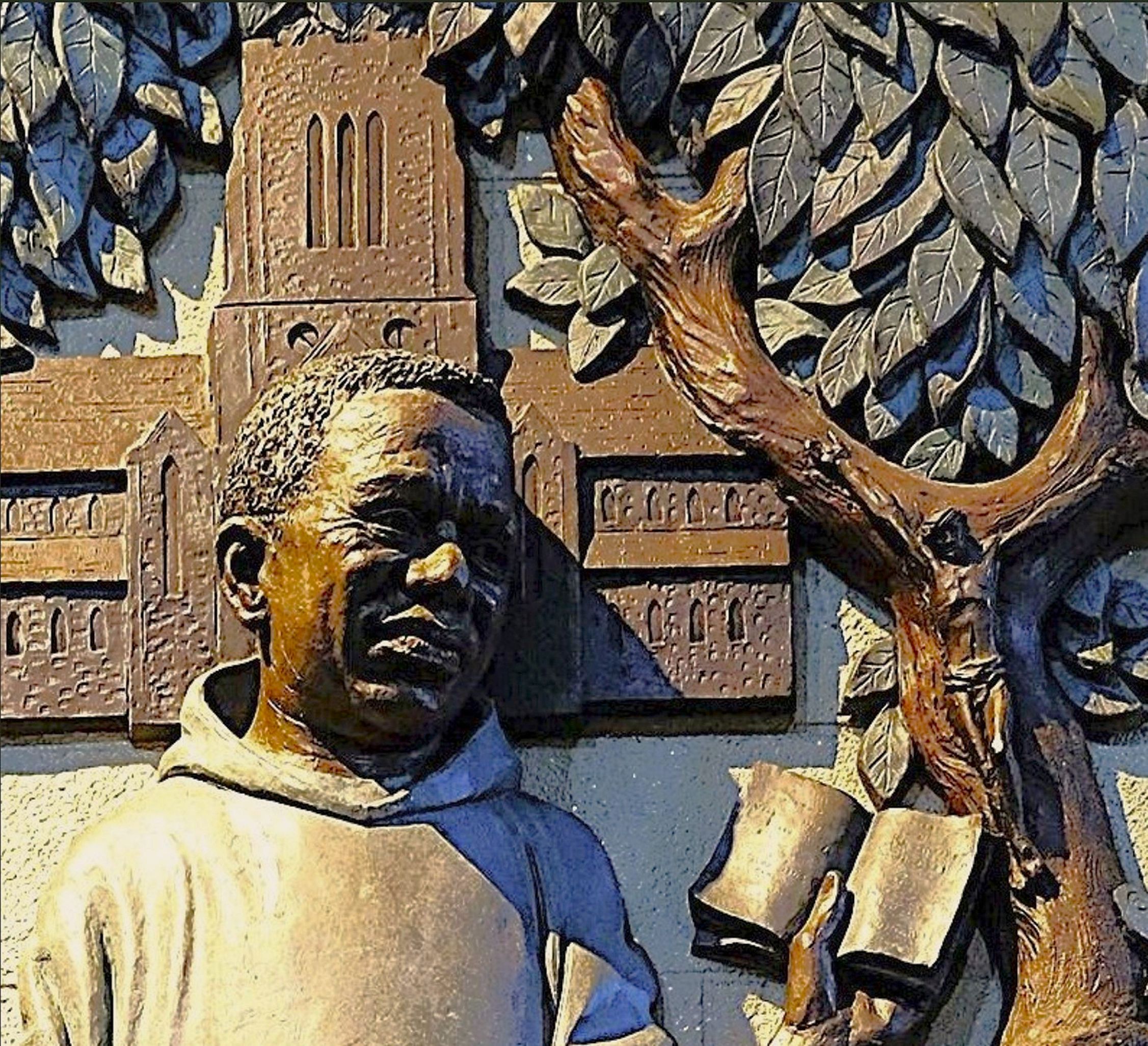
CANARSIE — When Father Ikenna Okagbue became a priest in 2017, he said he drew inspiration from a role model back home in southeastern Nigeria. That is, Blessed Cyprian Michael Iwene Tansi.
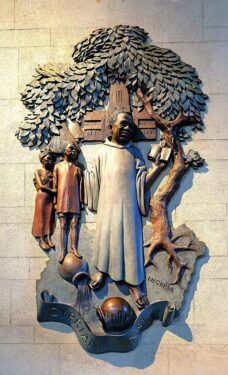
Father Tansi, beatified in 1998, evangelized the West African nation from 1937 to 1950. He vigorously served parishioners, inspired vocations, and facilitated conversions from Odinani, the traditional religion of Igbo-speaking people. Yet despite these accomplishments, Father Tansi personified humility, Father Okagbue said.
“Everything about him is ordinary,” Father Okagbue said. “From what I heard, all he wanted to be was a simple, ordinary priest. And that spoke a lot to me because it has been my desire to just be a simple parish priest.”
A Common Heritage
After 1950, Father Tansi devoted himself entirely to monastic prayer as a Trappist monk in England, where he died in 1964.
“That happens to be my hometown parish,” he said. “So, we share that common heritage.”
A Big Celebration
As a child, Father Okagbue had heard of Father Tansi but did not know his whole legacy until Pope St. John Paul II beatified him on March 22, 1998, in Oba, about 23 miles south of Aguleri. At that time, Father Okagbue was a high school student at the St. Peter Claver Seminary in Okpala, about 80 miles south of Aguleri.
The beatification, he recalled, “was a big celebration.” Father Okagbue and his classmates watched it on TV. His friends noted he was from the same town as Father Tansi, so they asked what he knew about the future saint.
“I said, ‘I don’t know much,’ ” Father Okagbue recalled with a laugh. “So, from that time on, I started to research about him, and I grew to love him.”
RELATED: Nigerians Like Trump’s ‘CPC’ Move, But Wary of Saber-Rattling
Education, Baptism, Grief
Father Tansi was born in 1903, while Nigeria was still under British colonial rule, which controlled the nation for nearly 100 years until it gained independence in 1960.
According to a biography published by the Diocese of Aguleri, Father Tansi’s parents were poor farmers who followed the Odinani religion, as did most of the community.
His father was incarcerated after being wrongly accused of tampering with a barrel of palm oil that was intended for export by the Royal Niger Company, the biography states. Therefore, after his release, he named his son Iwene, which in Igbo means “may anger not kill me.”
After his father’s death, the future priest’s mother sent him to her nephew, who had become a teacher at St. Joseph School in Aguleri, allowing Father Tansi to receive an education. He was baptized at age 9 and received the name Michael in 1912.
An exceptionally bright student, he was talented musically and a skilled soccer player. After graduating from high school, he became a teacher in Aguleri while discerning a priestly vocation.
Tragedy struck again in 1922, according to the biography, when an Odinani priest accused his mother of causing the deaths of local children. She died when the priest forced her to drink poison. The grieving young man helped his siblings convert, and they became Christians, according to the biography.
He later declined his family’s pleas to become a businessman and entered the seminary in 1925 at Igbariam.
Dedicated Reconciliation
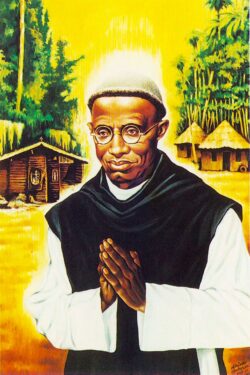
Ordained in 1937, Father Tansi pursued a ministry grounded in Catholic teachings on the care of all people.
As such, he pushed back against the constraints of colonialism to improve education for Nigerian children.
The priest also called attention to the oppression of women and championed their dignity, which had long been ignored by the traditional religion.
For example, he once waded into a mob that was attacking a woman for not adhering to the religion’s edicts on female behavior. He helped the woman escape and later urged her to file reports against the attackers, who were prosecuted, biographies state.
“There was always this tension between those who believed in African traditional religion and the missionaries who brought Christianity,” Father Okagbue said. “He had a test of that hostility, but he persevered.
“And he was gifted at reconciling people with God, and with one another.”
Monastic Life
In 1950, Father Michael Tansi took his energy for the pastoral ministry and applied it to the fervent prayer of a Trappist monk at Mount St. Bernard Abbey near Coalville in Leicestershire, England, where he took another name, Cyprian.
He struggled to adapt from equatorial Nigeria to damp, cold England. According to the biography, he was 60 when he died of an aortic aneurysm on Jan. 20, 1964. That date is now his feast day.
While the monastic life is lived behind walls, Blessed Cyprian Michael Iwane Tansi remains a profound example of a quintessential priest, Father Okagbue said.
“He spoke to the needy a lot, not just by preaching from the pulpit, but by visiting them at home,” Father Okagbue said. “And he was a priest who didn’t just preach the Gospel by word of mouth. He did the work himself.”