
by Gina Christian
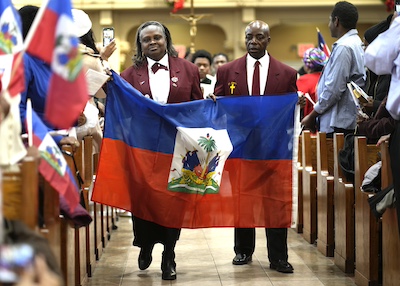
(OSV News) A Haitian Catholic chaplain serving in the U.S. said he and fellow Haitian Catholics are welcoming a last-minute reprieve from threats of deportation. However, he also noted they are still weighing options as the Trump administration cracks down on immigration.
“We received this good news while in prayer,” Father Eugène Almonor, a priest serving at St. William Parish in Philadelphia, told OSV News.
Father Almonor had just finished celebrating a Feb. 2 evening Mass when a parishioner received word a federal judge had blocked the Trump administration’s move to halt Temporary Protected Status (TPS) for hundreds of thousands of Haitian immigrants currently in the U.S. The protection was set to expire just before midnight on Feb. 2.
TPS is granted to those from Homeland Security-designated countries experiencing ongoing crises, including armed conflict, environmental disasters, epidemics, or other conditions. Under TPS, an individual is protected from immigration detention and deportation and can obtain employment and travel authorization.
But Judge Ana Reyes of the U.S. District Court for the District of Columbia granted a stay of the TPS expiration for Haitian nationals — declaring it “null, void, and of no legal effect” — pending judicial review.
Father Almonor — a native of Haiti who is now a naturalized U.S. citizen — told OSV News that “many people” had been “staying away from church” due to Immigration and Customs Enforcement roundups under the Trump administration.
“People were afraid to leave their homes,” he said, adding that isolation from religious activities in particular was uncharacteristic, since “Haitian people are spiritual people who enjoy coming to church, who enjoy worshipping God, who enjoy praising the Lord.”
In a searing 83-page opinion, Reyes said the plaintiffs in the case against the Trump administration — a group of five Haitian nationals with TPS protection — asserted that Homeland Security Secretary Kristi Noem had “preordained her termination decision and did so because of hostility to nonwhite immigrants.”
“This seems substantially likely,” wrote Reyes.
She cited Noem’s Dec. 1, 2025, X post recommending “a full travel ban on every damn country that’s been flooding our nation with killers, leeches, and entitlement junkies.”
Reyes noted that the five plaintiffs in the case were all accomplished professionals — among them a neurologist and a software engineer — and said while “Kristi Noem has a First Amendment right to call immigrants” such names, “Secretary Noem … is constrained by both our Constitution” and the Administrative Procedure Act “to apply faithfully the facts to the law in implementing the TPS program.”
“The record to date shows she has yet to do that,” wrote Reyes.
The opinion also criticized Noem’s failure to consult “with appropriate agencies” before ending Haiti’s TPS designation, as required by Congress. Reyes added that Noem had ignored “that Haitian TPS holders already live here, and legally so,” while contributing “billions” to the nation’s economy.
Haiti has been plagued by multiple, sustained crises, including political instability, natural disasters, foreign intervention, and international debt.
Father Thomas Hagan, who has served some three decades in Haiti’s capital, told OSV News Feb. 2 that swathes of the city are now uninhabitable due to the armed gangs.
“There are large sections that are just empty, destroyed buildings,” he said. “It almost looks like Berlin after the Second World War.”
Father Hagan — who founded and leads the nonprofit Hands Together, which provides educational, pastoral, and humanitarian development in Haiti’s most significant and poorest slum, Cité Soleil — added that food supplies from charitable organizations have dried up.
If Haitians under TPS protection were forced to return to the country, he said, “the hardest part, in addition to the violence, would be to just get a livelihood, because there are really not many jobs available.”
“If I had a family, I’d be worried about what could happen to them,” he said, pointing to routine kidnappings and killings.
Some of his staff members have recently received death threats, he said.
Father Almonor said his Haitian community members fear the violence in their homeland, “especially in Port-au-Prince.” He noted that some “prefer to cross the border into Canada,” since “the Canadian government welcomes them.”
Despite his U.S. citizenship, their distress is his, Father Almonor said.
“I am here to serve the Haitian people, to serve the Church,” he said. “I cannot accept that my situation is OK, and my people are living in a bad situation.
“I suffer with them. If they suffer, automatically, I suffer with them.”
He added that the faith of the Haitian Catholic community continues to inspire him.
“They help me,” Father Almonor said. “I receive from them.”