

CYPRESS HILLS — They faced discrimination in life that followed them in death.
They were Chinese immigrants who came to the U.S. in hopes of building a better life and worked hard at low-wage jobs in restaurants and factories. However, when they died, many cemeteries either refused to bury them or buried them in out-of-the-way spots away from the main section of the cemetery.
Father Andrew Tsui calls them the “Forgotten Souls,” and he said he is determined to remember them and to ensure others do, too.
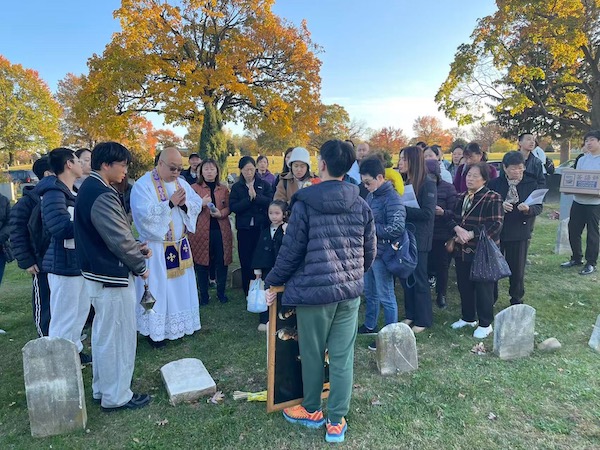
Father Tsui is the parochial vicar for St. Bartholomew Church in Elmhurst and the first American-born Chinese priest in the Diocese of Brooklyn. He led a group of Chinese-American Catholics to Cypress Hills Cemetery on the Brooklyn-Queens border on All Souls Day on Nov. 2 to pray over the gravesites of immigrants who died in the late 19th Century and early to mid-20th Century.
“I want to attempt to remember the long-forgotten souls that were early Chinese immigrants,” Father Tsui told The Tablet. “Those who had means were buried here temporarily, and their families took their bones back to China. But those who are poor were left here. Some of the graves had sunk into the ground, and they were hard to find, but we found them.”
RELATED: More Bilingual Skills Needed for Clergy to Serve Chinese Immigrants
As he led the group in prayer at the cemetery that day, Father Tsui said he thought of all the Chinese immigrants — laborers, mostly — who faced discrimination in housing and employment in their newly adopted country.
Chinese immigrants have been settling in New York since the early 19th Century, according to Queens College, which traced the migration back to sailors who came to Manhattan in the 1830s. Over the next 50 or so years, the Chinese population in New York and California steadily grew as immigrants arrived by ship.
But with the passage of the Chinese Exclusion Act in 1882, which Congress enacted out of fear that Chinese laborers were taking jobs from Americans, immigration nearly came to a halt. It was one of the first federal laws to use race as a basis for immigration policy.
“And many of the Chinese workers who were already here were here alone,” Father Tsui explained. “They had hoped to bring their family members over, but the Chinese Exclusion Act prevented them from doing so.”
As a result, when they died, they died alone.
Many cemeteries refused to permit Chinese people to be buried in their properties.
Cypress Hills Cemetery, a non-sectarian cemetery established in 1848, was not one of these cemeteries, according to the New York Cemetery Project.
RELATED: Chinese Faith Community Clears Trash, Shares the Gospel
Cypress Hills was nicknamed “the people’s graveyard” because of its policy of welcoming all to be buried within its gates. Still, many of the gravestones of Chinese immigrants there fell into disrepair over the years, Father Tsui said.
“In Chinese culture, we respect the dead,” he explained. “It’s so sad that when you go to the cemetery, you see the gravestones barely visible in the ground because they sunk. And secondly, it’s sad that a lot of these people are lost in history.”
For Father Tsui, the visit to Cypress Hills Cemetery was also personal.
His paternal great-grandfather, Edward Toy Hem, who died in 1936, is buried there. Father Tsui had been searching for the gravestone for years and eventually came across it in 2021.
“It was a great relief to me and my family,” he said.
It’s important to remember his great-grandfather and other immigrants, Father Tsui said, using the metaphor of a tree to make his point.
“A tree has roots. And we can’t forget that we, as a Chinese community, have deep roots as well,” he explained. “Our communities were built by men and women, our forebears, who sacrificed their lives and their energy for a better future. We are part of that better future.”