

FORT GREENE — The Diocese of Brooklyn, often referred to as the “Diocese of Immigrants,” has a history spanning more than 100 years of serving the spiritual needs of Spanish-speaking Catholics — and serving them in their native language.
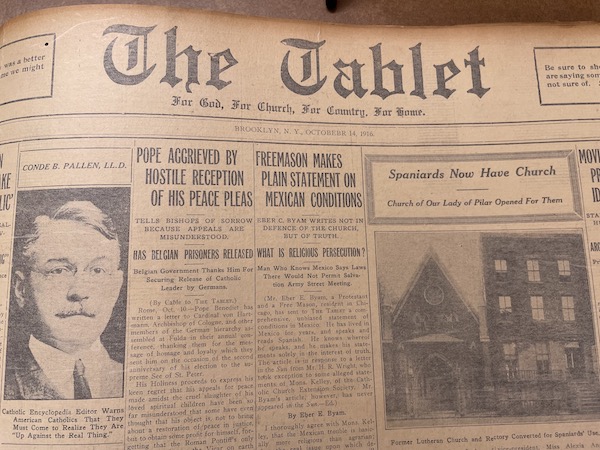
In 1916, Bishop Charles McDonnell observed that the Spanish-speaking population of New York City had been growing since the 1890s, and with it, the need to provide services to the Catholic community among them. So, he took action.
Bishop McDonnell established Our Lady of Pilar on Cumberland Street in Fort Greene in 1916 as a mission church catering to Spanish-speaking people, according to “History of the Diocese of Brooklyn,” a comprehensive account of the diocese’s origins written by Msgr. John Kean Sharp and published by Fordham University Press in 1954.
At the dedication Mass, Bishop McDonnell was accompanied to Our Lady of Pilar by Bishop Antonio Monestel of Honduras, a visiting priest from Mexico, whose name was not reported by Msgr. Sharp, in his book, delivered the homily.
To serve the parishioners of the church, Bishop McDonnell reached across the Atlantic Ocean to Spain. He asked priests from a Vincentian order in Barcelona to come to Brooklyn, and they accepted his invitation.
One of them, Father Antonio Canas, was installed as the church’s pastor.
Bishop McDonnell then started sending priests from the diocese to Spain so that they could learn Spanish at the University of Salamanca. It set a pattern. The tradition of dispatching clergy to learn to Spanish continued for decades.
Msgr. Kevin Noone, the former pastor of Our Lady of Angels Church in Bay Ridge, who is now retired, recalled how, as a newly ordained priest in the Diocese of Brooklyn in 1970, he attended language lessons.
“I was ordained for two weeks, and four of my classmates and myself volunteered. We were part of the program that sent priests to Puerto Rico,” he said.
The priests at Our Lady of Pilar looked after their flock in various ways, including hearing their confessions and offering them advice and counsel, as well as inspiring them with stirring homilies — all in Spanish.
The only thing the clergy could not do in Spanish was celebrate Mass. All Catholic Masses were celebrated in Latin — except for homilies. It wouldn’t be until the Second Vatican Council, nearly 50 years later, that Masses could be celebrated in local tongues.
RELATED: Pope Leo XIV Authorizes Traditional Latin Mass in St. Peter’s Square
However, the ability to confide in a priest who spoke their language was crucial for non-English speakers, said Joseph Coen, the former archivist for the diocese.
“The Church always believed that when it comes to matters of the heart, like confessions, you have to go with the language of the person,” he said. “These are intimate things people are telling a priest, and they need to feel comfortable.”
Meanwhile, the diocese was conducting more outreach.
A Hispanic lay ministry was established at Assumption Church in Brooklyn Heights and, over in Red Hook, Msgr. William White, the pastor of Visitation Parish, organized a committee of Hispanic laypeople to coordinate religious activities for non-English speaking Catholics. And priests from St. Michael’s Church in Sunset Park ministered to Puerto Ricans living near the Brooklyn Navy Yard. The diocese began to see an increase in the number of Puerto Ricans after they were granted U.S. citizenship by the Jones-Shafroth Act of 1917.
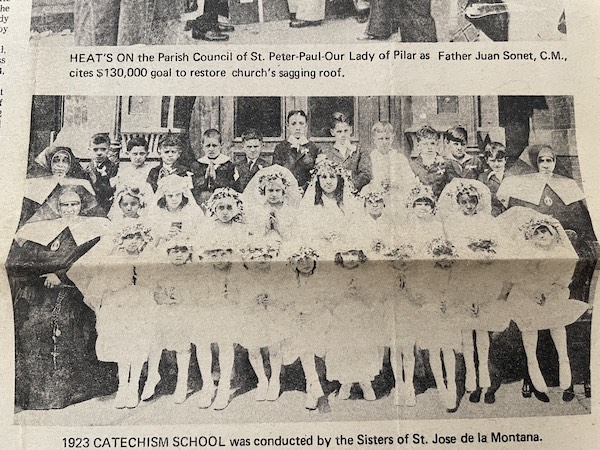
Our Lady of Pilar lasted as a stand-alone church for less than 20 years. In 1935, it was merged with St. Peter’s Church on Hicks Street in Cobble Hill, and the Vincentians began serving the newly created parish of St. Peter-Our Lady of Pilar.
While both Our Lady of Pilar and St. Peter’s play a significant role in the diocese’s history, neither church survives today. The merged parish was absorbed into St. Paul’s Church on Court Street in 1975.
Parishioners remained loyal to their old parish, however.
Msgr. Noone recalled that when he served as an episcopal vicar for an area that included northern Brooklyn and would talk to folks at St. Paul’s, “there were still people who considered themselves the remnant of St Peter’s.”
Msgr. Vincent Fullam, who served as episcopal vicar for the western part of Brooklyn and is now retired, said it’s important to remember that it’s the people in the churches — clergy and parishioners working together — that move the faith forward.
“When you’re talking about church ministry, you have to remember that you’re dependent on the people in the parish to carry the message to others,” he said. “The priests give support, and they give education. But the people who really carry the message are those sitting up there in the pews who hear it and try to live it in their lives.”