by Courtney Mares, OSV News
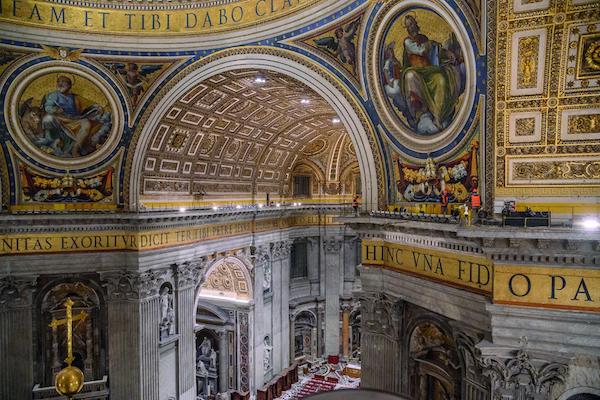
ROME (OSV News) — Four hundred years after its consecration, St. Peter’s Basilica is getting a 21st-century upgrade, with the Vatican unveiling plans for AI-powered translation services, expanded pilgrim access and high-tech structural monitoring as part of yearlong anniversary celebrations.
Cardinal Mauro Gambetti, archpriest of St. Peter’s Basilica, announced a wide-ranging slate of events and initiatives at a Vatican press conference on Feb. 16.
Pilgrims visiting St. Peter’s Basilica in 2026 will find expanded rooftop access, real-time Mass translations in 60 languages on their smartphones, extra weekly prayer and sacred music events, and a new temporary display of the Stations of the Cross.
The anniversary celebrations will culminate with Pope Leo XIV offering Mass in the basilica on Nov. 18, exactly four centuries after Pope Urban VIII solemnly dedicated the Renaissance basilica.
While Christians have been praying at the tomb of St. Peter for more than 1,950 years, the current basilica, which contains one of the world’s largest domes, dates back to the 16th century. The basilica took more than a century to build, with construction beginning in 1506 under Pope Julius II and finishing in 1615.
RELATED: Vatican Completes Official Mosaic Portrait of Pope Leo XIV for Papal Basilica
Cardinal Gambetti described the anniversary as “an opportunity to re-understand the basilica as an ‘authentic event’ in the history of humanity,” noting that Pope Julius II’s decision to demolish the “old St. Peter’s Basilica,” the fourth-century basilica built by Roman emperor Constantine, sparked fierce debate at the time.
“In reality, far from wanting to erase the past, Julius II intended to reshape what existed, bringing it back to its source,” Cardinal Gambetti said. “It was a ‘renovatio,’ a renewal in continuity, as is proper to authentic ecclesial tradition: the foundation of the faith — the tomb of the Apostle Peter — remained intact and at the center of the new project.”
The new basilica, designed principally by Donato Bramante, Michelangelo and Carlo Maderno, with piazza and fittings by Gian Lorenzo Bernini, is the largest church in the world by interior measure.
Among the most practical changes announced is a streamlined online reservation system intended to significantly reduce the often hours-long queues to enter the basilica. The Vatican is also introducing a multilingual platform offering real-time AI-assisted translations of Masses in up to 60 languages.
Developed in partnership with the Dicastery for Communication and the tech company Translated, which uses AI-based language services, the system will allow pilgrims to scan QR codes at the entrance of the basilica to access audio and text translations on their smartphones without downloading additional apps.
More of the basilica’s terrace will open to the public, which includes a new permanent exhibition on the basilica’s history and a highly anticipated expanded rooftop snack bar beneath Michelangelo’s dome that will be nearly double its current size.
Inside the basilica, a new Stations of the Cross designed by young Swiss artist Manuel Dürr, the winner of an international competition launched in 2023, will be on temporary display for Lent 2026, which will be inaugurated on Feb. 20.
The centenary year will feature weekly “Spiritual Elevations,” with prayer and polyphonic singing led by the famed St. Peter’s Basilica choir, the Cappella Giulia, every Saturday at 3:30 p.m. local time at the Altar of the Chair.
A series of lectures examining the basilica from historical, theological, liturgical and spiritual perspectives will run throughout the year, along with spiritual meditations by Father Roberto Pasolini, preacher of the papal household, on Tuesdays in November leading up to the basilica’s anniversary Mass.
The cardinal also highlighted pilgrimage routes in Rome to retrace the footsteps of Sts. Peter and Paul through the Eternal City. A theatrical performance of Michele La Ginestra’s “29 June – Peter and Paul in Rome” will take place around the time of the solemnity of Sts. Peter and Paul in June.
To mark the anniversary, a new font called “Michelangelus” based on Michelangelo’s actual penmanship will be included in the newest Microsoft’s Office.
RELATED: Pope Approves Expanded Family Benefits for Vatican Employees
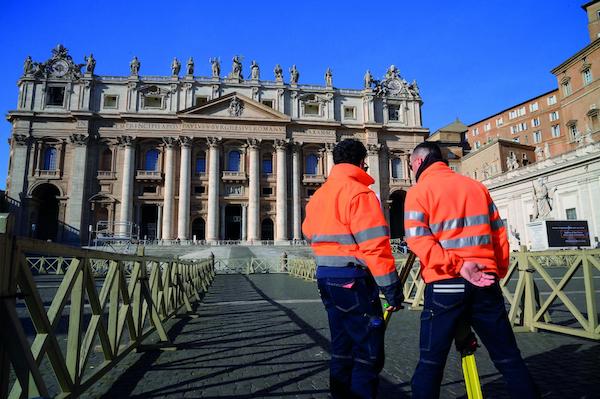
In addition to the celebrations, an extensive conservation program is underway in partnership with Italian multinational energy company Eni to safeguard the basilica’s structural stability for future centuries.
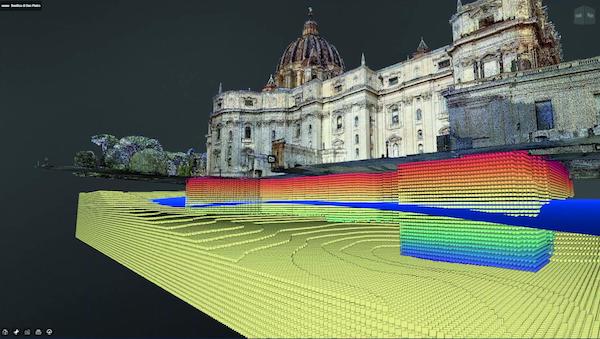
The “Beyond the Visible” project employs advanced geophysical, geological, topographical and structural survey technologies to study the foundations and the geological formations beneath the basilica.
The project by the oil and gas company, which required about 4,500 hours of on-site work over the course of two months, revealed that the basilica’s foundations, especially in the southern area, rest on clay and gravel layers with an active water table about 38 feet below the facade level. Historical records in the Vatican archives show that architect Carlo Maderno was also aware of some of these challenges in the 17th century and adopted advanced solutions for his time for the foundation and water drainage.
Annalisa Muccioli, head of research and development at Eni, described St. Peter’s Basilica as in a “good state of health” in 2026.
“Greater knowledge will allow us to prevent any future phenomena,” Muccioli said at the Vatican press conference.
“While Pope Julius II had to opt for the demolition and reconstruction of the church to allow for the renovation of a compromised structure, today Pope Leo can afford to renovate without demolishing anything,” Cardinal Gambetti said.
The cardinal expressed hope that pilgrims and visitors “will be able to enjoy (it) over the next quarter of a millennium thanks to the techniques and technology provided by Eni” and other technology companies.
Beyond the Vatican walls, Rome is marking the anniversary with a new exhibition exploring the artist-patron relationship between Bernini and Pope Urban VIII, who reigned from 1623 to 1644.
Bernini designed St. Peter’s iconic colonnade and piazza, as well as the massive bronze baldacchino canopy over the main altar and the gilded Chair of St. Peter in the apse.
The exhibition, titled “Bernini and the Barberini,” opened on Feb. 12 in Palazzo Barberini and contains sculptures, drawings and paintings, including works on loan from the Vatican Museums, and runs through June 14.