
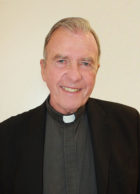
Two decades ago, Andrews founded Council #333 of the Knights of St. Peter Claver at his church, St. Clement Pope. He is the grand knight of the council and is looking for new members.
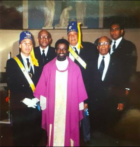
Two decades ago, Andrews founded Council #333 of the Knights of St. Peter Claver at his church, St. Clement Pope. He is the grand knight of the council and is looking for new members.
As a basic principle, the proper place to celebrate the sacraments is the church, except, of course, the anointing of the sick, for obvious reasons. But most of the sacraments, whenever there is a situation that justifies it, can be administered somewhere else. For instance, we see confessions and Masses in these times of pandemic held outdoors.
On the evening of Oct. 16, Judge Nicholas Garaufis denied the second request of the Diocese of Brooklyn for a preliminary injunction on Governor Andrew Cuomo’s executive order curtailing the number of people who can participate in religious services and attend Mass in communities with high COVID-19 positivity rates.

That kitchen table and those pictures encapsulate the shaping of my early political ideology. Faith, family, the Irish immigrant experience, and the importance of American citizenship were tenets emphasized by the words and example of my late parents.

Pope Francis often has expressed openness to the idea of laws recognizing civil unions, including for gay couples, to protect their rights. The pontiff’s comments in a brief passage in the documentary film, “Francesco,” are similar to the position he took while archbishop of Buenos Aires and echo remarks he has made in several interviews during his pontificate: “Marriage” is only between a man and a woman, but civil union laws could provide legal protection for couples in long-term, committed relationships.
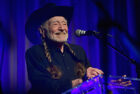
Willie Nelson’s love of inspirational songs dates back to his childhood in Abbott, Texas, and “Amazing Grace,” a hymn he first heard in church as a young boy.

Edward Charles Ford was 91 when he passed away on Oct. 8.
This question about questions is ultimately pretty simple — do we ask questions, engage in discourse and discussion on social media and in-person with our friends (and with our enemies) for the sake of clarity, for the sake of learning the opinions of others and why they might hold these opinions, or do we do it to trip the other up, to hammer home our point, to verbally “beat down” those who might disagree with us?
The image of the pre-conciliar Catholic Church in the United States as catechetically effective and politically potent can be hard to square with the long-term damage done to Catholicism’s role in American public life by that very pre-Vatican II Catholic, John F. Kennedy.
Reading Haught’s book I had a strange experience. For both philosophers and theologians, and indeed for everyone I have ever heard discuss or write about the topic, the mystery of why an all-loving God, indeed a God Who is Love, allows so much suffering seems to be too great a mystery for any human mind to comprehend completely.