Tag Archive | "Catholic schools"

Chicago Stresses Need for Funding Its Catholic Schools

CHICAGO (CNS) – The Archdiocese of Chicago’s strategic plan to keep its Catholic schools vital and viable emphasizes new management strategies, the need to find new funding and a strong focus on Catholic identity and excellent academics.

The plan highlights an issue facing Catholic schools nationwide: funding.

It calls for a capital campaign to establish a scholarship fund and raise money for capital needs and to maintain efforts to secure some public funding for Catholic education. It also stresses the need for increased partnerships with organizations that have supported Catholic schools, such as the Big Shoulders Fund, a Chicago foundation whose mission is to help Catholic schools in the neediest areas of Chicago.

The plan also reorganizes the Office of Catholic Schools by creating new senior management positions in the areas of Catholic identity, academics, operations and finance.

Posted in UncategorizedComments (0)

Chicago Stresses Need for Funding Its Catholic Schools

CHICAGO (CNS) – The Archdiocese of Chicago’s strategic plan to keep its Catholic schools vital and viable emphasizes new management strategies, the need to find new funding and a strong focus on Catholic identity and excellent academics.
The plan highlights an issue facing Catholic schools nationwide: funding.
It calls for a capital campaign to establish a scholarship fund and raise money for capital needs and to maintain efforts to secure some public funding for Catholic education. It also stresses the need for increased partnerships with organizations that have supported Catholic schools, such as the Big Shoulders Fund, a Chicago foundation whose mission is to help Catholic schools in the neediest areas of Chicago.
The plan also reorganizes the Office of Catholic Schools by creating new senior management positions in the areas of Catholic identity, academics, operations and finance.


Posted in UncategorizedComments (0)

Catholic Schools Raise the Bar

by Bishop Nicholas DiMarzio

My dear brothers and sisters in the Lord,

This year, Catholic Schools Week was observed from Sunday, Jan. 27, to Saturday, Feb. 2, with the theme “Catholic Schools Raise the Standards,” a theme which focuses on the new initiative of raising the bar on the national standards and benchmarks for effective Catholic elementary and secondary schools, and high standards at Catholic schools across the country. The logo “illustrates a chart of steady growth culminating in the highest achievement of all, a cross representing the faith that underscores all Catholic education.”

The theme is so appropriate, as we are not only reminded of the high academic achievements attained by Catholic schools and academies within Brooklyn and Queens, but also of Christ who is the foundation on which all Catholic schools and academies are built. I am reminded of the quote that Bishop Thomas V. Daily had posted in every school building in the diocese:

“Let it be known to all who enter here that Christ is the reason for this school, the unseen but ever present Teacher in its classes, the model of its Faculty, the inspiration of its Students.”

Strengthening Catholic Education

Indeed, gratitude must be given in reflection upon Catholic education within the Diocese of Brooklyn. “Preserving the Vision,” an initiative which as you may know began three years ago and continues today to be an instrument of strategic planning for the future of our Catholic schools here in Brooklyn and Queens, continues to encourage and enable schools and academies to assess and strengthen both Catholic identity and academic excellence.

Through “Preserving the Vision,” Catholic education within the Diocese of Brooklyn has strengthened tremendously. An ongoing strategic planning process has enabled the Diocese to guide schools and academies in the completion, implementation and review of strategic plans designed to help them prosper. The process enables newly formed academies to successfully transition into a two-tiered governance model allowing for academies to be governed by a board of directors who specialize in school management, as well as a board of members including myself and pastors involved with the school. “Preserving the Vision” will allow for every school to be transitioned to this effective model by 2017.

With the children at the heart of Catholic education, improvements also advance at the diocesan and local levels in areas such as marketing, public relations, development efforts, technology to enhance instruction and communication, and in providing training and resources for administrators and teachers to implement the expectations found in the N.Y.S. Common Core Learning Standards. Today, we boast 91 Catholic schools and academies with 30,048 children of all races and many ethnicities.

It is my pleasure to announce that 25 of those 91 schools and academies have already transitioned into the academy model, which is so vital to the health and sustainability of the school communities within Brooklyn and Queens. Moreover, our board mentors have been hired within the Diocese of Brooklyn for additional assistance to the boards of directors. These mentors work to ensure that the board of directors fully utilizes all resources that are available to them to be successful in their governance responsibility and to enhance the working relationships among the board of directors, the members of the academy, the principal and the parent community.

The Diocese of Brooklyn is truly blessed to have these mentors to ensure that this vital governance model is fully implemented through their on-site assistance and regular participation. They are able to provide valuable feedback to the board of directors and the members regarding items such as the agenda, the notes and outcomes of the meetings and the challenges. Additionally, they understand board assessment processes and will use this knowledge to develop and implement professional development plans for the needs of the boards. These mentors follow-up with the board chairperson on key issues to provide recommendations that will further each academy to viability and full vitality.

It is understood that the academy model is new and confusing to many. When I speak of mentors aiding in the development of roles for board secretaries, treasurers and sub-committees, it almost seems that there is a certain complexity to academies. Yet, the Church sometimes must guide her members in defining their roles and vocations. There are roles to fill, and we must rejoice that the women and men who serve us can guide others to define these new roles and to aid them in their transitions.

St. John’s University also continues to serve the Diocese of Brooklyn through partnerships in the St. Vincent de Paul Program. The program provides directors with ongoing professional development as continued board evaluation is essential for boards of directors.

Furthermore, regarding the success in schools and academies within Brooklyn and Queens, we must remember the monetary generosity of others. Scholarships totaling $951,358 were awarded to 560 students within the Diocese of Brooklyn by 237 “Angel” sponsors through Futures in Education. An additional $2,399,599 was awarded to 2,898 students through Diocesan scholarships and $3,250,000 to 1,850 students through the Bishop’s Program. Finally, 247 students received a total of $525,855 in financial aid through high school scholarship programs.

Following Hurricane Sandy, you may recall the additional emergency scholarship fund that was established through Futures in Education. Applications were immediately distributed to principals and returned to PSAS by Dec. 14, 2012 for analysis. These applications were hand-delivered in the Rockaway and Howard Beach schools. Overall, more than one million dollars in relief was requested from approximately 700 students, with additional families requesting any help at all. Today, I am pleased to announce that Futures in Education expects to award in February over one million dollars to 764 students affected by Hurricane Sandy.

Great Gratitude

As much as I cannot express the great gratitude I have for donations of over eight million dollars toward the education of children, neither can I express the great gratitude I have for parents who are their primary educators and who make such sacrifices to send their children to Catholic school, nor can I express the fullness of my gratitude toward our Catholic Schools Office. Under the direction of the Superintendent for Catholic Schools Support Services, Thomas Chadzutko, Ed.D., and with the daily supervision and collaboration of Sister Angela Gannon, C.S.J., Secretary for Catholic Education and Formation, and our Vicar General, Bishop Frank Caggiano, the Schools Office has worked tirelessly throughout the year, and especially through Hurricane Sandy, to keep our children safe and in school.

Again, the theme of Catholic Schools Week this year is “raising the standards,” a theme comparable to putting out into the deep. As a community, we have raised the bar, not only in academic achievements, but in charity and self-sacrifice. Despite the many hardships families and school communities have endured in the past months, Catholic education within Brooklyn and Queens continues to put out into the deep, raising the bar to persevere and to thrive with Christ as the constant guide. I look forward to my visits to Catholic schools this year, where I will continue to play games of “Stump the Bishop” with children and to answer their questions about religion, although I still cannot tell them about the new math.

Posted in Put Out into the DeepComments (0)

CSW2013: Catholic Schools Are Raising the Standards in The Diocese of Brooklyn and Queens

by Dr. Thomas Chadzutko

The theme for Catholic Schools Week 2013 is “Catholic Schools Raise the Standards.”
Catholic schools and academies within the Diocese of Brooklyn are noted for the quest of academic excellence and the establishment of high moral standards. This year’s theme celebrates and recognizes the constant attention that Catholic educators pay to increasing the learning and knowledge of all students.
As we continue to fully implement the New York State Common Core Standards throughout the Diocese of Brooklyn, it is evident that our school/academy communities are taking a proactive approach to raising the standards.
2a_CSW2013_QRCAThis theme has special meaning as we recognize the establishment of the Catholic School Accreditation Association, a new vehicle by which Catholic schools and academies within the Diocese of Brooklyn will be accredited.
Catholic Schools Week is a time to draw special attention to the academic, faith development and service activities that students pursue all year long.

Catholic Schools Raise the Standards: In Our Parish
The parish is essential to Catholic schools and academies. Our pastors and parish priests are involved in the life of our schools/academies on a regular basis. Through monthly liturgies, seasonal prayer services and parish service projects, our students are engaged in the life of the parish. Our pastors and parish priests visit classrooms on a regular basis, and many are involved in the teaching of religion to specific classes. What better way to build community than by recognizing the important role that the parish plays in the life of the school and academy.
Essential to the work that is undertaken by our parish leaders are the standards that:
- center on the person of Jesus Christ,
- contribute to the evangelizing mission of the Catholic Church, and
- sustain the Gospel message in all that we do.

2a-CSW2013_sfa_astCatholic Schools Raise the Standards: In Our School/ Academy Communities
Striving for academic excellence is a major theme throughout the Diocese of Brooklyn.
This vision is set by the principal and all his/her efforts to ensure that the students entrusted to them are receiving a quality Catholic education. This vision is supported by the work of faculty and staff and their ongoing commitment to raising the standards in the classroom.
Embracing 21st-century technology, implementing the New York State Common Core Learning Standards and the pursuit of ongoing professional development are the standards by which teachers are raising the bar in the learning environment that they have created.
“Excellence in education is when we do everything that we can to make sure they become everything that they can.” This is so true in our Catholic schools and academies as every effort is made to meet the needs of all students and assist them in being successful for years to come.
This theme recognizes our focus on developing students both academically and spiritually today so they can become leaders in our community tomorrow.

Catholic Schools Raise the Standards: In Our Students2a-CSW2013_haca
Catholic schools/academies, because of their focus on high standards of academic achievement and faith development, produce graduates who make a significant contribution to our Catholic Church and American society.
Here within the Diocese of Brooklyn, our students are recognized for their involvement in the parish and greater community.
Academic excellence is one aspect of the student’s education, but involvement in extracurricular activities and enrichment programs is yet another sign of raising the standards.
Going beyond the curriculum is a priority, and all schools and academies continue to raise the standard in this area. Our school days are becoming longer, and our students are challenged to attain more.

OLYMPUS DIGITAL CAMERA

Catholic Schools Raise the Standards: In Our Parents
Our parents make the sacrifice to enroll their children in our Catholic schools and academies. They are truly committed to ensuring that their children will be prepared for the challenges that will face them in the future by providing a firm foundation from the very beginning. Parents set high expectations for their children and want them to be successful. Through a partnership with the schools and academies, this can be attained.
During this Catholic Schools Week, we pause to acknowledge parents’ many contributions to our schools and academies by volunteering on a regular basis, serving on a sub committee of the board of directors, serving on an advisory board or by being involved in the Home School Association.
Parents play an essential role in our schools and academies and are recognized for the difference they make in Catholic education.
Catholic education is our future, and through the efforts of Preserving the Vision, we will continue to ensure that Catholic education within the Diocese of Brooklyn will be viable and vital for generations to come.
Catholic school and academies within the Diocese of Brooklyn truly set the bar high, and we are collectively working to raise the standards.

Dr. Chadzutko is the diocesan Superintendent of Catholic School Support Services.

Posted in UncategorizedComments (0)

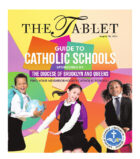
The Tablet’s Back-to-School Supplement

Here is a listing of the stories/content in The Tablet’s special back-to-school supplement, which appeared in the Aug. 25 issue. Click on the title link to read the story:


Catholic Schools Raise the Standards

by Dr. Thomas Chadzutko

Dr. Chadzutko explains the importance of a Catholic school education within the Diocese of Brooklyn.


New Early Childhood Development Centers Cater to Young Minds

by Antonina Zielinska

The diocesan superintendent’s office teamed up with St. John’s University, Jamaica, to form a task force charged with opening new Early Childhoos Development Centers in time for the 2012-2013 academic year.


New Academy in Park Slope

St. Joseph the Worker Catholic Academy opens this fall. It was created from the union of two successful schools: Immaculate Heart of Mary and Holy Name of Jesus.


Schools Office Has New Deputy Superintendent

The Office of the Superintendent-Catholic School Support Services has named Anthony Biscione, who has 31 years of service in Catholic education, as its new deputy superintendent.


Academic Calendar 2012-2013

A month-by-month listing of the important Catholic school dates for the 20120-2013 school year.


Renzulli Expands: Nine Schools Adopt Program

The Renzulli Learning Program, a web-based learning tool that identifies students interests and boosts academic performance, will be introduced in nine additional schools and academies within the Diocese of Brooklyn.


Class of 2012 Nets $11M in Scholarships

Catholic high schools in New York City offered more than $11 million in scholarships to eighth graders graduating from Catholic schools and academies in the Diocese of Brooklyn.


Contest Raises Saviourites’ Awareness About Drunk Driving

St. Saviour H.S., Park Slope, and Duffy Funeral Home sponsored an essay contest in which students wrote about the dangers of driving while intoxicated.


Fidelis Care Urges Parents to keep Vaccinations Up to Date

As schools prepare to reopen in the coming weeks, Fidelis Care encourages parents to speak with their family doctor to ensure their families are on schedule with vaccinations.


TACHS Exam Tips

Here are some tips for eighth graders preparing to take the TACHS Exam, the necessary test for admission to one of the diocese’s Catholic high schools.


Futures in Education Sponsors Scholarship Opportunities

Futures in Education is helping families send their children to Catholic schools via several scholarship opportunities.


New and Familiar Faces Take Reins in Catholic Education

With the start of the 2012-2013 school year, newly appointed principals are preparing to meet their school communities and to assume the diverse and challenging role of leadership within the Diocese of Brooklyn.


Back to School Shopping: Five Ways to $ave

Here are five tips used to save on back-to-school supplies.

Posted in NewsComments (0)

British Investigate Catholic Schools

MANCHESTER, England (CNS) – The British government is investigating claims that Catholic schools have acted illegally by circulating a letter allegedly inviting students to sign a petition in support of traditional marriage.
It is against British law for children under the age of 16 to sign political petitions, but the text of the letter, circulated in nearly 400 schools for children ages 11-16, invites the faithful to sign the petition organized by the Coalition for Marriage, a group of organizations opposed to government proposals to redefine marriage to include same-sex couples.
The government’s Department for Education is now investigating complaints by campaigners for gay marriage that students under the age of 16 years were encouraged to break the law. It is seeking a meeting with officials from the Catholic Education Service, an agency of the Bishops’ Conference of England and Wales.
The Catholic Education Service has denied any wrongdoing.
“Catholic state schools have always been permitted by law to teach matters relating to sex and relationships education, including the importance of marriage, in accordance with the teaching of the Catholic Church,” said an April 26 statement. “The Catholic Church’s view on the importance of marriage is a religious view, not a political one.”

Posted in NewsComments (0)

Catholic Schools Are Stronger

by Biship Nicholas DiMarzio

My dear brothers and sisters in the Lord,

This year, Catholic Schools Week is observed from Jan. 29 to Feb. 5 with the theme, “Catholic Schools – Faith, Academics, Service.”  The logo is a triangle with the words “Catholic Schools” written in red across the bottom of the triangle.  The “T” in the word “Catholic” is a purple cross that has an unfurling green banner with words in white letters proclaiming the theme, “Faith, Academics, Service.”

How important it is for us to recognize the unique role that Catholic schools play in the evangelization efforts of the Church.  We must always maintain the Catholic identity of our schools.

I am happy to report that the Diocese of Brooklyn has made tremendous progress in capturing the already existing Catholic nature of our schools and encouraging some of our schools to become more Catholic and concrete in their identity.  This has been one of the goals of “Preserving the Vision,” which as you may know began three years ago and continues today to be an instrument of strategic planning for the future of our Catholic schools here in Brooklyn and Queens.

Today, the Diocese boasts 97 Catholic Schools and Academies with a N-8 enrollment of 30,755.   The number is down from our past history.  However, our Catholic schools are stronger than ever before.

With the establishment of eight new academies in September 2012, joining the already existing 17 academies formed since 2009, we have a proven mechanism for maintaining the viability and insuring the Catholic identity of our schools.  All of this is due to the tremendous effort on the part of our Catholic Schools Office under the direction of the Superintendent for Catholic Schools Support Services, Thomas Chadzutko, Ed.D., and with the daily supervision and collaboration of Sister Angela Gannon, C.S.J., Secretary for Catholic Education and Formation, and our Vicar General, Bishop Frank Caggiano.

All in our Catholic Schools Office, the Boards of Directors of our academies and the many volunteers who work on our School Advisory Boards must be commended for the countless hours given to the cause of preserving and developing the network of Catholic schools here in Brooklyn and Queens.

Catholic Schools Week gives us an opportunity to focus our attention on our Catholic schools, their administrators, our teachers and our students.  A tremendous effort is being made by the pastors of our Diocese, both those whose parishes continue to sponsor parochial schools and those who serve as Members of a regional Catholic academy.  Their efforts must not be forgotten.  If it were not for the dedication, cooperation and support of our pastors, our Catholic schools would long ago have ceased to exist.

During Catholic Schools Week, I cannot forget to mention our parents who make great sacrifices to send their children to our schools so that they may receive a quality Catholic education. Catholic schools are always a joint venture between parents and educators. Catholic teaching reminds us that the responsibility for education relies primarily on the parents, and others assist them in fulfilling their responsibility.
For me, one of the highlights of Catholic Schools Week is when I visit several of the Catholic Schools in our diocese.  The Catholic atmosphere is palpable during these visits, at which I like to play a game with the students that I call, “Stump the Bishop.”  The students are able to ask me any question they wish.

After a number of years of playing this game, however, I now try to specify that the questions should be about religion, because two years ago I was stumped when one of the students asked me a question about the new math.  Unfortunately, I do not know what the new math is about!  But usually I can answer any question regarding religion.

At times, there are amazing insights which come out of the mouths of our Catholic school children, especially the younger ones who as we know always spontaneously say what is on their minds.  Many times their comments to me contain deep insights regarding our faith.  I remember several years ago when one young boy asked me a question that I thought was, “Do you have any pets?”  But, since I did not hear his question clearly, I asked him to repeat what he said.  When he did, the young boy said, “Do you give pep talks to the priests?”  Truly, this was an incredible insight from a fourth grader.  We all need pep talks; priests, deacons, men and women religious, principals, teachers, students and, yes, even bishops.  Catholic Schools Week gives an opportunity for all those involved in our Catholic schools to receive a pep talk, reminding them of the great work that is accomplished even under great difficulties.

The whole effort of establishing Catholic schools and keeping them in existence has been an exercise in putting out into the deep, from the very beginnings of Catholic education two centuries ago until today.  Sometimes we seem to be rowing against the tide, but at the same time we are making progress.  All the efforts made for our Catholic Schools is well worth that effort.  We will continue as a Diocese here in Brooklyn and Queens to do our best to support Catholic education in our Catholic Schools.

Posted in Put Out into the DeepComments (0)

The Future of Catholic Schools – Academies Offer Opportunities For New Beginnings

by Gail Donovan,

This is the third in a series of articles about the future of Catholic schools in Brooklyn and Queens.

Ask Rosemarie McGoldrick, principal of Holy Angels Catholic Academy, Bay Ridge, about the best part of establishing a new academy and she’ll answer “the opportunity to have a new beginning.”

Holy Angels Catholic Academy opened in September, 2009, in the building that previously housed Our Lady of Angels School, which closed. The new academy’s marketing, branding, and recruiting efforts have already boosted enrollment to 236 students  from last year’s 175 students.

“Enrollment is increasing from the bottom up,” McGoldrick said. “We’ve had so much interest since the academy opened that we’ve had to open a second pre-k class and a second kindergarten.”

Holy Angels Catholic Academy is one of 17 academies established in the Diocese of Brooklyn under Preserving the Vision.  All Catholic schools in the Diocese of Brooklyn will be converted to academies by 2017.  The academies are new entities that have replaced a single school or schools that have merged, and are supervised by a two-tier governance structure made up of members, who are pastors from surrounding parishes, and boards comprised of lay people.

To support academy principals and boards, Dr. Mary Jane Krebbs, associate dean for Graduate Studies and co-director of the Institute for Catholic Schools at St. John’s University, and her team from St. John’s provide them with a two-year training curriculum, in-service sessions, on-site visits, and other resources.

“The goal is to enable the principals and boards to make a smooth transition into a new life cycle for Catholic education,” said Krebbs, who also serves as chair of the Strategic Planning subcommittee of the Preserving the Vision Advisory Committee.

As part of the academy’s marketing and rebranding efforts, McGoldrick took the time to explain to parents how the new entity would differ from the former school, including the new governance structure, role of the board, and the role of the pastor as the spiritual leader for the students. New uniforms were introduced and new teachers hired, she said, adding that all faculty members working in academies must be state certified.

During the first year as an academy, the board voted to use money from a reserve fund to upgrade the building’s technology and now Holy Angels features a new computer lab, laptop program, and SMART Boards and Internet access in the classrooms. Computer, gym, library, art, and music are part of the curriculum, and students in grades three through eight also take Spanish classes.

As part of their contracts, teachers are required to organize one club once a week for an hour. The clubs are offered free to students in first through eighth grades and include tap dancing, sports, sign language, word puzzles, music, art, board games, and a book club. Another change was the extension of the nursery program from half-day to a full-day, and the creation of a separate early childhood gross motor skills playroom.

A supportive board helps McGoldrick with administrative tasks, which frees the pastors from Our Lady of Angels and neighboring St. Andrew the Apostle to focus on the spiritual needs of the students.  The result is the quality of the education at Holy Angels Catholic Academy has improved.

Help for Principal
Suzanne Karl, chair of the board of Divine Wisdom Catholic Academy in Douglaston and a member of the Preserving the Vision Advisory Committee’s Marketing, Recruitment, and Retention Subcommittee, said the board of Divine Wisdom includes representatives from all professional fields, which enables Principal Michael LaForgia to spend his time and energy on academics.

Karl concedes that closing St. Anastasia School and reopening as Divine Wisdom Catholic Academy in the same building in 2009 was challenging. The reward, however, is “bringing new life into the building,” she said. “There’s a lot of energy here. It’s been very fulfilling. We’ve started a new business. One school closed and we started another from scratch.”

To succeed, members of the Divine Wisdom board understood that they would have to market and brand the academy as a new institution because St. Anastasia’s enrollment had fallen to 165 students. The board also understood that the academy would have to compete head-on with public schools in District 26, one of the most desirable public school districts in Queens.

As part of the academy’s marketing and branding strategy, the board voted to upgrade and renovate the entire building, strengthen academics, and add classes that public schools in the area were eliminating, Karl said.
While public schools have cut programs like gym and art, Divine Wisdom has added an early childhood wing; Spanish beginning in pre-kindergarten; and instruction in musical instruments for students in third, fourth, and fifth grades. Divine Wisdom has introduced Balanced Literacy, which tests a student’s reading level and monitors it to ensure that he or she is advancing, and the academy takes a holistic approach to the curriculum by integrating art and computer lessons into academic subjects.

Divine Wisdom recognizes and celebrates its diverse student body and has hired consultants to train teachers on methods of teaching differential learning to ensure that the needs of all students – advanced, average, and those needing additional assistance – are being met.  The academy also offers accelerated math for sixth, seventh, and eighth grades, which prepares students to take the state Regents tests. For students with special needs, a resource room, ESL classes, and special education are available.  In addition, the academy is partnering with St. Francis Prep, Fresh Meadows, on community service and academic programs, and participates in programs offered by St. John’s University.

The result of these changes is that Divine Wisdom has added 100 students from the public schools and boosted its overall enrollment to 276.

“Once parents come in for a tour, they’re sold on the school,” said Karl, who, as the board member with marketing expertise, personally gives most of the school tours in part to learn what types of programs parents are seeking so she can recommend them to the board.

In South Ozone Park
Our Lady’s Catholic Academy in South Ozone Park, which converted from a single parish school, St. Anthony Padua, to an academy in 2009 also has benefited from the new academy structure.

Principal Kevin Coyne notes that enrollment has increased from 180 students at the end of June, 2009, when he walked into the school to 340 students today. The academy now has two pre-kindergartens, two kindergartens, two first grades, and anticipates adding a second second-grade class, and a second sixth-grade class.

He praised members of his academy’s board of directors and chairperson Katherine Loughran. “The board has ideas for maximizing the education of each individual child,” he said. “We don’t see why a school in a low-income, immigrant neighborhood shouldn’t have the best of everything. We focus on the needs of the community and have a shared belief in servant leadership – everyone working with the same goal in mind.”

A full copy of Preserving the Vision Strategic Plan 2011-2014 is available at http:/mybqcatholicschool.com.


Gail Donovan is a member of the diocesan Strategic Marketing Communications Committee for Catholic Schools.

Posted in NewsComments (1)

Christ Jesus, Our Hope – Reconfiguration Has Brought New Life to Neighborhood Schools

by Jay Akasie

This is the second article in a special series on the reconfiguration process in the diocese.

AMCA_Tom_Pricnipal_girls

Ave Maria Catholic Academy is enjoying success in Howard Beach through the efforts of Principal Maria Cuomo, right; Thomas Rowland, chair of the board of directors, left; and students who share the good news about their school in the community.

Never tell a determined and talented Catholic community that something can’t be done if they put their minds and resources together to accomplish it.
When the situation looked bleak for Our Lady of Grace School, Howard Beach, declining enrollment and dwindling finances didn’t discourage Principal Maria Cuomo. Instead, she huddled with Father Anthony Rucando, pastor, and Tom Rowland, a school parent and dedicated businessman.

Together, they came up with the best plan to ensure that the Diocese of Brooklyn’s track record for quality Catholic education would flourish in their neighborhood well into the next century.

The old school had an illustrious history, but administrators realized that the changing face of the area meant that they, too, had to be willing to change. In order to attract more students and strengthen the curriculum, they decided to move to an academy model that would tap into ties with the private sector as well as an association with St. John’s University.

The re-named Ave Maria Catholic Academy opened on Sept. 1, 2009, with a re-organized pre-kindergarten through eighth grade school that preserves the former parish school’s high standards for learning, its Catholic identity, and continues to shape the minds of America’s future leaders.

“I think it was a perfect time for the school to forge ahead into this new academy model,” said Cuomo. “The board of directors has collaborated with the administration, faculty and parents to bring improvements to our school.”

This year Ave Maria Catholic Academy is flexing its financial muscle as well. It opened a new science laboratory and is soon to unveil its all-new media center equipped with 20 new laptop computers as well as several desktops, according to Cuomo. “We have also expanded our Italian language program and currently offer the Integrated Algebra 1 Regents Course,” she said.

One of the greatest benefits from becoming an academy, according to Cuomo, is the partnership Ave Maria has made with St. John’s University.  The university provides guidance and resources to both the board of directors and administration. “Their knowledge and expertise in the field of education cannot be taken for granted.  We are so thankful for their commitment to Ave Maria Catholic Academy,” she said.

The Superintendent of Schools for the Diocese of Brooklyn, Dr. Thomas Chadzutko, said that Ave Maria serves as the perfect demonstration as to why the academy can be the right educational model for Catholic schools of the future.

The academy paradigm is advantageous, he explained, because it brings people to the board of directors with levels of expertise like finance, marketing, and recruitment — professional backgrounds that are not often involved with school boards. Plus, the academy is an incorporated entity that’s separate from the parish. “That allows us to seek funding and grants that religious organizations don’t always enjoy because of former connections to a parish,” said Dr. Chadzutko.

Ave Maria was able to utilize these advantages to lower tuition and to hire more teachers – something for which the old parish school model did not allow. One of the biggest challenges that Catholic schools in Brooklyn and Queens now face is that many of them were created more than a century ago, when inner-city parishes bustling with families packed students into the classrooms. Demand for Catholic education was high and the cost was low.
They were parish schools, staffed largely by nuns, and almost every church had one. But the demographics of Brooklyn and Queens changed. By the 1970s, the diocese faced the challenge of maintaining large physical plants and dwindling enrollments. More families were moving to the suburbs.

The lion’s share of the current diocesan reorganization plan – Christ Jesus, Our Hope — involves identifying which parishes can operate best when merged into another parish nearby.

One of the little known aspects of these parish mergers is that schools that are often attached to the parish continue to operate after the merger. Parishes are now being asked to reorganize their schools into strong, prominent Catholic academies that are suited to the needs of 21st-century families.

Such success stories like Ave Maria and others bode well for the future of Catholic education in Brooklyn and Queens. “We’re thinking about regional planning issues. These new academies ensure that entire neighborhoods won’t be lacking a Catholic school,” said Dr. Chadzutko.

fifthgrade

Inspired by the Blessed Mother, Ave Maria Catholic Academy seeks to provide an enduring spiritual foundation and superior academic background for all students, who in time, are expected to strengthen, enlighten and better the Church and their community.

The foresight to convert Catholic schools into Catholic academies is bucking the sad trend nationwide of sterling parochial schools having to shut their doors because of dwindling funds and admissions. A recent study by Loyola Marymount University found that Catholic schools nationwide graduate 98% of their students and send most of them to college.

Despite that record of excellence, nationwide there are 6,900 Catholic schools with two million students. In 1960, there were more than 13,000 Catholic schools with a combined enrollment of 5.5 million students. That’s a drop in nationwide enrollment by more than two-thirds.

A professor of education at the Catholic University of America, John Convey, has overseen 16 studies of diocesan school systems across America since 1983, including one such study for the Diocese of Brooklyn. What he found was that parents are more critical than ever of getting what they perceive to be the best value for their educational dollar. Professor Convey also found that many parents place a premium on Catholic teaching and doctrine in the face of crass secularism that can erode the mind and character of a young child.

“What makes a good Catholic school is a strong community that surrounds the school, high academic standards, high expectations for all students, and a sense of commitment on the part of teachers,” said Convey. “Catholic school teachers have a very strong sense of commitment to the mission of the school and that makes them very effective.”

Indeed, at Ave Maria one of the biggest challenges to the reorganization was the sense of disconnect between Ave Maria Catholic Academy and the alumni that graduated from the school’s predecessor, Our Lady of Grace School, explained Cuomo. But the new academy is still very connected to Our Lady of Grace parish, she said, with students attending weekly Mass, and with the pastor, Father Rucando, teaching a weekly religion class to grades two through eight.  “Our Catholic identity remains strong,” said Cuomo.

Salve Regina Catholic Academy on Jerome St. in East New York opened last month for the first time.  (See story on Page 6.) It combined the teaching staffs and resources of the parish schools of St. Rita’s, St. Michael’s, and St. Sylvester’s. Enrollment is now bustling with more than 730 students.

Across town, St. Catherine of Genoa, East Flatbush, was faced with a similar dilemma: how to maintain its high standards and to continue teaching students to live out the Gospel in whatever they endeavor to do. The solution was to work with nearby St. Therese of Lisieux Church and to consolidate their two parish schools. They chose to locate the new academy at the site of the old St. Therese’s School. Like Salve Regina, St. Catherine of Genoa-St. Therese of Lisieux Academy opened its doors for the first time last month.

Some 350 students in grades one through eight are attending the new academy. Yet the future of both schools used to be a lot more uncertain.  Father Charles Odura, the pastor of St. Catherine’s, said that there was nearly a 100% chance that the two schools would have to close.  So he and St. Therese’s pastor, Father Hilaire Belizaire, worked with Dr. Chadzutko to come up with an ambitious plan that would save both institutions.

“We just didn’t have the numbers,” said Father Odura. “By coming together, we saved the schools of St. Catherine’s and St. Therese’s.  And we were able to pick the best faculty from the two former schools to come over to the new one.  So not only do we have a better academic program, but the children are being better cared for.”

Says Superintendent Chadzutko, “Take the successes of these academies, for example.  They highlight why the leadership of the laity is critical going forward. Sometimes we can be too, well, parochial, and thinking about Catholic education in this new way will be advantageous to everyone in the long-term.

Posted in NewsComments (1)