

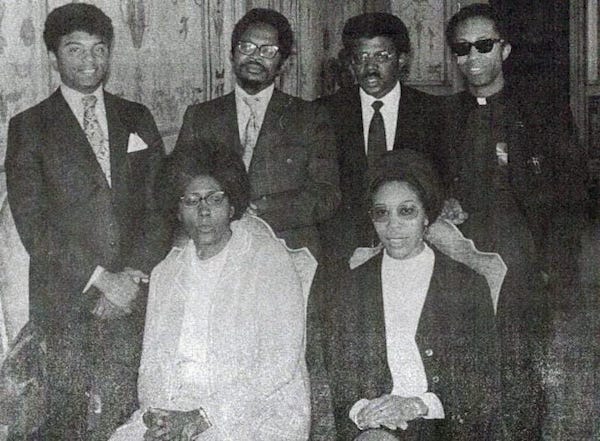
Fifty-five years ago, six Black Catholics crossed the Atlantic to the Vatican to discuss racism in the American Church. They never got the audience with Pope Paul VI they sought, but experts say what they started is still shaping U.S. dioceses today.
“If you see a multicultural office or an office for ministry for Black Catholics within a (U.S.) diocese today, that came out of the Black Catholic movement of the late ’60s and early ’70s, which this delegation was part of,” explained Joseph Flipper, associate professor of theology at the University of Notre Dame and author of “The Black Catholic Movement: An Unfinished Fight for Self-Determination in the Church.”
The six-person delegation, which traveled to the Vatican in October 1971, included Father Lawrence Lucas, co-founder of the National Black Catholic Clergy Caucus; Sister Martin de Porres Grey, president of the National Black Sisters Conference; Brother Joseph Davis, executive director of the National Office for Black Catholics; and lay leaders Estelle Collins, Joseph Dulin, and Charles Hammock.
The delegation did not get the sit-down with Pope Paul that they sought. However, they met with high-level Vatican officials for about 90 minutes, including Cardinal John Wright, prefect of the Congregation for Clergy, and Archbishop Giovanni Benelli, the undersecretary of state.
The delegation’s members brought with them a list of grievances over the American Church’s treatment of black people. Chief among them were that churches and schools in minority communities were not receiving financial or spiritual support from dioceses and a lack of upward mobility for black priests, who were not being promoted to the ranks of monsignor or bishop in adequate numbers.
RELATED: Black Catholic History Month Mass Salutes Divine Nine
The delegation also asked the Vatican to appoint a black man as archbishop of the Archdiocese of Washington, D.C. — something that ultimately happened in 2019 with the appointment of Archbishop Wilton Gregory, who was elevated to cardinal in 2020.
“They were received. They were heard. But then the Vatican officials referred them back to bishops in the United States,” Flipper explained. “In effect, they were saying, ‘The kinds of questions and issues that you are bringing up to us are things that need to be resolved at a local level.’ ”
Still, Father Collins Adutwum, adjunct assistant professor in St. John’s University’s Department of Theology and Religious Studies, noted that the group’s efforts were crucial in planting seeds and inspiring black Catholics back home. He said their desire for change in the Church went hand in hand with the Civil Rights Movement.
“There was a strong sense of pride because these people were able to go all the way to the level of the Vatican, where before, it was people fighting to have their voices heard within their local dioceses. … It was also a way of challenging the Church to live up to its teachings,” Father Adutwum said, noting that progress has been made.
“The Church walks, but walks slowly. Fast forward to now, you have different U.S. bishops who are black,” he said. “It did take time for the desired change to happen, but sometimes what matters in the end is that your voice is heard.”