


LITTLE ITALY — A map issued by the Mamdani administration to showcase New York’s international neighborhoods during the World Cup didn’t score a goal with some City Council members who expressed outrage when several communities famous for their immigrant roots — such as Little Italy — were omitted by cartographers.
And while council members who spoke to The Tablet on July 10 said they were pleased that Mayor Zohran Mamdani stated at a press conference that the map would be updated to include Little Italy, at least one lawmaker said she intended to keep putting pressure on City Hall to include other ethnic neighborhoods.
“We’re going to keep pushing,” said Councilwoman Joann Ariola, a Republican who represents Howard Beach, Ozone Park, Breezy Point, and other Queens neighborhoods. “Little Italy isn’t the only Italian community in our city. There’s Howard Beach and Arthur Avenue in the Bronx.”
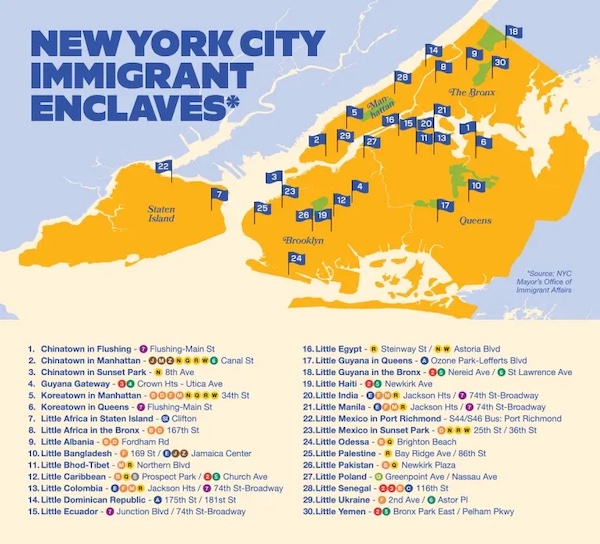
The controversy erupted after the city released a map on July 8 titled “New York City Immigrant Enclaves” to promote the city as an international hub during the World Cup.
The map included such communities as Little Bangladesh in Flatbush, Little Egypt in Astoria, Little Palestine in Bay Ridge, and the city’s three Chinatowns in Manhattan, Flushing, and Sunset Park, but Little Italy didn’t make the cut. Neither did Borough Park, the traditional Jewish community, and Irish neighborhoods like Woodside, Queens, and Woodlawn in the Bronx.
Facing fierce backlash — that included a statement from the City Council’s Italian Caucus demanding that the map be redrawn — the Democratic mayor said the city would make an adjustment.
RELATED: As World Cup Begins, Queens Priest is Feeling the Fever
Speaking at a press conference on an unrelated topic on July 10, Mamdani also defended the map, saying it was initially created by the Adams Administration.
“This map was initially created by the prior administration in 2023, and when we inherited it, we added a few additional neighborhoods. It’s clearly not an exhaustive list of the more than 200 ethnic communities that call our city home,” the mayor told reporters. “We’re going to be making additional changes in the future to reflect that, and that includes adding Little Italy to the map.”
Ariola, co-chair of the council’s Italian Caucus, said that she’s glad “to see that the mayor has seen the light,” but added that the map mess should not have happened in the first place.
“My initial reaction was outrage. Little Italy was the original “Little” neighborhood going back more than 100 years,” she added. “And you’re just going to cancel it? It’s an example of the mayor’s selective inclusivity.”
Councilman Frank Morano, a Republican whose district includes the South Shore of Staten Island, said that while he was happy with Mamdani’s promise, he added, “It’s too bad it took a ruckus from us to get him to move on this.”
Morano, co-chair of the Italian Caucus, said the map disrespected many of the immigrant communities that helped build the city. “It’s like they tried to wipe away history,” he said.
RELATED: How Immigrants Helped Shape the Diocese of Brooklyn’s Growth
Objections to the map came from both sides of the political aisle.
Councilman Christopher Marte, a Democrat who represents Little Italy and is a member of the council’s Irish Caucus, said he was disappointed when he saw the map and pleased to hear that the mayor is willing to redraw it.
“I look forward to seeing the new map. Immigrants have contributed so much to our city, and any map meant to highlight their importance should reflect that,” he said.
Councilmember Eric Dinowitz, a Democrat who represents Riverdale, Spuyten, and Kingsbridge in the Bronx, said the map “erases the contributions of major communities who helped build this city into what it is today.”
Dinowitz, who noted that the city “was built by immigrants,” called New York “the most diverse city in the world.”