
There’s now an ugly and utterly predictable dynamic on Easter Sunday: Somewhere in the world, full churches will be attacked and some number of Christians will die.
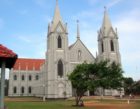
There’s now an ugly and utterly predictable dynamic on Easter Sunday: Somewhere in the world, full churches will be attacked and some number of Christians will die.

Jesus’ gesture of washing his disciples’ feet, an act once reserved to servants and slaves, is one that all Christians, especially bishops, must imitate, Pope Francis told hundreds of inmates and prison employees on Holy Thursday.
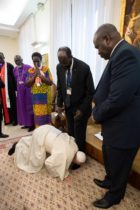
At the end of a highly unusual spiritual retreat for the political leaders of warring factions, Pope Francis knelt at the feet of the leaders of South Sudan, begging them to give peace a chance and to be worthy “fathers of the nation.”
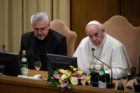
Pope Francis railed against human trafficking, once again labeling it a “crime against humanity” while addressing a Vatican-organized conference in Rome on the issue April 11.
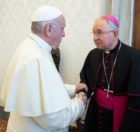
Archbishop José Gómez, the de facto head of the United States Conference of Catholic Bishops (USCCB) as the body’s president, Cardinal Daniel DiNardo, faces health issues, will travel to Rome the week after Easter to meet Vatican officials to discuss new measures for U.S. bishop accountability.
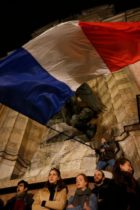
Monday’s stunning fire at the Cathédrale Notre-Dame de Paris, which has left the magnificent Gothic structure a smoldering hulk of its former self, represents a devastating blow not merely to French Catholics but to Catholicism everywhere, since it’s one of those sites that transcends its nationality and culture.
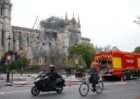
The president of France and the archbishop of Paris have vowed to rebuild Notre Dame Cathedral after a devastating fire, continuing what a professor of architecture described as the natural lifecycle of a historic building.
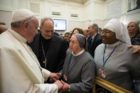
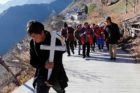
For Sister Eugenia Bonetti, recently tapped by Pope Francis to write the reflections for Friday’s Way of the Cross, the aim will be to show the world the ways in which Christ still suffers today.
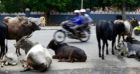
The murder was the latest in a series of “cow vigilante” incidents in the country, where Hindus attack Christians and Muslims who are accused of killing cows, which are considered sacred in Hinduism.
Accepting an invitation from the Chinese government, the Holy See is one of a number of nations and organizations participating in an international garden expo in Beijing.