


As the U.S. government continues releasing information about unidentified anomalous phenomena (UAPs), the Catholic Church has been asking its own questions — for far longer than most people realize.
While the Church has no official dogma on extraterrestrial life, the question has occupied Catholic thinkers for centuries. The Vatican has maintained an astronomical observatory since 1582 and has held conferences on the topic as recently as 2014.
“Some people have always felt that the Church is very anti-science, and that has just never been true,” said Father Joseph Gibino, vicar for evangelization and catechesis in the Diocese of Brooklyn. “When you think about how the Vatican has had an observatory for over 500 years — that’s pretty remarkable.”
Father John Cush, professor of dogmatic theology at St. Joseph Seminary and College, added that the Church “has never issued any definitive doctrinal statement about intelligent extraterrestrial life. However, it does not exclude the possibility.”
God, as professed in the Nicene Creed, is the maker of heaven and earth, of all things visible and invisible — yet nothing in Catholic doctrine states that Earth is the only place where life exists.
“Theologically speaking,” Father Cush said, “if God chose to create life elsewhere, it would simply be another manifestation of divine creativity.”
“The Church considers the existence of intelligent, non-human life to be compatible with our faith,” Father Gibino added. “The Vatican astronomers have stated that finding (extraterrestrials) would not contradict any belief in God, as God is free to create life wherever he wishes.”
Father Cush reached back further into the tradition, quoting St. Thomas Aquinas: “The divine power extends beyond the order of the universe.”
The deeper theological questions, both priests agreed, concern original sin and salvation.
Father Cush laid out the possibilities: extraterrestrial beings may not be fallen and have no need of redemption; Christ’s redemption may apply universally to all rational creatures, or God might provide different means of redemption for different races.
The anchor, he said, is Christ himself.
“If extraterrestrial beings exist, they too would ultimately be within the cosmic lordship of Christ,” he said, pointing to St. Paul’s letter to the Colossians: All things were created through him and for him.
Father Gibino raised a related possibility. St. Bonaventure asked what creation would look like had there been no original sin.
Father Gibino also pointed to C.S. Lewis‘s Cosmic Trilogy, which imagines a world on Venus where creation never participated in the fall.
“What if there was a life form in the universe that did not participate in evil?” Father Gibino asked. “What would that look like?”
Both priests were clear about what the Church does not entertain.
“A lot of this very popular, sort of ancient alien theory that says the ancient gods were extraterrestrial or angels — the Church doesn’t accept any of that,” Father Gibino said.
Long before the U.S. government began declassifying UAP reports, the question of otherworldly visitors was visible in Christian art.
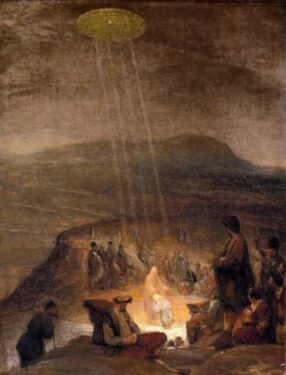
Dutch painter Aert de Gelder completed The Baptism of Christ around 1710, depicting the scene at the River Jordan bathed in beams of light streaming from a large disc hovering in the sky. In most classical depictions, that light emanates from a dove — the Holy Spirit descending upon Jesus, as described in Matthew 3:16.
Father Cush said the disc should be read no differently.
“It represents the opening of heaven and the glory of the Father,” he said. “The painting therefore depicts the Trinitarian manifestation at the beginning of Christ’s public ministry, a theme deeply rooted in Christian theology and artistic tradition.”
For those who see extraterrestrial meaning in sacred imagery, however, it has become one of the most cited examples of what they call evidence hidden in plain sight.
Father Gibino said the broader question deserves serious engagement regardless.
“It does ask us to consider creation, salvation in Christ, the nature of evil, original sin,” he said. “There are embedded, very important discussions here that are just good for adult faith formation.”