
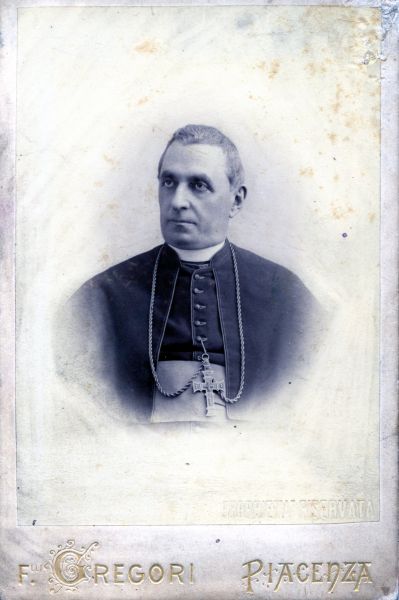
GREENWICH VILLAGE — St. John the Baptist Scalabrini, the Italian bishop known as the “Father of Migrants,” spent 14 weeks speaking up for immigrants across the United States in 1901. A century and a quarter later, his followers are still doing the same.
St. Scalabrini visited America in 1901, from Aug. 3 to Nov. 12, stopping in cities including New York, Utica, New Haven, Boston, Cleveland, Cincinnati, St. Paul, Providence, and Washington, D.C. His journey included stops at two churches in Greenwich Village — Our Lady of Pompeii and St. Joachim — and St. Joseph’s Seminary and College in Yonkers.
“He had a really busy, packed itinerary, met a great number of people, including President Roosevelt, and talked about the struggles of migrants wherever he went,” said Dr. Mary Brown, archivist at the Center for Migration Studies of New York (CMS).
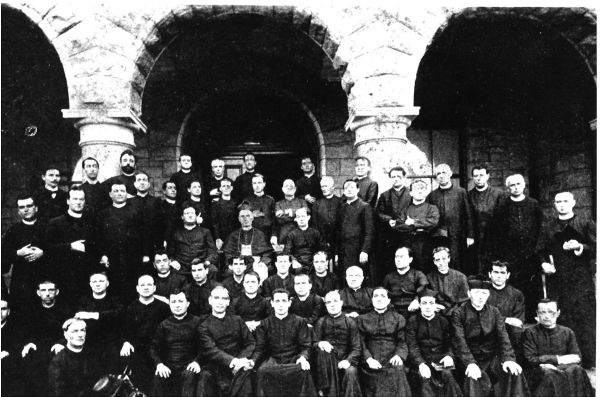
The future saint, who was known as the “Father of Migrants,” met with President Theodore Roosevelt at the White House on Oct. 10 and urged him to protect Italian migrants from discrimination and violence.
St. Scalabrini (1839-1905), who was canonized by Pope Francis in 2022, was the bishop of the Diocese of Piacenza, Italy — today the Diocese of Piacenza-Bobbio — at the time of his U.S. visit. By then, he was already well known for having founded the Congregation of the Missionaries of St. Charles (commonly known as the Scalabrinians), a religious order of priests and brothers dedicated to working with migrants, in 1887.
When he arrived on U.S. shores, Lower Manhattan and Greenwich Village were home to large numbers of Italian immigrants, many of whom faced discrimination in jobs and housing and were forced to live in cramped tenements.
Within days of his arrival, Bishop Scalabrini visited Our Lady of Pompeii Church, then located at the corner of 6th Avenue and Bleecker Street, celebrated Mass, and blessed children receiving the sacraments of Communion and confirmation.
“He blessed the icon of Our Lady of Pompeii that was in the church,” said Father Jefferson Bariviera, the current pastor and a member of the Congregation of the Missionaries of St. Charles.
The church building was closed when Sixth Avenue was expanded in 1926 and is now located on Carmine Street.
St. Joachim Church on Roosevelt Street was another major stop on his tour, as it was the first national parish established for Italian immigrants in the United States. The church’s Scalabrinian priests presented him with a book of watercolor paintings of the Congregation of the Missionaries of St. Charles’ countrywide missions.
Also, during his stay in New York, he blessed the new building for the St. Raphael Society, an organization near Our Lady of Pompeii Church that provided legal help and other forms of assistance to newly arrived immigrants. Father Bariviera said the society, which ended its operations in 1923 when other organizations took over its work, embodied the spirit of the Congregation of the Missionaries of St. Charles.
“Since the beginning, the idea of the Scalabrinians was to accompany the migrants spiritually, but at the same time socially,” he explained. “The idea of the Scalabrinians was to incorporate the immigrants into society.”
Before he sailed home, Bishop Scalabrini also crossed the East River. The Scalabrinians’ itinerary, drawn from his diary and letters, notes that on Nov. 6, he visited Brooklyn’s Italian community after lunch, less than a week before he left New York for Italy.
Bishop Jacques Fabre-Jeune of Charleston, South Carolina, a member of the Congregation of the Missionaries of St. Charles, said Bishop Scalabrini believed in walking alongside migrants.
“He was a good pastor,” Bishop Fabre-Jeune said. “He was a pastor who listened to the cries, to the plight, of his sheep.
“Always at the forefront of his mind was the dignity of the human person.”
While his pastoral journey focused on advocating for migrants, Bishop Scalabrini also encouraged the clergy. During a week-long stay at St. Joseph’s Seminary, he led a retreat for 40 priests and missionaries.
Mario Russell, executive director of the CMS, said Bishop Scalabrini’s visit to the U.S. left a lasting impact.
“The Center for Migration Studies is one of the direct legacies of the intelligence and imagination of Bishop Scalabrini, who really understood that to minister to migrants, to welcome and integrate them,” Russell said. “It was important to be in the field, to be in the places and spaces where migrants are.”