My dear brothers and sisters in the Lord,
Winston Churchill, quoting one of his obscure predecessors, remarked “Democracy is the worst form of government, except for all the others.” This year’s election certainly seems to bolster the Prime Minister’s position.
Many have commented upon and much has been written about the inadequacies of both the Republican Party and Democratic Party presidential nominees. Mr. Trump and Mrs. Clinton are polarizing political figures nationally and broadly unpopular with the members of their own respective parties.
So what must we do as Catholics and faithful citizens? In a representative democracy, voting is a fundamental responsibility. It is not simply a civic requirement, but rather a moral obligation.
Saint John Paul II reminds us, “…the lay faithful are never to relinquish their participation in ‘public life’, that is, in the many different economic, social, legislative, administrative and cultural areas, which are intended to promote organically and institutionally the common good.” (Christifideles Laici, 42)
Elected officials have authority based on our consent. Therefore, we share the burden for the evil that the state may perpetrate, as well as the credit for the goodness of its policies and deeds.
So we might begin by asking what is the purpose of the government or the State? In the Catechism of the Catholic Church (cc) we read, “Human society can be neither well-ordered nor prosperous unless it has some people invested with legitimate authority to preserve its institutions and to devote themselves as far as is necessary to work and care for the good of all.” (cc1897) Thus, we can conclude that the purpose of government is to work towards the common good.
All answers lead us to another question. What is the common good? The Church understands the common good as creating the conditions so that as individuals and as a group we may find fulfillment. This is not dissimilar to our Founding Fathers, in writing the Declaration of Independence, prioritized the rights of “Life, Liberty and the Pursuit of Happiness.”
Over the next weeks until the presidential election, we will look at the positions of the two presidential candidates and how their positions on various domestic and international issues are con- sistent or inconsistent with the three fundamental components of the common good.
They are as follows:
1. “The right to act according to a sound norm
of conscience and to safeguard . . . privacy, and rightful freedom also in matters of religion.” (cc1907)
2. “To make accessible to each what is needed to lead a truly human life: food, clothing, health, work, education and culture, suitable information, the right to establish a family, and so on.” (cc1908)
3. “The stability and security of a just social order.” (cc1909)

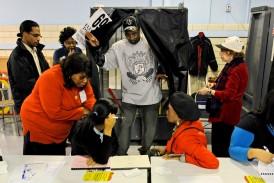
Typically, elections turn on categories of liberal, conservative, left and right paradigms. These categories are fundamentally inconsistent with the teachings of the Church.
Indeed, we as Catholics must prioritize the “right to life.” It is accurate to think of the sanctity of life as non-negotiable for the Catholic voter. At the same time, in a Doctrinal note issued by the Congregation for the Doctrine of the Faith (CDF) in 1999, Bishops were reminded that, “A well- formed Christian conscience does not permit one to vote for a political program or an individual law which contradicts the fundamental contents of faith and morals. The Christian faith is an integral unity, and thus it is incoherent to isolate some particular element to the detriment of the whole of Catholic doctrine. A political commitment to a single isolated aspect of the Church’s social doc- trine does not exhaust one’s responsibility towards the common good.” (CDF 4)
For us as Catholic citizens, it is gravely wrong to vote for a candidate because he or she supports laws and policies that allow for the destruction of innocent human life. At the same time, the commitment to safeguarding human life in one stage of development does not relieve us from the responsibility to promote respect for human life and dignity at all other stages and in all other spheres of our common life as a society.
Our Catholic Faith requires that we go about the hard work of forming our conscience. This involves reflecting on the Sacred Scriptures and the plan that Almighty God has for us – His creation which He loves. At the same time, we study the constant teaching of the Church and see how the great Fathers and Mothers of the Church have understood the application of Scripture to the very real and evolving circumstances of our world. Then, after all of this and considering the discrete choices that confront us, we are called to choose.
Voting is choosing and it requires the great gift of prudence. The American bishops remind us that “Catholics may choose different ways to respond to compelling social problems, but we cannot differ on our moral obligation to help build a more just and peaceful world through morally acceptable means, so that the weak and vulnerable are protected and human rights and dignity are defended.” (Forming Consciences for Faithful Citizenship 20)
Our Nation and world constantly put out into the deep in the face of difficult and seemingly insurmountable challenges, from callous disregard for human life both in the womb and at the end of life to strife in our cities; religious persecution abroad to racial tensions at home; an economy that has left so many behind to the disintegration of the family; war abroad and the threat of terrorism at home to the plight of immigrants. All of us pray for a world in which human life, economic prosperity and peace between nations flourish. If that is what we desire, then we also must vote to make it a reality.