
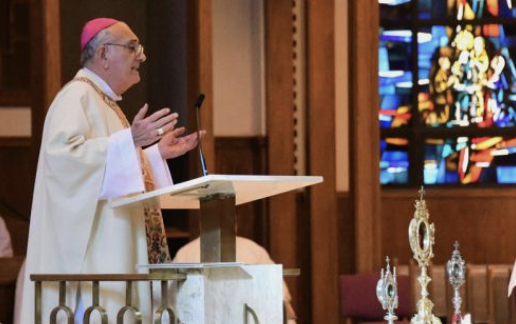
WINDSOR TERRACE — A federal judge denied a request made by the Diocese of Brooklyn for a temporary restraining order to block Gov. Andrew Cuomo from enforcing his new COVID-19 rules on houses of worship.
Judge Eric Komitee’s decision, handed down late at night on Oct. 9 following a hearing that afternoon, means that the new restrictions Cuomo mandated can go into effect.
The hearing took place one day after the diocese filed its lawsuit.

While writing that the decision was a “difficult” one, Komitee sided with the governor. “Under Supreme Court precedent, the right to freely exercise one’s religion does not exempt worshipers from compliance with ‘neutral, generally applicable regulatory law (s).’”
In his decision, Komitee wrote that Cuomo’s executive order was actually aimed at houses of worship in the Orthodox Jewish community and that the diocese “appears to have been swept up in that effort having been mostly spared, so far at least, from the problem at hand.”
The judge noted that in an appearance on CNN Newsroom with Poppy Harlow and Jim Sciuttto on Oct. 9, Cuomo stated that “the cluster is a predominantly ultra-orthodox (Hasidic) community” and that “the issue is with that ultra-orthodox community.”
Bishop Nicholas DiMarzio issued a statement on Oct. 10 expressing disappointment with the judge’s decision and vowing that the diocese’s fight is not over.
“We are disappointed by last night’s initial ruling, but this is only the beginning of the case, and we expect ultimately to prevail. We are seeking what is just,” the bishop stated. “And we have kept parishioners safe and will continue to do so. Thus, there is no reason for this latest interference with our First Amendment right to celebrate Mass together, so we will continue to press the courts and our elected officials to end it as soon as possible.”
But Bishop DiMarzio also said the diocese intends to obey the governor’s new regulations. The first Sunday Masses with the new rules in effect will take place on Oct. 10
“We are left with no choice but, for now, to abide by the new restrictions that limit Mass attendance to 10 people in the red zones and 25 in the orange zones. But we will continue to fight to vindicate our fundamental constitutional rights, and we will continue to be a model for safety in our religious community. And by doing right and being right, we will prevail,” he said.
The judge’s ruling came several hours after a different federal judge sided with the governor in a separate lawsuit filed by Agudath Israel of America, a coalition of Orthodox Jewish organizations, that was also seeking to stop Cuomo’s order from taking hold.
Borough Park, a predominantly Orthodox Jewish community in Brooklyn, has been the scene of nightly demonstrations this week by protesters objecting to the new limits.
On Oct. 6, the governor announced new limits on the number of people allowed to attend religious services in houses of worship in so-called red zone neighborhoods designated as COVID-19 hot spots. In some neighborhoods, only 10 people will be allowed to attend services.
The diocese filed suit against Cuomo in his official capacity as governor, charging that the restrictions he put in under his New Cluster Action Initiative violate religious freedom. The governor announced his initiative on Oct. 6 in response to an increase in COVID-19 positivity cases in Brooklyn and Queens neighborhoods — in some neighborhoods, the rate is as high as 5 percent.
Under the New Cluster Action Initiative, three zones are being created — red, orange, and yellow — with red zones falling under the most severe restrictions. In red zones, churches and other religious institutions are limited to 25 percent capacity, with no more than 10 people. In orange zones, attendance at religious services is restricted to a maximum of 33 percent capacity with no more than 25 people. In yellow zones, 50 percent capacity would have been permitted at services.
The diocese noted there are 28 churches and parishes within the red and orange zones in its court filing.
The bishop said the diocese had no choice but to file the lawsuit.
“As the leader of the Diocese of Brooklyn, I have a sacred duty to spiritually provide for all parishioners, mothers, fathers, and our children who attend church. We filed this lawsuit in the name of the 1.5 million Catholics who worship in our Diocese, who celebrate Mass in 33 languages and come from a diverse tapestry of ethnicities, races, and nationalities, so that we could all keep our right to pray in church as one community of believers. Last night’s initial decision is a sad day for our Church community, but we will not let it deter us from our faith. I ask all Catholics to join me in continued prayer for the end of this terrible virus,” he said.
The diocese also charged that the governor’s order is unfair because it treats religious institutions differently than secular entities.
As an example, the lawsuit pointed out the “starkly different consequences the order imposes on secular business, allowing, for instance, hundreds of people to shop at a grocery store but limiting worship in a 1,200-seat church to a mere 10 parishioners (nine including clergy).”
While several neighborhoods in Brooklyn and Queens have seen increases in COVID-19 cases, the churches have not seen a spike, according to the bishop.
The diocese also outlined, in detail, how it has carefully managed the Masses in its churches to ensure the safety of church-goers. A section of the court document filed by the diocese reads as follows:
- Ensure that parishioners wear masks at all times.
- Block off every other pew so congregants cannot sit immediately in front of or behind one another.
- Mark off seats with tape six feet apart within each open pew to ensure appropriate social distancing.
- Provide hand sanitizer stations throughout the church.
- Remove all hymnals, missalettes, and other worship aids from pews.
- Only open for abridged hours both on weekdays and for weekend masses.
- Keep multiple doors open for various points of entry and exit, and direct traffic in and out of the church, to ensure that worshipers enter and exit in a socially distant manner.
- Retain additional ushers and security guards to enforce compliance with all of the required procedures and protocols.