


Forty-seven years ago, American runner Tommie Smith took the gold medal stand after setting a new world record in the 200-meter race at the 1968 Mexico City Olympics.
He was joined by his teammate, John Carlos, who finished in third place.
Though this set-up seems like any typical occurrence on an Olympic podium, this particular medal ceremony soon became memorable.
Wearing black socks, scarves, necklaces and one black glove each during the playing of the national anthem, Smith and Carlos bowed their heads and raised a fist to give the “Black Power” salute – a gesture signifying the inequalities faced by blacks during the Civil Rights Movement.
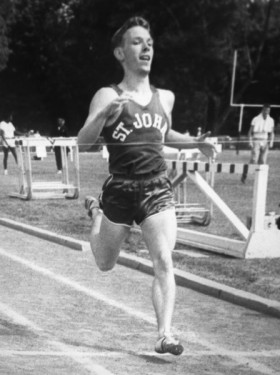
As this was going on, standing in the front row was Tom Farrell, a product of Our Lady Queen of Martyrs parish, Forest Hills. He was a teammate of Smith and Carlos who was competing in his second Olympic Games.
The journey for Farrell to arrive at that moment began at Archbishop Molloy H.S., Briarwood, when he joined the school’s track team as a freshman in 1957. He eventually earned a track scholarship to St. John’s University, Jamaica.
After becoming St. John’s first-ever NCAA champion as a junior in college, Farrell qualified for the 1964 Tokyo Olympics, where he finished in fifth place in the 800-meter run.
“I still pinch myself that it happened,” said Farrell, who also was a 1965 NCAA champion en route to becoming one of the most decorated athletes in St. John’s history. “It was awesome to not only represent the country but you represent people you went to high school with, represent St. John’s, your parents, your family. It was just awesome to be part of the Olympic team.”
After graduating from St. John’s in 1966 and joining the U.S. Army, Farrell again qualified for the Olympics in 1968. This time around, he won the bronze medal in the 800-meter run.
In the months leading up to the Olympics, he developed friendships with Smith and Carlos, especially since Carlos was also originally from New York City. At the time, there were discussions, led by Dr. Harry Edwards from UCLA, that black athletes should boycott the Olympics to protest the societal injustices they faced.
But rather than boycott a once-in-a-lifetime opportunity, Smith and Carlos had a different plan. And right when they crossed the finish line on Oct. 16, 1968, Farrell knew he needed a front-row seat.
For their actions in giving the “Black Power” salute, Smith and Carlos were booed vehemently by the crowd as they left podium. Additionally, International Olympic Committee President Avery Brundage suspended the two athletes for the rest of the games and banned them from the Olympic Village.
The image became front-page news around the globe, and Smith and Carlos received heavy criticism, including death threats to their families. However, as is the definition of a team, Farrell and the other U.S. track Olympians supported their teammates.

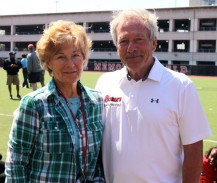
“We were part of a team,” he said. “We all loved each other. We were all friends. There were no problems among any team members. We supported what they thought was right.”
Years later, the iconic Olympic moment is remembered as a powerful stand taken by two athletes who firmly believed in their cause – no matter the consequences.
“What they did was a tremendously patriotic statement that they were sincere about,” Farrell said. “It demonstrated what they felt was right because of all the injustices that blacks had undertaken through so many years. You look back many years later, and these guys are heroes for what they did.”
These days, Farrell, who was a member of the St. John’s inaugural Hall of Fame class, splits his time between New York and Los Angeles. For the past 15 years, he has served as a volunteer assistant track coach at his alma mater, serving as a mentor to the runners. The track team hosts a track meet in his honor, the Tom Farrell Classic, each spring.
“St. John’s has a fondness,” he said. “I love the school; I love the kids. The school has been very good to me. It was my way of giving back.”
Every once in a while, Farrell will run into Smith or Carlos to relive those Olympic memories. And in the true spirit of team, he has always stood by his teammates’ iconic gesture.
“They’re my brothers,” he said. “They sure are!”
Contact Jim Mancari via email at jmmanc@gmail.com.