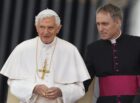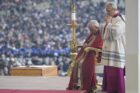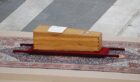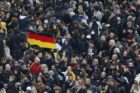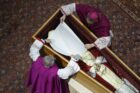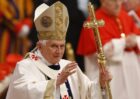
CASTEL GANDOLFO, Italy (CNS) – With a warm embrace, a helping hand, shared prayer, a long discussion and lunch together, Pope Francis spent several hours with retired Pope Benedict XVI March 23 at the papal summer villa.
Posted on 27 March 2013.
CASTEL GANDOLFO, Italy (CNS) – With a warm embrace, a helping hand, shared prayer, a long discussion and lunch together, Pope Francis spent several hours with retired Pope Benedict XVI March 23 at the papal summer villa.Posted in UncategorizedComments (0)
Posted on 07 March 2013.
by Ed Wilkinson

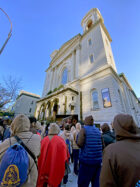
Women pray at Immaculate Heart of Mary Church, Windsor Terrace, during a special Mass of thanksgiving for the pontificate of Benedict XVI.
About 150 people showed up on Feb. 26 for a Mass of thanksgiving for the pontificate of Pope Benedict XVI at Immaculate Heart of Mary Church, Windsor Terrace.
Auxiliary Bishop Raymond Chappetto was the main celebrant of the liturgy that was sponsored by the local cluster of parishes.

At a Mass of thanksgiving at Immaculate Heart of Mary, the faithful were encouraged to pray for the cardinals who will elect the new pope.
Concelebrants included Msgr. Joseph Grimaldi, episcopal vicar for Brooklyn; Father Robert Adamo, pastor of Immaculate Heart; Father James Cunningham, pastor of Holy Name, Park Slope; and Father Francis Obu-Mends, in residence at IHM. Assisting at the altar were Deacons Jim Noble and John Cantirino of Immaculate Heart; Deacons John Devaney and Felipe Almendarez of Holy Name; and Deacon Marco Lopez, who served as master of ceremonies.
When Pope Benedict was elected eight years ago, Bishop Chappetto noted: “We wondered what he would be like, would he be accepted, could he be a pastor to the world?
“He did it. He became a wonderful pastor and shepherd of souls. He travelled the world, preaching about Jesus and writing about Jesus.”

priests process from the altar following Mass of thanksgiving for Benedict XVI.
Bishop Chappetto said that Benedict was the first pope he had ever met. He went to Rome shortly after he was ordained a bishop and personally thanked the pope.
“I told him that I wanted to thank him very much for naming me a bishop,” Bishop Chappetto said. “He only said three words, ‘God bless you.’ But his eyes spoke volumes. T
hey spoke to me about love, attention and compassion. I remember looking into his eyes and feeling like I was the most important person in the world to him at that moment.”
Bishop Chappetto concluded: “We look upon his pontificate with gratitude. He truly was a reflection of Jesus Christ to the world and to us as Catholics.”
After Mass, those in attendance were invited to choose a name of a cardinal from a basket and to pray for that prelate during the conclave that the Holy Spirit will inspire his choice for the next pope.
Posted in NewsComments (0)
Posted on 07 March 2013.
VATICAN CITY (CNS) – Chanting the Litany of the Saints, asking a host of holy men and women to help them, the cardinals enter the Sistine Chapel in procession, aware of their enormous responsibility to elect a new pope.
Less than half of the 117 cardinals eligible to vote for a successor to Pope Benedict XVI were in the 2005 conclave that elected him.
Two of those that were – Honduran Cardinal Oscar Rodriguez Maradiaga of Tegucigalpa and South African Cardinal Wilfrid Napier – described the scene as being one of deep prayer and some trembling.
Cardinal Rodriguez Maradiaga told Catholic News Service that, during the conclave, the cardinals spend most of their time in the Sistine Chapel, even though they cast ballots only four times a day.
The time in the chapel includes prayer, writing names on ballots and counting them. But when casting each vote, each cardinal must stand and publicly swear, in Latin, that he is voting according to his conscience. With 115 cardinal-electors expected, that will take time.
“In front of the crucifix and in front of the ‘Final Judgment’ painting, we say, ‘I call Jesus as a witness, and he will judge me that I have elected according to my conscience,’ so you can imagine … why it takes so long. And in the meantime, when everybody is casting their votes, we are praying, so it is like a big cenacle of prayer.”
“This is beautiful,” Cardinal Rodriguez Maradiaga said. “This is the most loving experience, how an election should be. I wish all the elections in the world could be like that: in an atmosphere of prayer.”
Cardinal Napier told CNS that even the way the cardinals are dressed – in choir dress like they dress for liturgies – contributes to the atmosphere of prayer.
Although he has the experience of the 2005 conclave, he said, “It’s probably going to be just as frightening, just as (much) anxiety” this time, especially because “I’d say there’s a wider field of choices, there are younger cardinals who I believe have real qualities of leadership. At the same time perhaps we don’t know each other that well, but we have to put a lot of faith in the presence and activity in the Holy Spirit.”
Cardinal Napier said that when the cardinals arrive in the chapel, they make a formal vow of secrecy, then each cardinal goes up and puts a hand on the Bible, confirming his oath.
Once each cardinal sits down, he said, he thinks “this is it,” and sees on his table the list of names of the cardinals, the ballot paper, the instructions and a small biography of each cardinal.
“Then you know you really are about to get down to business very soon,” he said. There is “a sense of excitement, a sense of anxiety,” wondering “how is it all going to work out?”
“But probably the most solemn, the most difficult, frightening (moment) is when you go with your ballot paper in your hand and hold it up in front of the altar and say, ‘I call on the Lord Jesus, who will be my judge, to witness that I am voting for the one I believe to be worthy.’
“That’s really a moment of intense emotion, faith, all these emotions come together at that point. If I’m voting for unworthy reasons, I’m actually asking Jesus to judge me, to condemn me, so it’s a very, very solemn moment,” Cardinal Napier said.
After each cardinal casts his ballot, the papers are opened and read out, one by one, he said. Since each cardinal has a complete list of cardinals, “you’re ticking off as the votes are being cast for one person or another and then totting it up at the end.”
If no candidate has reached the two-thirds required for a valid election, the ballots and all the lists with their counts “are all gathered and taken to the back of the chapel to be burned. The smoke goes up black (for no pope). It’s very touching,” the South African cardinal said.
U.S. Cardinal J. Francis Stafford, who celebrated his 80th birthday last July and is ineligible to enter this conclave, told CNS, “The conclave is basically an extended liturgy,” with prayer punctuating every moment of the day, including the voting.
“We are called to be silent, to be open to the mystery of God present to us in Christ and the Holy Spirit, and that silence begins with an interior silence … so they can listen to the promptings of God’s spirit because they are doing something very, very significant,” he said.

Cardinals attending a meeting at the synod hall in the Vatican March 4.

German Cardinal Walter Kasper.

Cardinal Oswald Gracias of Mumbai, India, assists Cardinal Ivan Dias of Mumbai.

Cardinals Polycarp Pengo of Dar es Salaam, Tanzania, and Wilfrid Napier of Durban, South Africa.

Cardinals Jaime Ortega Alamino of Havana, Cuba, and Joao Braz de Aviz, prefect of the Congregation for Institutes of Consecrated Life and Societies of Apostolic Life.

Cardinals Justin Rigali, retired archbishop of Philadelphia, and Timothy M. Dolan of New York.

Cardinal Angelo Scola of Milan, Ital.

Cardinal Gianfranco Ravasi, president of the Pontifical Council for Culture.

a Swiss Guard salutes as U.S. Cardinals Roger M. Mahony, retired archbishop of Los Angeles, Edward M. Egan, retired archbishop of New York, and Donald W. Wuerl of Washington enter a meeting.

Argentine Cardinal Leonardo Sandri, prefect of the Congregation for Eastern Churches.

Cardinals Luis Tagle of Manila and Ricardo J. Vidal, retired archbishop of Cebu, Philippines.

Ghanaian Cardinal Peter Turkson, president of the Pontifical Council for Justice and Peace.
Posted in NewsComments (0)
Posted on 06 March 2013.
by Ed Wilkinson
I was in the presence of Pope Benedict XVI three times, twice while he was pope and once before he was chosen to lead the Catholic Church.
In 1986, Cardinal Joseph Ratzinger came to Manhattan to make a philosophical presentation at a Lutheran church. He was considered a controversial figure because he was the head of the Congregation for the Doctrine of the Faith at the Vatican. The visit became more newsworthy because radical gay groups promised to demonstrate in protest of the Church’s stance against the practice of homosexuality.
I wanted to hear this famous cardinal who was not particularly known for making appearances in the U.S. So there I was, on the floor of the Lutheran church, standing next to Cardinal Ratzinger, helping to set up a group photo that also included Cardinal John J. O’Connor, Father John Neuhaus and then-Archbishop Francis Stafford.
True to form, the gay groups disrupted the speech by standing up and yelling out while the cardinal was speaking. N.Y.C. police had been alerted and quickly removed the demonstrators from the church.
My lasting impression of the talk was the gentleness and soft-spoken tone of the cardinal’s remarks, which by the way had nothing to do with homosexuality. It was hard to believe that this was the man so many feared as the Grand Inquisitor.
In 2008 when Benedict came to New York, I was privileged to have been one of a select number of photo-journalists chosen to be at Kennedy Airport to record the pope’s arrival. It was a low-key affair with only a small group of invited guests. My photos of that event were later included in a book commemorating the papal journey.
A few days later, I was back at Kennedy Airport for the much larger send-off that was co-sponsored by the Diocese of Brooklyn and the Knights of Columbus. Thousands of Catholics from the area were invited. Local choirs and bands performed. Bishop Nicholas DiMarzio hosted the event and introduced the pope to all of our auxiliary bishops. Vice President Dick Chaney and his wife Lynn were on hand to offer the nation’s thanks to Benedict for his commitment to peace and justice.
When Benedict XVI was elected in 2005, no one knew what to expect from an already 78-year-old. He surprised us with his vigor and his gentleness. His writings of encyclicals and books were best sellers and introduced us to a man of love and deep faith. He was a teacher and a scholar. He preferred to remain quiet rather than running around the world waving to crowds. But he did what God asked him to do at a time when most of us are kicking back and relaxing.
I once was asked by a Catholic college president whom I would like to hear speak at the school. I said Cardinal Ratzinger. That remark drew a smirk and was ignored. I often wonder if there was any second guessing my suggestion.
We really did get to know Benedict XVI, and that’s why there was sadness last week as he said his goodbyes and retired to a life that he said would be hidden from the public view.
I take him literally. I expect we will see very little of the pope emeritus because he will not want to confuse the world about the presence of two popes. There is only one pope, and Benedict will be the first to remind us of that.
We thank him for allowing us to get to know him. We realize that all of us are better people for his eight years as our pope. We wish him the peace and serenity he has been seeking.
Posted in Columns, Editors SpaceComments (0)
Posted on 28 February 2013.
by Francis X. Rocca
VATICAN CITY (CNS) – In one of his last public appearances, Pope Benedict XVI told an overflow crowd in St. Peter’s Square Feb. 24 that his upcoming retirement does not mean he is abandoning the Church, but that he will be serving it in a new way, through prayer and meditation.
At noon, the pope appeared at his window in the Apostolic Palace to pray the Angelus, a papal Sunday ritual that will not be repeated until after the election of a new pope.
Despite the blustery weather, turnout was several times the usual for such occasions – easily more than 150,000, with some estimates as high as a quarter of a million. The crowd filled the square, except where prevented by barricades, and spilled out into the Via della Conciliazione. Many groups held signs expressing gratitude and affection – “You are not alone,” one read – and national flags from countries as far away as Brazil.
Benedict was the “the rock: solid, strong and unwavering and yet kind and compassionate and loving at the same time,” said Balthazar Aguirre of Our Lady of Mercy parish in Daly City, Calif. He and his two sisters took time off from work to come to Rome for the pope’s last week as the head of the universal Church.
“Prayer doesn’t mean isolating one’s self from the world and its contradictions,” the pope said, in his commentary on the day’s Gospel reading (Lk 9:28-36). “Prayer leads one back to the path, to action.
“Christian existence,” he said, “consists in a continuous climbing of the mountain for an encounter with God, in order to descend again bearing the love and strength derived from it, so as to serve our brothers and sisters with the same love of God.”
Posted in UncategorizedComments (0)
Posted on 27 February 2013.
With great emotion His Holiness Pope Benedict XVI celebrated his final Sunday prayers in St. Peter’s Square, restating his conscientious conviction that his decision to retire is from the Lord.
“If God is asking me to do this, it is precisely so I can continue to serve with the same dedication and love as before but in a way that is more appropriate for my age and for my strength,” he said.
With that same trust in God’s providence, the Holy Father has also set the wheels in motion for the speedy choice of a successor.
We have no penchant for the most popular game in town these days: handicapping the next pope. The required two-thirds of cardinal-electors, we can be reasonably confident, will open their minds and hearts prayerfully to the Holy Spirit under whose guidance they will discern that signal character, experience and personal aptitude which will identify our next Holy Father. We also suspect that, subordinate to any accidentals (charm, country of origin, insider knowledge, etc.) or personal favorites, they will look for what seem to be two essentials at this time: administrative effectiveness and clarity of vision. Under current exigencies, both require extraordinary communication skills within the Church – not just with fluent Italian and English, though not without – and in both secular and religious circles of the contemporary world.
Any pope today faces a formidable challenge to combine effective vision with good administration. The integrity of the central governance of the Church will have to find some equilibrium between the values of transparency and confidentiality. Though the voracious appetite of some in the media is never satiated, it is not always the messenger alone who ignites controversy or fans the flames. Can one criticize the shark smelling morsels tossed overboard from a food fight aboard the ship? Whatever the substance or motives behind the so-called “VatiLeaks” narrative, the very secrecy of the internal investigation will doubtless fuel speculation. The camera is always on, but blaming the messenger, however biased or intemperate, is not a communications strategy. The message itself needs to be clear, positive and vigorous enough to be heard in our cyberspace wilderness, flooded daily as it is with the amplified noise of anything that grabs a headline. Rumors and scandal-mongering are predictable but more likely to take the spotlight when the show itself is not engaging its audience.
Ecclesia semper reformanda (“the Church must always be reformed”) is as relevant today as when Blessed Pope John XXIII inaugurated Vatican II. That reform certainly must include the Church’s central offices – not just now but in every age. No one model of administration can reasonably expect to be effective everywhere for all time. The accountability demanded today has its 2,000-year-old roots in the teachings of Jesus on good stewardship and the faithful rightly expect Church administrators to live for the advancement of the Gospel before their own careers.
At the same time, efficient, transparent and reliable administration is not enough. Church leadership also requires vision. Visionary leadership is more focused on what we are for than what we are against, Whom we proclaim than what we condemn. It inspires disciples more than mere loyalists, producers and not just preservers, motivators and not only managers. Good administration helps pave the way for effective visioning by helping to minimize the distractions from the mission that the vision defines.
Who among our current leaders is or is likely to prove the most competent to fill the Shoes of the Fisherman in so short time we refrain from speculating about. We hope that the leadership we pray for as the Conclave approaches will not fail to provide the Church and the world with the inspired direction we so need now.
Posted in As the Tablet Sees It, EditorialsComments (0)
Posted on 27 February 2013.
by Ed Wilkinson
You can call him Pope Emeritus or Pontiff Emeritus. He’ll wear the white cassock but not the red shoes. He’ll live out of view of the public in what used to be a cloistered convent.
These are some of the things that we know about Benedict XVI’s future as he “retires” from the papacy.
There are a lot more things about the future of the papacy and the Church that we do not know. But we shouldn’t be overly concerned about them.
There is no need to panic because the pope has decided to retire and a new pope will take the reins of the Church.
True, there have been some nasty and distasteful things written about the Church in the media these past weeks. As Catholics, we rely on the guidance of the Holy Spirit, so we believe that things will work out for the best.
Some may be scandalized by the politicking that goes on among the hierarchy prior to the conclave. The truth is that it has always been thus. The Church is a human institution, and it resorts to human methods when having to get something done. It’s the way of the world, and the Spirit will use them to bring all things to fulfillment.
It certainly makes for good theater, and the Church will get a lot of publicity in the coming weeks. It’s important that we all keep our feet on the ground and our eyes on the prize.
This past week, one cardinal resigned his position and gave up his vote in the conclave because he was accused of acting inappropriately toward his fellow priests and seminarians. Exactly what transpired we’ll never know, but it apparently is serious enough that he would take such drastic steps.
The Vatican Secretariat of State has called “deplorable” the “widespread distribution of often unverified, unverifiable or completely false news stories” intended to exert “pressures on the election of the pope.”
Jesuit Father Federico Lombardi, the Vatican spokesman, delivered an editorial on Vatican Radio lamenting “pressures and considerations that are foreign to the spirit with which the church would like to live this period of waiting and preparation.”
He denounced “those who seek to profit from the moment of surprise and disorientation of the spiritually naive to sow confusion and to discredit the Church and its governance,” and accused such people of using “old tools, such as gossip, misinformation and sometimes slander” to influence the cardinals who will be voting in the upcoming papal election.
Neither Vatican statement specified the news stories in question, but Father Lombardi’s editorial referred to distortions by “those who consider money, sex and power before all else and are used to reading diverse realities from these perspectives.”
The Italian press has been portraying the Vatican as divided among political factions, with some officials supposedly subject to blackmail for sexual misdeeds and suggesting a link between bureaucratic infighting and Pope Benedict’s historic decision to step down.
The Spirit will use even the nastiness and frailty of current events to purge the Church of its own sinfulness, and the life of the Body will go on. What’s important is that we not lose our own focus on what really matters in the life of the Church.
We thank Pope Benedict XVI for his yeoman work in guiding the Church these past eight years, and we look forward with great anticipation to the announcement of our next Holy Father.
Posted in Columns, Editors SpaceComments (0)
Posted on 27 February 2013.

Pope greets crowd as he leads his final general audience in St. Peter’s Square at the Vatican Feb. 27.
by Francis X. Rocca
VATICAN CITY (CNS) — On his last full day as pope, Pope Benedict XVI delivered an unusually personal and emotional farewell address, thanking the faithful around the world for their support and assuring them that he would remain in their service even in retirement.
The pope thanked the cardinals, some 70 of whom sat near him in front of St. Peter’s Basilica, and who are expected to begin meeting March 4 to plan the election of the next pope. Pope Benedict also voiced his gratitude to other members of the hierarchy, the Vatican diplomatic corps and “all those who work for good communication,” a category presumably including the press.
Posted in NewsComments (0)
Posted on 20 February 2013.
by Ed Wilkinson
The New York Times ran a column this past week asking the question about whether or not Benedict XVI will still be infallible when he retires.
The answer, of course, is no! Only the reigning pontiff is infallible and only when he makes a definitive statement about faith or morals.
In fact, the Holy Father makes infallible statements very infrequently. In 1950, Pope Pius XII proclaimed the doctrine of the Assumption – that the Blessed Mother was raised body and soul into heaven when her time on earth came to an end. In 1854, Pope Pius IX defined the Immaculate Conception – that Mary was free from the stain of sin throughout her entire life.
There’s a lot being said about Pope Benedict as the final days of his papacy wind down. On Feb. 28, at 8 p.m., his tenure as Holy Father comes to an end. He says he no longer has the strength and energy to devote to the position. It seems a fair and logical statement when you consider the demands put on a pope and one who is 85 years of age.
Pope Benedict is to be admired for acting on this conviction, the first time in modern history that a pope has done so. He feels the Church deserves more than he can give, and he has moved to make that happen.
Most of us grew up with the idea that the pope had to die in office. In fact, there is nothing in Church law that says so. Benedict XVI has introduced a very modern idea – retirement – to an institution that is used to doing things the way they always have. After all, bishops retire at the age of 75, and cardinals cannot vote for the next pope after they reach the age of 80. Maybe the Church should consider a proper retirement age for a pope.
Whoever ascends to the Chair of Peter will have plenty of work to do. There is the not-so-easy task of overseeing the workings of the Vatican, the demands of governing a city-state and the rigors of papal trips – the first of which probably will be the journey to Rio de Janeiro for World Youth Day in July.
Everyone plays the guessing game of who will be the next pope. It’s a lot of fun to speculate, but the Holy Spirit has a way of throwing surprises at us. No one suspected Karol Wojtyla would become John Paul II in 1978! Many of us thought Cardinal Joseph Ratzinger (Benedict XVI) was too old in 2005.
But Benedict XVI turned out to be a pleasant surprise to the world. He came into the role with a reputation for being a strict enforcer of the faith as the head of the Congregation for the Doctrine of the Faith and turned his image upside down when he showed himself to be a man of gentleness and love. His first encyclical, Deus Caritas Est, in 2005 was a beautiful treatise on love being the foundation of the Christian faith. His second letter to the world, Spe Salvi, was a homily on hope to a world that appears so often to be desperate and forlorn. He had been working on another encyclical on faith during this Year of Faith, but it will go into history as the unfinished missive of a great scholar and teacher.
We will miss Pope Benedict as he promises to live out his days hidden from the world, praying for the Church. There have been many things written this week about his legacy, some not too flattering! I prefer to remember him as a man who rose to the occasion, a great intellect and writer, a kind man with a twinkle in his eyes and great affection his heart. I believe he was a great pope!
Posted in Columns, Editors SpaceComments (0)
Posted on 15 February 2013.
Christ Our Hope was the theme of Pope Benedict XVI’s apostolic journey to the U.S. in 2008. The six-day trip, April 15-20, began in Washington, D.C., and concluded in New York City. The Diocese of Brooklyn was present to welcome the Holy Father when he arrived at John F. Kennedy International Airport… While in New York, the pope addressed the United Nations General Assembly; celebrated Masses at St. Patrick’s Cathedral, Manhattan, and Yankee Stadium, the Bronx; and attended a youth rally at St. Joseph Seminary, Dunwoodie… Over 4,000 guests attended his departure ceremony, hosted by the Brooklyn Diocese at Kennedy Airport’s Hangar 19. Below, retired Brooklyn Bishop Thomas V. Daily is in the background as Brooklyn Auxiliary Bishops Rene Valero and Octavio Cisneros bid adieu to the Holy Father… The Holy Father addressed and blessed the faithful in his presence… Bishop Nicholas DiMarzio looks on as Eric Flores, 12, of Regina Pacis parish, Bensonhurst, presented the Holy Father with flowers as a parting gift. (Photos © Catholic News Service and The Tablet)
Posted in NewsComments (0)