Tag Archive | "Mexico"

Mexican Outreach: Newest Apostolate Seeks to Help Integrate Mexicans into the Community

by Marie Elena Giossi

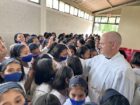
Mexican Catholics are rejoicing in prayer and song over the establishment of the Mexican Apostolate of the Diocese of Brooklyn and Queens. Auxiliary Bishop Octavio Cisneros, below, blessed the ministry and its coordinators during Sunday Mass at St. Joseph’s Co-Cathedral, Prospect Heights, April 7.

Mexican Catholics are rejoicing in prayer and song over the establishment of the Mexican Apostolate of the Diocese of Brooklyn and Queens. Auxiliary Bishop Octavio Cisneros, below, blessed the ministry and its coordinators during Sunday Mass at St. Joseph’s Co-Cathedral, Prospect Heights, April 7.

Clergy and lay people are celebrating the launch of a new diocesan apostolate dedicated to nurturing and preserving the faith, culture and traditions of Mexican Catholics in Brooklyn and Queens.
Auxiliary Bishop Octavio Cisneros bestowed his blessing upon the newly formed Mexican Apostolate during the 10:30 a.m. Spanish Mass at St. Joseph’s Co-Cathedral, Prospect Heights, last Sunday, April 7. He installed the apostolate’s planning committee and coordinators in their new ministry and sent them forth to evangelize their parishes and communities.MexApost5
“Mexicans bring great gifts to the Church,” the bishop said. “They bring a spirit of faith, a spirit of family.…  Our Blessed Mother, under the title of Our Lady of Guadalupe, has kept that faith in our Mexican brothers and sisters, in our families, and now that gift has to flourish and has to flourish with learning what that faith means.”
In recent years, tens of thousands of Mexican immigrants, particularly from the south central Mexican state of Puebla, have settled in the Brooklyn Diocese. Much like other Spanish-speaking immigrants to this country, this rapidly growing group faces the challenges of trying to learn the language, to assimilate and to make lives for themselves.
 “It was about time that we begin to coordinate a ministry to the Mexican community,” said Bishop Cisneros, who coordinated the diocese’s Hispanic Ministry Office in the 1970s and ’80s. “When there is an apostolate, when there is a group that they can go to in their parish and community, then it is easier for them to be integrated into the faith community and into the society.”
Along with Bishop Nicholas DiMarzio, he has spearheaded the establishment of this apostolate, which is under the direction of Mexico City native, Father Jorge Ortiz-Garay, the diocese’s only Mexican-born priest.
“As Mary sent Juan Diego, so too are we being sent forth to bring people back to church and back to their faith,” said Father Ortiz-Garay, parochial vicar at the co-cathedral.
“Back home,” he explained, “faith is the center of our lives.”
However, when his countrymen come to the U.S. in search of jobs and a better life, he said they often lose their sense of faith, family and culture. Forced to work several, often low-paying jobs to make ends meet, they are unable to attend Mass, spend time with family and maintain the traditions of their homeland.

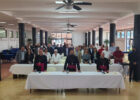
The planning committee and parish leaders of the diocesan Mexican Apostolate, from left, Elimelec Soriano; Natasha Bisbal, St. Laurence Church, East New York; Father Jorge Ortiz-Garay, director; Carolina Zafra, coordinator; and Deacon Felipe Armendarez.

The planning committee and parish leaders of the diocesan Mexican Apostolate, from left, Elimelec Soriano; Natasha Bisbal, St. Laurence Church, East New York; Father Jorge Ortiz-Garay, director; Carolina Zafra, coordinator; and Deacon Felipe Armendarez.

Faithful to Guadalupe Feast
That is why Mexican Catholics are so faithful to Our Lady of Guadalupe, because on her feast day, she brings those three elements back together.
While many still baptize and seek the traditional three-year-old and quinceañera blessings for their children, the reality is that “people are moving away from the church, little by little,” Father Ortiz-Garay said.
The apostolate will work to reverse this trend. Its mission is to evangelize Mexicans, to bring them back into the Church, to deepen their knowledge of the faith through ongoing formation, to promote vocations and to help clergy better understand the culture and traditions of the Mexican people. 
Assisting Father Ortiz-Garay in the apostolate’s day-to-day operations is a small planning committee: Deacon Felipe Armendarez from Holy Name of Jesus parish, Windsor Terrace, and St. Joseph’s parishioners, Carolina Zafra and Elimelec Soriano. To reach out to people on the parish level, lay coordinators have been appointed at the churches of St. Laurence, East New York; St. Leo, Corona; Our Lady of Mount Carmel, Astoria; St. Agatha, Sunset Park; and St. Brigid, Bushwick.
“This is a great opportunity for the Mexican community to have support from the diocese to preserve their faith,” said Zafra, who is currently coordinating parish-level coordinators.

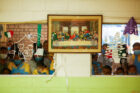
Mexicans celebrated the opening of their apostolate with Mass, songs and cultural cuisine. At left, Auxiliary Bishop Cisneros sings along with parish coordinators of the apostolate in the rectory of St. Joseph’s Co-Cathedral. Photos © Marie Elena Giossi

Mexicans celebrated the opening of their apostolate with Mass, songs and cultural cuisine. At left, Auxiliary Bishop Cisneros sings along with parish coordinators of the apostolate in the rectory of St. Joseph’s Co-Cathedral. Photos © Marie Elena Giossi

When she emigrated from Michocan, Mexico, 26 years ago, she said, “My refuge was the Church, and I was always trying to find family in my parish.” Her hope is that the apostolate will provide the same refuge for the new generation of Mexican immigrants.
Over the past few months, the planning committee has visited churches in communities with large concentrations of Mexican Catholics, such as Sunset Park, Ozone Park, Woodside, Corona, Coney Island and Bushwick, to spread the word about the apostolate.
The apostolate’s first major event will be the diocese’s annual Migration Day Mass this coming Sunday, April 14. The following weekend, catechetical workshops will be held to begin teaching parish coordinators how to evangelize their local communities. 
“We’re taking our patron, the Virgen de Guadalupe as our model of evangelizing,” said Soriano. “We’re trying to have people know each other and help each other, to evangelize them and their families, and to help their children come back to the church.”


Posted in NewsComments (0)

In Mexico, Pope Preaches About Trust

by Francis X. Rocca

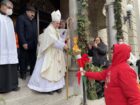
Pope Benedict XVI, wearing a sombrero, arrives to celebrate Mass at Bicentennial Park in Silao, Mexico, March 25. The pope moved on to Cuba, the second stop on his Latin American journey on Monday, March 26.

SILAO, Mexico (CNS) – Celebrating Mass in the Catholic heartland of Mexico, Pope Benedict XVI told a nation and a continent suffering from poverty, corruption and violence, to trust in God and the intercession of Mary to help them bring about a “more just and fraternal society.”
“When addressing the deeper dimension of personal and community life, human strategies will not suffice to save us,” the pope said in his homily during the outdoor Mass at Guanajuato Bicentennial Park March 25, the second full day of his second papal visit to Latin America. “We must have recourse to the one who alone can give life in its fullness, because he is the essence of life and its author.”
Citing the responsorial psalm for the day’s Mass – “Create a clean heart in me, O God” – the pope said that evil can be overcome only through a divinely inspired change of the human heart.
The pope made note of the monument to Christ the King visible atop a nearby hill and observed that Christ’s “kingdom does not stand on the power of his armies subduing others through force or violence. It rests on a higher power that wins over hearts: the love of God that he brought into the world with his sacrifice and the truth to which he bore witness.”
That message was consistent with Pope Benedict’s frequently stated objections to strategies for social progress that blend Christian social doctrine with Marxism or other secular ideologies.
“The church is not a political power, it is not a party,” the pope told reporters on his flight to Mexico March 23. “It is a moral reality, a moral power.”
In his Silao homily, the pope did not specifically address any of Latin America’s current social problems, but after praying the Angelus following the Mass, he recited a litany of ills plaguing Mexico and other countries in the region: “so many families are separated or forced to emigrate … so many are suffering due to poverty, corruption, domestic violence, drug trafficking, the crisis of values and increased crime.”
Speaking in the central Mexican state of Guanajuato, which was a stronghold of the 1920s Cristero Rebellion against an anti-clerical national regime, Pope Benedict recited the invocation that served as the Cristeros’ rallying cry: “Long live Christ the King and Mary of Guadalupe.”
But reaffirming his message of nonviolence, the pope prayed that Mary’s influence would “promote fraternity, setting aside futile acts of revenge and banishing all divisive hatred.”
The presidential candidates from Mexico’s three main political parties attended the Mass, along with President Felipe Calderon and his family.
Church authorities expected at least 300,000 people to attend the Mass, and Mexicans turned out in force, with many taking long trips just to see Pope Benedict on his first trip to the country since being elected in 2005.
Walked Over Three Miles
The journey was not easy for many. Thousands of the faithful walked more than three miles from parking lots in the town of Silao, 220 miles northwest of Mexico City.
“This is nothing too difficult,” quipped Jose Trinidad Borja, 81, a retired hardware store owner from Queretaro who boasts of having participated in the annual eight-day diocesan pilgrimage to the Basilica of Guadalupe in Mexico City for 65 straight years.
An army of vendors hawked water, coffee and tamales along the route in addition to Vatican flags and photos of Pope Benedict and his predecessor, Blessed John Paul II, who, with his five visits, became one of the most beloved figures in an officially secular country.
“With Benedict, I feel something indescribable,” said Guadalupe Nambo Gutierrez, a retired secretary from Guanajuato City, who saw the pope in the colonial town March 24 and attended the Mass the following day.
Getting a ticket was another matter. Nambo won a raffle for some of the tickets the Archdiocese of Leon allotted to St. Joseph and St. James the Apostle parish. Others simply decided to try their luck by showing up – and many could be seen outside the Mass site behind barricades guarded by federal police officers.
Bishop Raul Vera Lopez of Saltillo said his diocese only received its allotment of 2,500 tickets 10 days before the Mass, making it difficult for parishes to plan trips for churchgoers. Still, all the tickets were claimed and more than 6,500 requests were made.
Most of those coming from Saltillo, in northern Mexico, traveled overnight and were expected to return immediately after the Mass. Some parishes opted not to send people to the Mass because of concerns about security along the route.
“We hope that things calm a little after this visit,” said Silao resident Jorge Morales as he walked to the Mass.
The previous evening, Pope Benedict met privately in Guanajuato City with eight people who have lost relatives to recent violence, much of it drug-related, which has killed an estimated 50,000 Mexicans over the last five years.
That meeting preceded Pope Benedict’s brief appearance before a crowd in Guanajuato’s main square.
Addressing his remarks there particularly to local children, the pope called on “everyone to protect and care for children, so that nothing may extinguish their smile, but that they may live in peace and look to the future with confidence.”


Contributing to this story was David Agren.

ope Benedict XVI waves to the crowds gathered on the streets of Guanajuato, Mexico, shortly after he arrived in Mexico on March 23.

Posted in NewsComments (0)

Working Overtime For Papal Coverage

by Ed Wilkinson

What a week it has been!
Pope Benedict’s historic journey to Mexico and Cuba this past week was a huge undertaking.  Not just for the 84-year-old pontiff, but also for our local media here in the diocese.
The DeSales Media Group, which produces both The Tablet and NET television, made a strong commitment to covering the pope’s pastoral visit to Latin America. It meant weekend and overtime hours for everyone on staff.
Liz Faublas, the anchor of Currents, our daily cable news show, guided viewers through the five days of papal coverage. She was ably assisted by expert commentary from diocesan resources. We wanted to offer something that no one else was giving to viewers and we managed to do just that.
When the pope was in Mexico, we reached out to and received help from Father Ray Roden, who takes special interest in the history of the Church in Mexico. He and two native born Mexican seminarians, Jesus Ledezma and Hugo Rodriguez, were our on-air guests as Benedict visited Guanajuato and Leon. The visuals from the shrines and the basilicas were magnificent and Father Roden and his companions explained the significance and the history behind them.  The trio had recently been on pilgrimage and retreat in Mexico, so they were still filled with the excitement and refreshment that such a getaway provides.
As the Holy Father arrived in Cuba, we invited Msgr. Otto Garcia, the Cuban-born pastor of St. Joan of Arc, Jackson Heights, and former Vicar General, to our studio, along with Deacon Felipe Almendarez of Holy Name parish, Park Slope.  They provided the color and offered explanations that only natives from the island could supply.
Our liturgical expert, Father John Cush joined us when the pope celebrated Mass. After his expert commentary during the recent installation of the new cardinals, we knew he was the one we wanted to lead us through the special celebrations.
But that’s not all. Our in-studio performances were complemented by reports from the ground in Mexico and Cuba, where we invested in sending reporters and film crews. NET program director Ryan Stewart was in Mexico with producer Eli Soriano, a native of Mexico, and Father Jorge Ortiz-Garay, a Mexican-born priest who serves at St. Joseph’s Church, Prospect Heights.  In Cuba, Msgr. Kieran Harrington, Vicar for Communications, teamed up with Tablet reporter Antonina Zielinska and producer Will Fonseca. Their packages have been broadcast on Currents all week long as well as being used during our live coverage.
It was not easy getting into Cuba.  For the past month, we have been filing applications with the U.S. and Cuban governments to receive the proper credentials.  Those efforts have paid off with reports about the church in Cuba that you cannot see anywhere else but on NET and the pages of The Tablet.
Our hard working staff crew here in Brooklyn turned in a yeoman effort to transmit these images on your TV screens and produce the words on these pages. But this is what we are all about at DeSales, your one-stop media provider of church news.
We hope that you enjoyed our efforts. Your comments on how we can improve these services in the future are always welcome. DeSales is growing in ways we could not predict even months ago when we were established. We’re committed to going forward to bring you the most informative and most educational church coverage.

Posted in Editors SpaceComments (0)

FATHER PETER J. DALY

Latin America Needs Permanent Deacons

Father Peter J. Daly

Pope Benedict XVI’s visits to Mexico and Cuba were good things. Both countries are extremely troubled. The Catholic Church in those countries could use the encouragement of the Church’s supreme pastor.
I’ve never been to Cuba, but I have frequently been to Mexico and Nicaragua over the past 12 years. We have sister parishes in both countries. We have visited them, and the pastors of those parishes have visited us in the U.S.
Every country has its particular situation, but there are some similar problems. The Catholic Church everywhere, north and south, has been lazy.  We have rested on the assumption that we are part of the culture.  We think that people will learn the faith simply because they are part of a “Catholic culture.” But we cannot rely on culture to do our job.
The Catholic Church in Mexico and Nicaragua is much like the rest of Latin America. Everywhere there is increasing secularism and the challenges of materialism, just as we have in the U.S. There is also increasing competition from evangelical and Pentecostal churches, often “imported” from the U.S.
People are leaving the Catholic Church in Latin America, too. In Puerto Rico and Brazil, there are now more practicing Protestants. Every time I visit Latin America, I see more and more non-Catholic churches.
The Catholic Church in the various parts of the Americas has much that we could learn from one another.  U.S. parishes could learn about joyful and enthusiastic celebration from Latino countries. The Latino Catholic community could learn about the ministry of permanent deacons from North America.
The Catholic Church everywhere needs more clergy. Permanent deacons are part of the answer. The Latin American church could imitate the U.S. in embracing the permanent diaconate.  In the U.S. we have one priest for every 1,500 to 2,000 Catholics, depending on the area. But we have nearly 17,000 permanent deacons, which is about 40% of the permanent deacons in the world.
In Latin America, parishes often have one priest for 10,000 Catholics or more.  In most of Latin America, there are no permanent deacons. I met the only permanent deacon in the whole country of Nicaragua at a funeral a few years ago. There should be one in every village in Latin America.
For many people in rural Mexico or Nicaragua, the church is an empty building.  Many towns have a chapel where Mass is celebrated once or twice a year. People are baptized as babies but then spiritually abandoned.  As a result they become evangelicals or Pentecostals when a local preacher shows up in town. What else could we expect?
But if they had a permanent deacon, it would be better. He could be a married man from the village. He could be trained to preach the word, pray with the sick, officiate at weddings and bury the dead. He could know his people who would be his neighbors.  A permanent deacon could celebrate a Liturgy of the Word on Sunday, preach a homily and distribute the Eucharist consecrated earlier at the parish church.

Father Daly is a priest of the Archdicoese of Washington, D.C.

Posted in Up Front and PersonalComments (2)

Pope Coming to Mexico, Cuba

VATICAN CITY (CNS) – Vatican officials are at an advanced stage in studying the possibility of a papal trip to Mexico and Cuba in the spring of 2012, the Vatican spokesman said.

Jesuit Father Federico Lombardi, the spokesman, told reporters Nov. 10 that the nuncios to Mexico and Cuba have been told to inform those governments that “the pope is studying a concrete plan to visit the two countries.”

Posted in NewsComments (0)