Tag Archive | "Cuba"

Reporter’s Notebook From Cuba

by Antonina Zielinska

After nearly two months of phone calls, paperwork, and tests of resilience, Msgr. Kieran Harrington, diocesan vicar for communications; Will Fonseca, producer and cameraman for NET-TV; and I, landed in Cuba as journalists to cover the pastoral visit of Pope Benedict XVI on March 23.

Despite hours and hours of preparation we landed with only one confirmed interview and assurances that we had hotel reservations. We had no idea what anything would cost – not even the hotel rooms we reserved — or how to function in a society that had just recently changed its atheist mandate.

We were not the only ones with a high sense of confusion. When we landed, Cuban officials did not really know what to do with three Catholic journalists, one of whom was a priest.  Will was interrogated for three hours because the authorities did not like the fact that he had a wireless microphone.  It was not a pleasant welcome, even though the people were very courteous.

My week in Cuba interacting with the locals, led me to the conclusion that the Cuban people are a people of love and charity, living under difficult circumstances. After a tough day of travel and dealing with officials we met our first driver, who was contacted only the day prior. Since we landed in Holguin, he had to drive us to our hotel in Santiago de Cuba, a city he was not familiar with.

Santiago turned out to be a maze of broken roads on hills.  The driver was lost.  So he asked person after person where to go. Most tried to be as helpful as they could be.  Finally, one man showed us the true meaning of Cuban charity. He walked over to a motorcyclist, got on his bike, and led the way for us for about 10 minutes. This man, who had never met us before, did not want us to wander the city in darkness and went out of his way to help us.

The very next morning, we visited the Shrine Church of Our Lady of Charity, the patroness of Cuba and the center of the pastoral visit of the Holy Father. Here, I understood the previous night’s events in a whole new light.

Though we saw very few posted advertisements, during our visit in Cuba, the entire country was decorated with posters declaring “La Caridad Nos Une,” which means “Charity Unites Us.”  These were referencing the patroness and, in the way I saw it, the spirit of the people.

We were able to speak with the rector of the sanctuary, Father Jorge Enrique Palma Arrué, and Sister Martha Leé, H.S., who work in the Church of Our Lady of Charity. They both told us of the great devotion of the people to the Lady of Charity.  Father Palma saw this as a great opportunity to evangelize.  He said Cubans of all walks of life come to visit, even those who do not realize that the Virgin Mother of God and the Lady of Charity are one in the same.

Sister Martha said all Cubans, young and old, men and women, come to visit.  And when Cubans travel abroad among the first things they do is come back to the Lady and offer gifts of thanks for a safe return. Soldiers, athletes, those who were healed and those who are still sick, and others who feel a strong connection to the patroness leave their medals, honors, and other objects at the shrine.

“The Virgin of Charity has always been a bright ray, a star through which God illuminates the people of Cuba,” Sister Martha said.

Sister Martha was able to get me on the phone with Sister Nora Valdivia Velazquez, H.S., who runs three missions on the outskirts of Santiago, one of which is in the village of Refugio.

In Refugio, I was able to see a glimpse of the spirit of the people. The people all lived in shacks, but everything they owned was clean and taken care of.  The children all had shoes on their feet, appeared healthy and could read and write. They did not have paved roads or windows, but they did have televisions, running water and electricity, that went out only occasionally. It was obvious that all the people took great pride in the little they had.

Among their greatest wealth is community. Everyone knew each other and took care of each other. Even one of the most famous baseball players in the country lived in this community.

The parish of St. Joseph caters to communities like this in the outer reaches of the city.  It has 40 mission houses but no church building and only one priest, whom the people see four to five times a year. Therefore it falls to missioners like Sister Nora to evangelize and take care of the people.  She teaches them about the church and helps them help themselves by organizing classes for life skills such as sewing and embroidery. Sister Nora and the Cuban Conference of Catholic Bishops agree that the missions are the future of the Catholic Church in Cuba.

She said she is amazed at the receptiveness of the people. When she started Holy Literature classes, she said she questioned the ability of the adult students to grasp the new concepts. However, she said they were so hungry for knowledge that the classes were a big success. So far she was able to bring over 120 people into the community in the village of Refugio.

¨And who is the greatest promoter of all of this?” asked Sister Nora. “Who helps us succeed and allows us to build the future of the Cuban church?  Our patroness, mother, and queen — the Virgin of Caridad. She is the great advocate who bring us closer to Jesus. She brings her Son to the people of Cuba.”

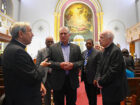
Bishop Nicholas DiMarzio and Auxiliary Bishop Octavio Cisneros are shown in Santiago de Cuba at the Shrine of Our Lady of Charity.

Pope Benedict XVI greets pilgrims before his Mass in Havana’s revolutionary square with the silhouettes of Cuban revolutionary leaders Che Guevara and Camilo Cienfuegos Gorriarán in the background.

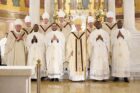
Bishop DiMarzio and Bishop Cisneros concelebrate Mass with Bishop Thomas Wenski at Havana’s Cathedral.


Sister Nora Valdivia Velazquez, H.S., teaches Holy Literature class to a group of students in Refugio, a village where she runs a mission.

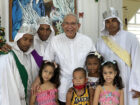
Women from the mission welcome the Brooklyn news team into their home. A poster on their entry door announces the visit of the pope to Cuba.

Posted in NewsComments (0)

It’s a Deal! – Cuba Grants Pope’s Wish to Make Good Friday a National Holiday

by Carol Glatz

Pope Benedict XVI meets with Cuba’s former President Fidel Castro at the apostolic nunciature in Havana March 28.

VATICAN CITY (CNS) – The Vatican spokesman praised Cuba’s decision to accept Pope Benedict XVI’s request to make Good Friday a national holiday this year.
“It is certainly a very positive sign,” Jesuit Father Federico Lombardi, the Vatican spokesman, said April 1.

Good Friday, the commemoration of Jesus’ passion and death, falls on April 6 this year.

During the pope’s private meeting with Cuban President Raul Castro in Havana March 27, the pope asked for further freedoms for the Catholic Church in the communist nation, including the declaration of Good Friday as a holiday.

The Cuban government accepted the proposal March 31 after the pope’s March 29 return to the Vatican.

Father Lombardi said the Vatican hopes that the holiday will enable people to attend religious services and have “happy Easter celebrations.”

The Vatican hopes Pope Benedict’s March 26-28 visit to Cuba “continues to bring the desired fruits for the good of the church and all Cubans,” the spokesman added.

Only Good Friday 2012 has been made a public holiday; the government hasn’t decided whether it will become a permanent celebration, news reports said.

Blessed John Paul II’s trip to Cuba in 1998 led to Cuba recognizing Christmas as a recurring public holiday.

Though the Church estimates 60-70% of Cubans are Catholic, Church officials estimate that only about 2.5% of Cuba’s population of 11 million can be considered practicing Catholics today, a fraction of the proportion prior to the revolution, though it represents a significant rise since Pope John Paul’s visit 14 years ago.

Meeting with Raul Castro
Pope Benedict spent more than 40 minutes meeting privately with Cuban President Raul Castro. During that meeting, he also asked the Cuban leader for further freedoms for the Catholic Church in Cuba and attention to certain “humanitarian” situations.

Father Lombardi told reporters that while he could not give the press details about the humanitarian cases raised during the meeting, the pope did give Castro specific names of people in detention or suffering for other reasons the government was in a position to help alleviate.

The spokesman said the pope expressed his pleasure at how church-state relations had improved over the last 14 years and expressed his hope for “further developments” so that the Church could increase its contributions to Cuban society.

While not giving reporters a specific list of requests beyond the Good Friday holiday, Father Lombardi said that “if the pope says the church wants to act for the good of society, it means he hopes the church can express itself in additional ways,” including by running schools and hospitals and having greater access to the media.

“The pope, like every Catholic, is asking for a chance to give our best” for the good of society, he said.

The private meeting was the third encounter between Pope Benedict and Castro in Cuba; the president welcomed the pope at the airport in Santiago de Cuba March 26 and greeted him briefly at the end of the pope’s Mass there.

After their private meeting, the pope and president exchanged official gifts. Castro gave Pope Benedict a wooden sculpture of Cuba’s patroness, Our Lady of Charity of El Cobre, and the pope gave the president a replica of a 15th-century atlas that has an annex featuring the newly discovered Americas.

The meeting took place in the Palace of the Revolution, a building housing the president’s office, the Cabinet offices and the Central Committee of the Communist Party of Cuba.

Castro, 80, has served as Cuba’s president since 2008 when his older brother, Fidel, now 85, resigned for health reasons.

While the pope met privately with the president, Cardinal Tarcisio Bertone, Vatican secretary of state, and other Vatican officials met with Castro’s vice president and other government ministers.

The pope had arrived in Havana at noon from Santiago de Cuba, where he celebrated Mass March 26 and prayed before an image of Our Lady of Charity of El Cobre.

Pope Benedict’s arrival at Havana’s Jose Marti International Airport was a low-key, informal affair, since the formal welcoming ceremony was held in Santiago de Cuba the previous day.

Havana Cardinal Jaime Ortega Alamino greeted the pope, a troupe of young ballet dancers performed and a youth orchestra played.  A small group of people – perhaps 100 – were allowed to stand outside by the terminal to welcome the pope. Wearing white T-shirts and baseball caps, they chanted “Benedicto, amigo, Cuba esta contigo” (“Benedict, friend, Cuba is with you”).

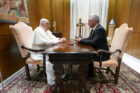
Pope Benedict XVI and Cuba’s President Raul Castro gesture to the media as they appear for a photo opportunity outside the Palace of the Revolution in Havana March 27.


Contributing to this story was Cindy Wooden.

Posted in NewsComments (0)

Visit to Cuba Was More Complicated Than JP II’s

by Wallice J. de la Vega

Part of the charm of Cuba is the sight of vintage automobiles in the streets. But it is also a sign of the poor economic conditions that keep the island nation decades behind the rest of the world.

SANTIAGO DE CUBA, Cuba (CNS) – In many respects, the coordination of Pope Benedict XVI’s papal visit to Cuba relied on the experience from the 1998 visit of his predecessor, Blessed John Paul II.

Blessed John Paul visited four cities in five days. Although Pope Benedict visited two cities in three days, in some ways this trip was more complicated, said a Cuban official involved in the planning.

Marcos Gabriel, coordinating official from the Ministry of Foreign Affairs assigned to oversee the Santiago portion of the March 26-28 papal visit, also worked on the 1998 trip.

He told Catholic News Service March 28 that for multiple-location events, like the two papal visits, the Cuban central government sets up separate teams that “organize individually and coordinate jointly.”

Although the 1998 visit meant a larger set of expenditures and manpower provided, in part, by the state, the shorter lead time – three months from Vatican confirmation – for coordinating Pope Benedict’s visit was compounded by Cuba’s poor internal economic situation.

“Cuba, as a sovereign nation, is not separate from the rest of the world,” Gabriel told Catholic News Service. “We are not a developed country but, just like other nations of the world, we have felt the effects of this financial-economic crisis of recent years.”

Lagging Economy
Although private-property laws changed soon after President Raul Castro took office in 2006, creating an increase in small businesses, the economy is lagging, Gabriel said.

“We have been dragging along the economic aftermath of three strong financial impacts in our history,” said Gabriel, referring to the U.S. trade embargo against Cuba since 1962, a sudden 1989 drop in European contracts, and the most recent global economic crisis.

Cuba has no ministry of religious affairs, said Gabriel. However, for events like the papal visits, teams are composed using personnel from several agencies.

“Right here in this room, we have colleagues from foreign relations, communications, transportation, and other (ministries),” he said. “We come together as needed, because here there is no continuous use of resources for religious matters, having a secular government.”

After a quick pause, Miguel spoke of the heavy workload his team carried for the past few months to make the papal visit a success.

“From the start we knew it was a difficult challenge,” he said. “Difficult, but not impossible.”

Posted in NewsComments (0)

Cuban-Americans Happy To Be Able to Go Home

by Tom Tracy

U.S. pilgrims from Florida and elsewhere pray the morning of March 26 at the Shrine of Our Lady of Charity in El Cobre, Cuba, before Pope Benedict XVI arrived in Cuba for the start of his three-day visit to the island nation.

SANTIAGO DE CUBA, Cuba (CNS) – When the Miami Air charter plane touched the ground March 26, applause and shouts of “Thanks be to God” rang out in the cabin, and Julia Malcolm had tears on her face.
It was Malcolm’s first time back in Cuba since leaving 51 years ago.
“I am crying but now, I am very happy that we will be with the pope and, like him, will kiss the ground,” said Malcolm, a member of St. John the Baptist Church in Fort Lauderdale, Fla.
Malcolm’s charter flight was part of a pilgrimage organized by the Archdiocese of Miami. More than 300 pilgrims traveled first to Santiago de Cuba, then on to Havana. At least 500 others from the archdiocese were expected to join them in Havana.
“I am so proud of what they have done in getting everything organized for this pilgrimage, because the pope is coming; otherwise I would not have come,” Malcolm said.
Julia Palmer of Kentucky accompanied Malcolm, her mother. Palmer said she and her two sisters wanted to seize the opportunity of the pope’s visit to bring their mother back to Cuba.
“This is a trip of a lifetime, to see Cuba through the eyes of my mother,” she said.
After landing, the several hundred U.S. pilgrims were treated to a surprise: They had a chance to visit the historic Shrine of Our Lady of El Cobre, about 30 miles away. The Virgin of Charity of El Cobre is Cuba’s patroness.
Archbishop Patrick Pinder of Nassau, Bahamas, said he was impressed with the condition of the shrine and the local Cubans he encountered there.
“I was impressed with how well it was maintained,” Archbishop Pinder said, noting he has been in Cuba before, but never Santiago de Cuba or El Cobre. “It is not falling apart like … so many buildings in Havana. It speaks of a certain depth of faith of the people to keep up the church that way.
“It was certainly a place that touches the heart of people,” he added. “I don’t know any place in the U.S. where people leave their precious personal objects as they do here. There is something authentic about it; it is not overdone as a tourist place, but is a place of pilgrimage to Our Lady.”
That afternoon, the Florida pilgrims joined approximately 200,000 others for Pope Benedict XVI’s Mass in Antonio Maceo Revolution Square.
In a covered area where the Cuban bishops and priests vested before the Mass, Xiomara Bedoga Ocana, a sacristan at the cathedral in Santiago de Cuba who helped prepare the vestments for the Cuban bishops and visiting clergy, made new friends and prayed with several of the Cuban-American pilgrims.
“With all the difficulties we have had to go through in this country, it is something that we had the visit of two popes,” she said, referring to Blessed John Paul II’s 1998 visit. “Our faith grows, and it will continue to grow after this.”
A very pregnant Myrna Bustamante came with her “pretty much about to be born” Catholic child.
“I might go to the Maternidad at any moment now,” she said, referring to the local birthing hospital. “I couldn’t go this afternoon because of the heat, but I wouldn’t miss this evening’s Mass.”

Posted in NewsComments (0)

Pope Visits Shrine to The Patroness of Cuba

Pope Benedict XVI meets children during a visit to the Shrine of Our Lady of Charity of El Cobre in Cuba March 27.

EL COBRE, Cuba (CNS) – Entrusting people to Mary’s maternal care is a normal Catholic practice, but when Pope Benedict XVI prayed that Our Lady of Charity of El Cobre would wrap her golden mantle around the people of Cuba, it was particularly poignant.
For 400 years, Cubans – believers and nonbelievers alike – have brought their sorrows and joys before the little statue of Mary, and even Cuba’s communist rulers have claimed her as a cultural icon of the Cuban struggle for freedom and equality.
When Pope Benedict visited the Virgin’s shrine March 27, he joined the thousands of pilgrims marking the 400th anniversary of the discovery of the statue, and he echoed the prayers of many of them for a future marked by less poverty and greater freedom.
“I have entrusted to the mother of God the future of your country, advancing along the ways of renewal and hope, for the greater good of all Cubans,” he said.
With only Cuban bishops and priests, his Vatican entourage and a choir present inside the shrine of La Caridad, as the image is known, Pope Benedict first knelt in prayer before the Eucharist, then he stood and recited the special prayer that the Cuban bishops composed for the fourth-centenary celebrations.
He went up to the statue, lit a candle and stood in silent prayer for several minutes while a choir sang the “Salve Regina,” or “Hail, Holy Queen.”
Hundreds of pilgrims and visitors waited outside for a glimpse of the pope and a few words from him.
Gift of Heaven
Leaving the shrine, the pope stood on the steps and told the crowd that the Virgin’s “presence in this town of El Cobre is a gift of heaven for all Cubans.”
On an island where families have been divided by exile, emigration and imprisonment, the pope assured the people that while inside he prayed to Mary “for the needs of all who suffer, of those who are deprived of freedom, for those who are separated from their loved ones or who are undergoing times of difficulty.”
He said he prayed for Cuba’s young people that “they may be authentic friends of Christ and not succumb to things which bring sadness in their wake.”
Pope Benedict prayed for families who live their faith and transmit it to their children and, especially, for the families “who offer their homes as mission centers for the celebration of Mass” in a country where the government restricts the building of new churches and where there is a severe shortage of priests.
The pope told the people to follow Mary’s example and build their lives “on the firm rock which is Jesus Christ, to work for justice, to be servants of charity and to persevere in the midst of trials.”
“May nothing or no one take from you your inner joy, which is so characteristic of the Cuban soul,” he said, before leaving the shrine to the rhythmic clapping and cheers of the crowd.

Posted in NewsComments (0)

Working Overtime For Papal Coverage

by Ed Wilkinson

What a week it has been!
Pope Benedict’s historic journey to Mexico and Cuba this past week was a huge undertaking.  Not just for the 84-year-old pontiff, but also for our local media here in the diocese.
The DeSales Media Group, which produces both The Tablet and NET television, made a strong commitment to covering the pope’s pastoral visit to Latin America. It meant weekend and overtime hours for everyone on staff.
Liz Faublas, the anchor of Currents, our daily cable news show, guided viewers through the five days of papal coverage. She was ably assisted by expert commentary from diocesan resources. We wanted to offer something that no one else was giving to viewers and we managed to do just that.
When the pope was in Mexico, we reached out to and received help from Father Ray Roden, who takes special interest in the history of the Church in Mexico. He and two native born Mexican seminarians, Jesus Ledezma and Hugo Rodriguez, were our on-air guests as Benedict visited Guanajuato and Leon. The visuals from the shrines and the basilicas were magnificent and Father Roden and his companions explained the significance and the history behind them.  The trio had recently been on pilgrimage and retreat in Mexico, so they were still filled with the excitement and refreshment that such a getaway provides.
As the Holy Father arrived in Cuba, we invited Msgr. Otto Garcia, the Cuban-born pastor of St. Joan of Arc, Jackson Heights, and former Vicar General, to our studio, along with Deacon Felipe Almendarez of Holy Name parish, Park Slope.  They provided the color and offered explanations that only natives from the island could supply.
Our liturgical expert, Father John Cush joined us when the pope celebrated Mass. After his expert commentary during the recent installation of the new cardinals, we knew he was the one we wanted to lead us through the special celebrations.
But that’s not all. Our in-studio performances were complemented by reports from the ground in Mexico and Cuba, where we invested in sending reporters and film crews. NET program director Ryan Stewart was in Mexico with producer Eli Soriano, a native of Mexico, and Father Jorge Ortiz-Garay, a Mexican-born priest who serves at St. Joseph’s Church, Prospect Heights.  In Cuba, Msgr. Kieran Harrington, Vicar for Communications, teamed up with Tablet reporter Antonina Zielinska and producer Will Fonseca. Their packages have been broadcast on Currents all week long as well as being used during our live coverage.
It was not easy getting into Cuba.  For the past month, we have been filing applications with the U.S. and Cuban governments to receive the proper credentials.  Those efforts have paid off with reports about the church in Cuba that you cannot see anywhere else but on NET and the pages of The Tablet.
Our hard working staff crew here in Brooklyn turned in a yeoman effort to transmit these images on your TV screens and produce the words on these pages. But this is what we are all about at DeSales, your one-stop media provider of church news.
We hope that you enjoyed our efforts. Your comments on how we can improve these services in the future are always welcome. DeSales is growing in ways we could not predict even months ago when we were established. We’re committed to going forward to bring you the most informative and most educational church coverage.

Posted in Editors SpaceComments (0)

Two Memorable Evenings with Fidel

by Bishop Nicholas DiMarzio

My dear brothers and sisters in the Lord,

As I prepared for my fourth trip to Cuba, I was asked by The Tablet Editor Ed Wilkinson to offer some reflections about a place of which I have many fond memories.
My origins are from the Archdiocese of Newark, as you know, where there is the second largest Cuban population in the U.S. outside of Miami. It is difficult to estimate the impact that the Cuban immigrants and refugees, especially the first waves, had on the Church of Newark.
I directed Newark’s Migration Office during which time the archdiocese welcomed the Mariel boatlift refugees in late April, 1980. Later, when serving as executive director of Migration and Refugee Services for the United States Conference of Catholic Bishops (USCCB), I was instrumental in the release of longtime political prisoners from Castro’s jails. Truly, I have fond memories of these brave and embattled people.
My first trip to Cuba was basically to find an excuse to enter into Cuba. I was attached to a group of scholars who were presenting talks on migration at the University of Havana.  With a newly minted Ph.D., I was able to give a talk on “Cuban Migration and the Catholic Church.” A delegation of U.S. bishops lead by then-Archbishop Bernard Law had visited Castro two years prior to my visit to ask for the release of these historic prisoners. Castro had promised that he would release them, yet nothing happened.

While there, I was able to contact the Cuban Bishops’ Conference, and through its contacts, I was able to see Fidel Castro and ask him to release the longtime political prisoners, many of whom had been in prison for 28 years.  Some of these prisoners had been Castro’s former allies who were making a statement and telling the world that they were political prisoners and not normal prisoners. Many of these people would not don prison uniforms, but rather preferred to live in their pajamas.
The meetings with Castro began at midnight and took place two nights in a row. I made a plea that the American bishops, not the United States government, were willing to welcome the political prisoners to the United States. During those two meetings, I did not do much talking, but I did do a lot of listening. I heard how proud Castro was of the revolution and its aftermath. He even showed me the un-cashed rent checks from Guantánamo Bay that he kept neatly in his top desk drawer. Those two nights were truly memorable. It was Castro, his interpreter and I. Castro spoke much better English than he revealed. At our second meeting, he made the promise that he would release the political prisoners.

As a momento of our meetings, Castro autographed a copy of a book, in Spanish, titled “Fidel & Religion:  Conversations with Frei Betto on Marxism and Liberation Theology,” which was a translation of his conferences with a Brazilian friar named Frei Betto.
My second trip to Cuba was a follow-up on Castro’s promise in an effort to arrange the release of these political prisoners.  During this trip, I was able to visit the prisoners in their prison situation. These men and woman of conscience proved to me that they were truly unique. None expressed any bitterness regarding their situation, only hopefulness in a spirit of faith, which was truly admirable. Almost 1,000 of the Plantados were released during a period of 18 months.
In 1996, when I was named Auxiliary Bishop of Newark, a delegation of these Plantados came from Miami to my ordination with a very simple, yet poignant message inscribed on a plaque: “To the man that helped us out.”  As you can see, these people had not even lost their sense of humor in all that time of imprisonment. I will never forget the small part I played in their release and how significant it certainly was to them.
My third trip to Cuba was on the occasion of Pope John Paul II’s visit. It was a quick visit, yet a historic one, as the pope came and overwhelmed the Cuban establishment with his charism and warmth.  The Cuban government never imagined that his visit would bring out so many people. Unfortunately, immediately after the pope’s visit, for some strange reason, tighter restrictions were imposed on the functioning of the Church.  Eventually, thank God and our Blessed Mother, under the title of Señora de la Caridad del Cobre (Our Lady of Charity of Cobre), the chill has warmed and now Cuba welcomes a second pontiff, Benedict XVI, to its shores.
Pope Benedict, like the good father he is, is visiting his child most in need. Any father or mother gives his or her attention to a child who is ill and needs special attention.  Certainly, this is the situation in Cuba today as the Church continues to struggle to exist and to preach the Gospel. It is estimated that perhaps 60% of the Cuban people consider themselves Catholic and may, indeed, be baptized.  The pope’s visit is on the occasion of the 400th anniversary of the finding of the image of Our Lady of Charity of Cobre by fishermen in the midst of a storm. (More about the origins of Our Lady of  Charity of Cobre on Page 6.)
After the visit of John Paul II, the Church in Cuba has continued to grow, restoring the shrine in Santiago and developing a new seminary outside of Havana.  These are two great milestones for the Church in Cuba. The various dioceses continue to work with difficulty restoring faith and hope, and bringing the message of Jesus to a people in need of spiritual uplifting.  During his trip, it is hoped that the Holy Father will announce the progress in the sainthood cause of Felix Varela, a Cuban priest who was instrumental in the struggle for Cuban independence, and eventually settled in the United States and worked here in New York City. Our own Auxiliary Bishop Octavio Cisneros is the postulator, or promoter, for Varela’s cause.  Bishop Cisneros will represent the USCCB in Mexico, the first stop of Pope Benedict XVI’s trip, and then meet us in Cuba.

Every pilgrimage is an exercise of putting out into the deep. When we leave our homes with a spiritual purpose, we never know to what depth of faith the Lord can bring us. My trip to Cuba is a bit odd in its scheduling since it leaves at 6 a.m. from Miami and goes to Santiago, Cuba. From there, we travel at midnight for Havana where we will remain for the rest of the pilgrimage. All of this travel will be worth it in the end.
Pray with me to Our Lady of Charity of Cobre that this trip of our Holy Father, Pope Benedict XVI, will have a positive impact on the faith of the Cuban people and warm the heart of its government.

Posted in Put Out into the DeepComments (0)

FATHER PETER J. DALY

Latin America Needs Permanent Deacons

Father Peter J. Daly

Pope Benedict XVI’s visits to Mexico and Cuba were good things. Both countries are extremely troubled. The Catholic Church in those countries could use the encouragement of the Church’s supreme pastor.
I’ve never been to Cuba, but I have frequently been to Mexico and Nicaragua over the past 12 years. We have sister parishes in both countries. We have visited them, and the pastors of those parishes have visited us in the U.S.
Every country has its particular situation, but there are some similar problems. The Catholic Church everywhere, north and south, has been lazy.  We have rested on the assumption that we are part of the culture.  We think that people will learn the faith simply because they are part of a “Catholic culture.” But we cannot rely on culture to do our job.
The Catholic Church in Mexico and Nicaragua is much like the rest of Latin America. Everywhere there is increasing secularism and the challenges of materialism, just as we have in the U.S. There is also increasing competition from evangelical and Pentecostal churches, often “imported” from the U.S.
People are leaving the Catholic Church in Latin America, too. In Puerto Rico and Brazil, there are now more practicing Protestants. Every time I visit Latin America, I see more and more non-Catholic churches.
The Catholic Church in the various parts of the Americas has much that we could learn from one another.  U.S. parishes could learn about joyful and enthusiastic celebration from Latino countries. The Latino Catholic community could learn about the ministry of permanent deacons from North America.
The Catholic Church everywhere needs more clergy. Permanent deacons are part of the answer. The Latin American church could imitate the U.S. in embracing the permanent diaconate.  In the U.S. we have one priest for every 1,500 to 2,000 Catholics, depending on the area. But we have nearly 17,000 permanent deacons, which is about 40% of the permanent deacons in the world.
In Latin America, parishes often have one priest for 10,000 Catholics or more.  In most of Latin America, there are no permanent deacons. I met the only permanent deacon in the whole country of Nicaragua at a funeral a few years ago. There should be one in every village in Latin America.
For many people in rural Mexico or Nicaragua, the church is an empty building.  Many towns have a chapel where Mass is celebrated once or twice a year. People are baptized as babies but then spiritually abandoned.  As a result they become evangelicals or Pentecostals when a local preacher shows up in town. What else could we expect?
But if they had a permanent deacon, it would be better. He could be a married man from the village. He could be trained to preach the word, pray with the sick, officiate at weddings and bury the dead. He could know his people who would be his neighbors.  A permanent deacon could celebrate a Liturgy of the Word on Sunday, preach a homily and distribute the Eucharist consecrated earlier at the parish church.

Father Daly is a priest of the Archdicoese of Washington, D.C.

Posted in Up Front and PersonalComments (2)

Follow Pope on The NET

New Evangelization Television (NET), the Diocese of Brooklyn’s cable television station serving the five boroughs of New York City, presents exclusive studio coverage of the Apostolic Journey to Latin America, March 23 – 26 from Mexico and March 26 – 28 from Cuba.
Commencing in Mexico, special broadcasting began on March 23 at 6:30 p.m., when NET broadcasted the welcoming ceremony in Guanajuato. Coverage continues on March 24 at 8:30 p.m., when NET will air Pope Benedict XVI’s gathering with children in Peace Square. On March 25, at noon, coverage resumes with Mass at Bicentennial Park and an 8 p.m. vespers service with the Holy Father in the Cathedral. NET will also air the farewell ceremony at Guanajuato Airport as the Mexico journey concludes on March 26 at 11 a.m.
Shortly after the Pope’s departure from Mexico, NET picks up coverage of the welcoming ceremony in Santiago de Cuba starting at 3 p.m. At 6:30 p.m., the reporting continues with the Mass celebrating the 400th anniversary of the Virgin of Charity. On March 27 at 10:30 a.m., NET will follow Pope Benedict XVI as he visits the Shrine of Our Lady of Charity and his 6:30 p.m. meeting with President Castro. Coverage continues March 28 at 10 a.m. with Mass in Havana’s Revolutionary Square, and concludes at 5:30 p.m. with the farewell ceremony at Jose Marti Airport.
Liz Faublas, anchor of NET’s daily news show Currents, will host the coverage. She will be joined by special co-hosts during the papal trip. There also will be special reports from NET and Tablet reporters in Mexico and Cuba.
Nationally, NET’s distinctive programming and special events coverage can be watched on its live feed at www.netny.net. NET can be seen on Time Warner Channel 97 and Cablevision Channel 30.

Posted in NewsComments (0)

There’s More to the Church in Cuba

by Patricia Zapor

Cardinal Jaime Ortega Alamino of Havana speaks Feb. 25 after a Stations of the Cross service during preparations for Pope Benedict XVI’s upcoming visit to Cuba.

HAVANA (CNS) ­– The Catholic Church that Pope Benedict XVI will visit March 26-28 is, to put it simply, more.

Since Pope John Paul II’s visit in 1998, the church is more unified, more public, more likely to work with the government in accomplishing specific goals, more involved in providing assistance to the Cuban people, more comfortable in its place in society. Its bishops, priests and laypeople, while still wary of pushing official tolerance too far, are more confident in teaching the faith in a way they believe can help shape the future of all of Cuba.

Above all, it is more hopeful.

In interviews and casual conversations with Catholic News Service in mid-February, just about everyone – including nonbelievers – in the places Pope Benedict will visit expressed hope for what his trip might trigger. People said they saw important changes the last time a pope visited Cuba, and they have hopes for what this trip might bring.

They spoke of a Cuban people around the world unified by the Virgin of Charity of El Cobre – La Caridad as she is affectionately called. Pope Benedict’s stop in Cuba has been described by the Cuban bishops as a personal pilgrimage to share in this year’s celebrations of the 400th anniversary of La Caridad.

“It is a blessing for all Cubans,” said Juan Alberto Alba, whose infant godson was one of 33 children baptized Feb. 11 at the Shrine of Our Lady of Charity of El Cobre, where the pope will visit March 27.  “In the past it was bad to be Catholic, but the faith has grown.”

“The Cuban church is a church with hope in Christ,” said Msgr. Ramon Suarez Polcari, chancellor of the Havana Archdiocese.  That sense of hope has become more obvious in the past few years.

It has happened in low-profile ways such as in the growth of thriving home-based missions and the expanded presence of Caritas, the church’s development and relief agency.  Among higher-profile events, a new seminary opened outside Havana in 2010; Havana Cardinal Jaime Ortega Alamino mediated the release of more than 50 political prisoners; and processions and prayer services across the country drew thousands of people to pay homage to a statue of the nation’s patroness.

New church efforts include the country’s first MBA program, just one offering at the not-quite-open Father Felix Varela Cultural Center. It fills an education gap in a country where only in the last few months have individuals been allowed to own businesses, and few people have the necessary background to run one.

Roberto Veiga Gonzalez, editor of Espacio Laical, a widely respected magazine for the laity published under the auspices of the Archdiocese of Havana, said that “every day the church is more integrated into society.”

Part of Cuban Culture
Catholicism is “a moral, religious reference point for many sectors of Cuba, even when they are not Catholic. Catholicism is a part of Cuban culture,” he said.

Veiga explained that in 19th-century gatherings, “the Cuban nation began to be dreamed of at the Catholic seminary.” So it is natural that the church is playing a role in helping bring about change now, by creating a climate for dialogue. That seminary now houses the Varela Cultural Center, a program of the church intended to be a place for all Cubans to share culture and dialogue.

While optimism is palpable, the picture is not uniformly rosy.

Everyday life in Cuba is a struggle for most people. Salaries are low; the base wage is about $20 a month. Food and other resources are often in short supply and expensive. Few people have access to costly – and bad – Internet and cell phone service. The government controls what news gets in and who can leave the country. Plenty of people spend time in Cuban prisons for criticizing the government.

Though the church estimates 60-70% of Cubans are Catholic, attendance at weekly Mass remains low, in single digits as a percentage of the population. A majority of children are baptized, but far fewer receive other sacraments. Catholic funerals are popular, however.

So much has changed about the attitude toward Catholicism since 1992, when the government dropped its official designation as atheist, that even the biography of President Raul Castro on Wikipedia lists his religion as “Roman Catholic (formerly atheist).”

But a series of polls done for the church in 2002-2003 as part of preparations for a pastoral plan found that 75% of practicing Catholics were unfamiliar with the national ecclesial “encuentro” of 1986 that is considered a turning point for the Cuban church’s pastoral style.

Gustavo Andujar, cultural director of the Varela Cultural Center, set to fully open next year, said that means three-quarters of practicing Catholics “were not ‘historic’ Catholics, but late-comers, with little if any formation and without a deeply rooted sense of belonging to the church.”

Posted in NewsComments (0)